2026 NFL Prospect Visits: Diving into the Data


I’m not sure how I stumbled into being a “top-30 visits” guy but here we are! For some reason, I was intrigued how some NFL teams used their visits and if this public information was helpful leading up to the NFL Draft.
Think of this exercise like a dating game. We are trying to play matchmaker between NFL teams and their prospects and the prospect visit piece of information is simply another way for us to connect the dots. I started out this journey asking a few simple questions:
- How often do top-30 visits/workouts correlate with teams picking that player? (An exact match!)
- If a team uses multiple top-30 visits on QB/RB/WR/TE, how likely are they to take that position in the draft?
- Do NFL teams use a tier-based system knowing there is an opportunity cost at every pick selection spot?
I wrote a massive article last year (Top-30 Visits for NFL Draft Prospects: A Decade’s Worth of Data) that got me started on this journey and 2026 was a chance to build on that.
This article will explain the methodology behind prospect visit data, give you a few actionable thresholds and probabilities for positions and players, and hopefully give you a road map a head of the 2026 NFL Draft.
Methodology
While we can categorize teams “meeting” with a player in a number of different ways, I wanted to hone in on the most specific of meetings. There is a wide spectrum of reporting that you’ve likely seen on your timelines:
Senior Bowl– Invite-only all-star game in January that can have NFL coaching staffs directly working with players.
NFL Combine– This is probably the first filter for teams finding character-based issues and medical red flags. Beyond the drills and testing, teams and/or media members state they had a “formal interview” with players. These are anything from 20 minute interviews to casual lunch or dinners.
Pro Day– These are self-contained events on college campuses meant to not only showcase players for the upcoming NFL Draft but also a chance for the universities to “show out”. I wrote an article earlier this off-season on how this part of the evaluation process fits in.
Local Visits– These are visits for players from the team’s local area whether that is through college or hometown ties. These do NOT officially count as “top-30” visits, a strange rule in my opinion considering some teams live in densely populated areas (think all of Texas for the Cowboys) while others (Green Bay) do not usually have this opportunity. Some are doing local kids a solid.
Given that every team has some type of representation at most of these events, it is hard to distinguish their level of interest regardless of what puff piece your local beat writer or talk radio personality wants to drub up.
Top-30 Visits– Each NFL team can host “up to 30” non-local prospects at their facility. This entails a wide range of players from top prospects to fringe UDFA guys as teams have in-person interviews, medical re-checks, and perhaps a chance to see them vibe with your coaching staff.
Private Workouts– These are team-arranged workouts with individual prospects (often at the school or private facility) often used for identifying scheme fit and detailed evaluation. These are especially valuable for the QB position as I will detail below.
Given a team has a limited supply of visits (30) and that private workouts are generally low in number every year, this data set felt the easiest to begin to grapple with.
The database I used was from former Footballers writer Kent Weyrauch. He created a dashboard for NFL Draft visits cataloguing them all the way back to 2015. These are sourced from CBS, WalterFootball, and ProFootballNetwork. I also have found NFLTradeRumors to be a selective source as a backup with links to reports on X. (Although, I will as an aside add that some of these websites run so many ads I despise opening them up for fear of my computer being sent back to the stone age.)
Another one of my go-to resources that I check almost daily is NFL MockDraft Database (referred to as MDDB in this study). The crux of the website is indexing mock drafts and big boards from across the industry. The Athletic did an excellent piece talking about how NFL teams pay attention to these mocks.
While there is a large degree of speculation of how valuable some of these mocks are, it can be something to build into your process. I’m not talking about perusing a few of your favorites (Daniel Jeremiah, Dane Brugler, Peter Schrager) but rather aggregating a number to work from to act as a “proxy for draft capital”. Final draft capital gives us one number to consider but where someone was projected to go before the NFL Draft is another data point worth holding onto. It’s not perfect but it’s also not something to be ignored. It gives us a “wisdom of the crowd” perspective we can file away both before and after the NFL Draft.
After combing through hundreds and hundred of prospects, there were a couple of common themes worth mentioning on a 10,000-foot high-level type of view.
The raw number of top-30 visits + workouts is not at all an indicator of draft capital.
I posted a number of top-30 visit charts this week and the #1 response: who is Kaelon Black?!

The Indiana RB was by far the most requested RB of this year’s draft class. Is he a hot commodity? A riser?
In fact, it actually intuitively makes more sense that a player projected to go later in the draft would have more teams interested given there are more opportunities to take him on late Day 2 or Day 3. Some positions see more top-30 visits than others including backup/special teamers and QBs who likely will not be taken as starters.
Keep in mind that this visitation process is not handled the same way. We can’t always make 1-to-1 comparisons among position groups.
- 2020 Jets 4th round pick James Morgan (who I will actually discuss more later) had 14(!) reported top-30 visits. Lions 3rd round pick QB Hendon Hooker had 13!
- Justin Jefferson (ever heard of him?) had two total top-30 visits and neither were with the Vikings.
- The great Jahmyr Gibbs had one reported top-30 visit in 2023, and it wasn’t with the Lions.
- Colston Loveland and Tyler Warren each had just ONE top-30 visit and neither were with the teams that drafted them.
A top-30 visit can be a smokescreen but we aren’t on the inside. It’s fun to speculate and even after the draft you could try to write that narrative but each team views this differently. For example, the Washington Commanders famous “Top Golf” strategy invites the top prospects together for a night that technically counts as a “top-30” visit for each player. It is a reminder that not all top-30s are the same across the board for each team. Some teams are clear that these visits are for medicals only while others (like the Rams and Jaguars) remain veiled and do not publicly disclose most of their top-30 visits.
For 2026, here are the top-10 prospects (based on MDDB) and the visits reported.
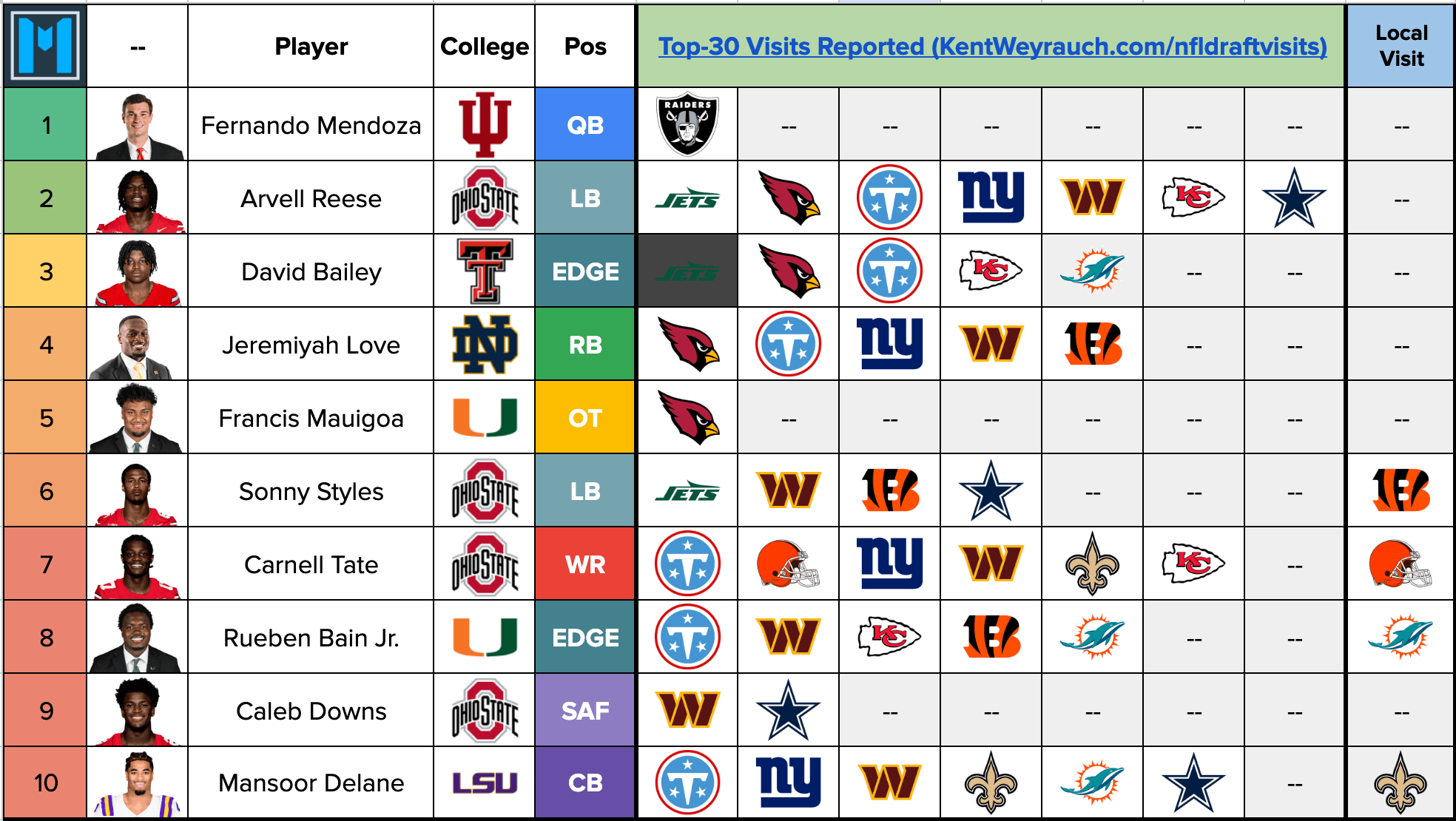
If you are trying to play match-maker for these guys, we do have a couple of strong indicators. Looking at top-5 NFL draft picks since 2015*, a whopping 87% of them had a known Top-30 visit or private workout with the team that drafted them. It eventually starts to decline but overall this is a data point to consider for early Round 1 picks.
- Picks 1-5: 87%
- Picks 6-10: 69%
- Picks 11-15: 54%
I haven’t run the numbers for picks further down in Round 1 but assuming it eventually falls off a cliff and hits sub 40%. This leads up to perhaps the most important finding in this study…
The team utilizing the visit is the signal, not the player.
This is the major takeaway if you read through this article. Seriously, if you read anything here let this please be the adage you hold onto. Given a team has a limited supply of these visits (30), we can differentiate which positions they are doing “more homework on”.
Here is a perfect example from last year… the Pittsburgh Steelers used 8(!) reported top-30 visits on the RB position. This was despite the team having just 2 TOTAL picks on the first 2 days of the draft: 21st and 83rd. How rare was eight top-30 visits on the RB position? Going back a decade, only four total teams hit a 6+ threshold for the RB position.
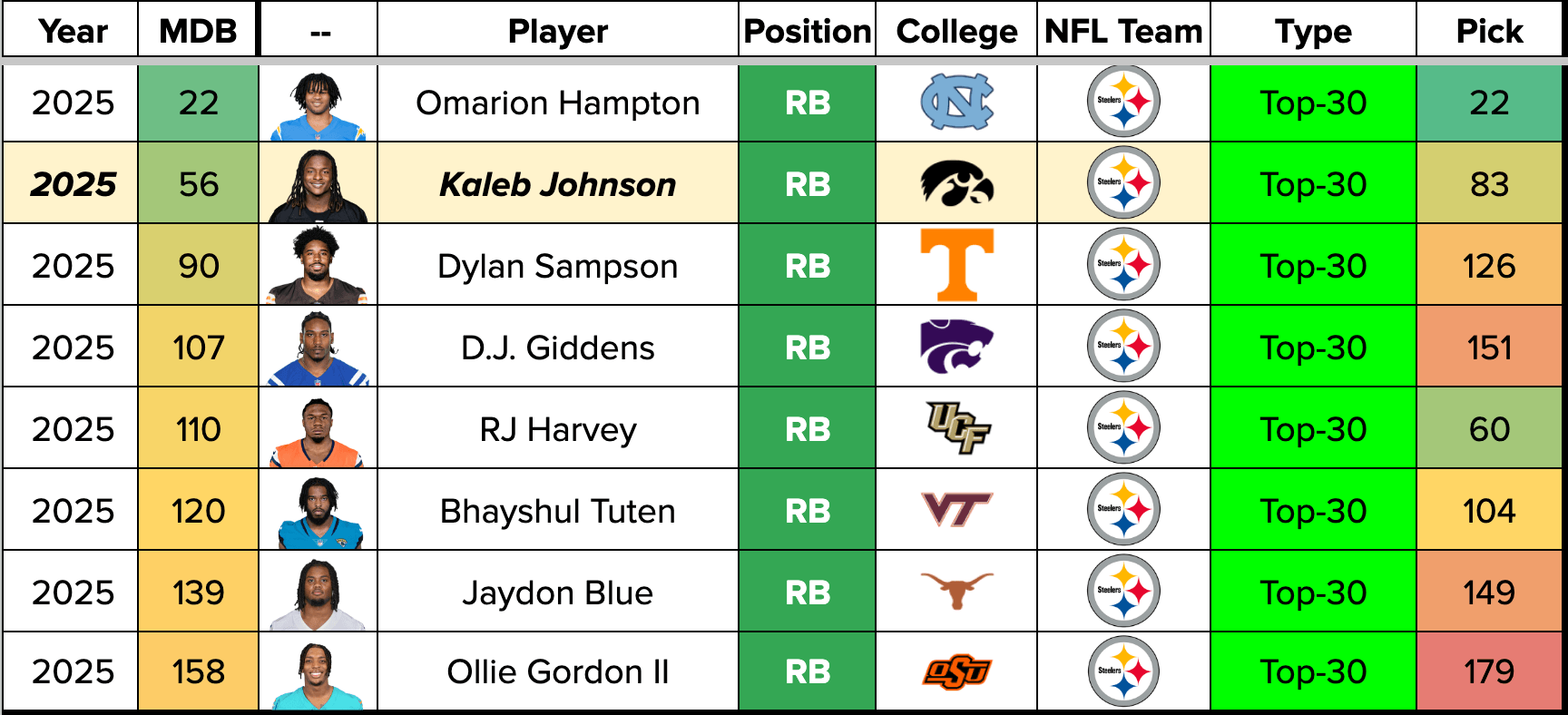
Now this also did not mean these were the only RBs on the menu for the Steelers to choose from. It was just hard connecting the dots based on what we haven’t seen. I wrote last year “based on history, the Steelers have an 80+ percent chance of taking a RB within the first four rounds despite only have three picks.”
How did we come to that figure? Over the last decade, if a team uses 3 or more top-30 visits on a RB, they’ve selected a RB in the 1st 4 rounds 80.6% of the time.
| If a Team Uses | RB 1st 3 Rounds | RB 1st 4 Rounds |
| 2+ | 49.4% | 68.8% |
| 3+ | 61.2% | 80.6% |
That is a fairly significant signal to work with in a time of so much speculation. Below we will work through the teams utilizing 3+ visits for the RB position so you can connect the dots with their draft capital and which prospects you think might be on their radar.
What about WRs? The WR rate for teams utilizing their top-30 visits is relatively strong but I expanded the prospect visits out to 3-5+ for this article:
| If a Team Uses | WR in 1st 3 Rounds |
| 3+ WR T30 Visits | 53.2% |
| 4+ WR T30 Visits | 63.4% |
| 5+ WR T30 Visits | 65.0% |
When we get to the WR section, we will work through some of the WRs in the top-100. Context is needed because the supply/demand changes every year for the position. This year we have 17 WRs currently in the top-100, 2nd most over the last 6 years.
We can gain player-adjacent intel for positions.
Another piece of information I identified from this massive prospect visit study is what I’m calling “player-adjacent intel”. If a player receives a good amount of top-30 visits (4 or more), I found that it often signaled that the teams who used a top-30 visit on the player were on the hunt.
Take for instance Treylon Burks (hold your laughter until after the article folks). He finished 22nd overall on MDDB and was drafted 18th overall by the Titans. However, 10(!) different teams brought him in for top-30 visits.
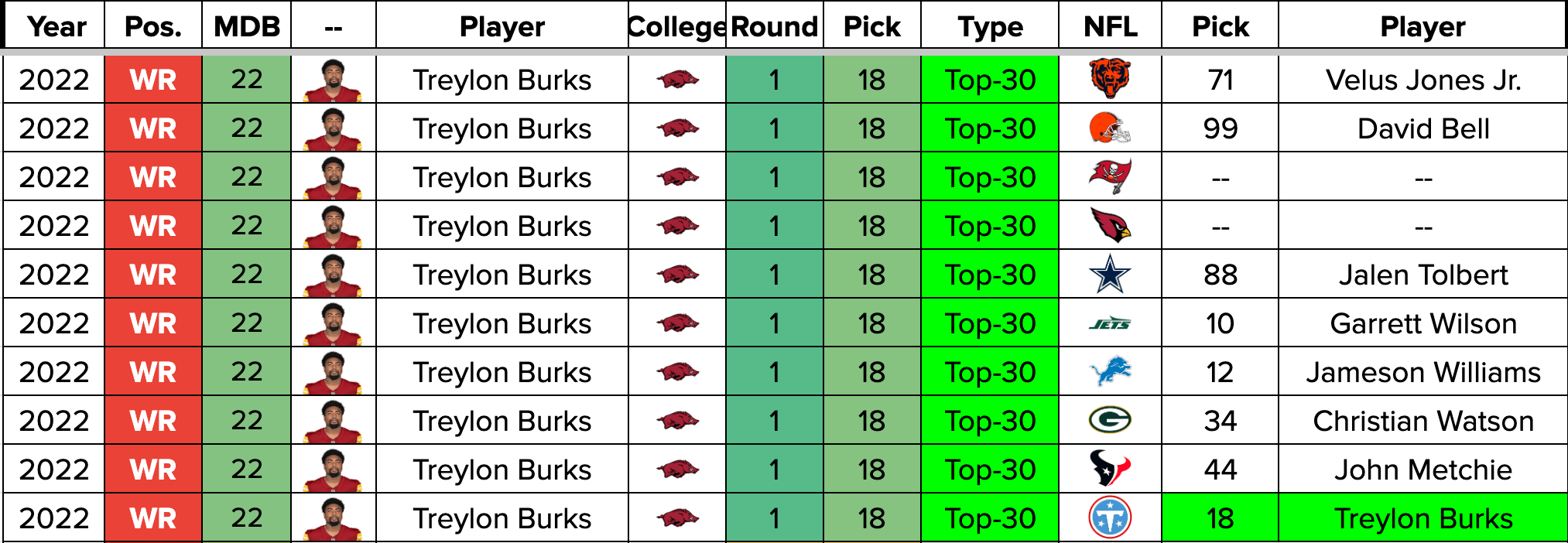
8 of those 10 teams selected WRs in the top-100 picks including two others. The Jets and Lions took other WRs before Burks and Burks would not be available for the other six teams to draft after pick 18. Nevertheless, it signals perhaps a tier-based drafting system set up by teams: if we can’t get this player at this point in the draft, who are we comfortable at this position later on?
Finding “exact matches” is a fool’s errand.
This is the part the general public does not comprehend: it is VERY hard to find exact matches because the NFL Draft does not occur in spreadsheets. It is a living, moving thing with trades, values, and unforeseen circumstances that erupt. NFL teams have their big boards and all their months of preparation but the other 31 teams are not publicly sharing that information and certainly do not know who will be available a few picks much less a round later.
- What incentive(s) does a billion-dollar organization have to leak out this info ahead of the NFL Draft?
- What is the benefit of sharing info about picks/players that might NOT be available?
- How would you know if that player was even available when you’re on the clock?
It’s likely either: smokescreen/misdirection, media speculation nonsense or suboptimal NFL GMing. Beat reporters are paid to share their thoughts and opinions. Some are great at their job. Some are transparent. Some are just downright scoundrels. Others want a moment of fame knowing there is little if any accountability weeks from now as the attention of the crowd moves forward. The NFL is an endless cycle of information and the people are always thirsty for more, not necessarily examining if the steady diet of tweets and alerts was healthy or factually correct. (Hint: most connections are pure speculation.) I’ve written about misinformation and the NFL Draft if you want a deeper dive on that subject.
But back to the data for exact matches. If we are looking at 1st round players, only 17 of the 32 picks (53%) from 2025 had a publicly known meeting with the team that drafted them.
You might say to yourself, “man that seems like a fairly low number”. Consider it a starting place and a data point to work with.
When we think about the WR position, here are the exact match numbers over the last decade with top-30 visits:
| WRs | Exact Match |
| 1st Round | 44.4% |
| 2nd Round | 18.8% |
| 3rd Round | 22.7% |
Not great right?
For example, consider two Ohio State WRs taken in different drafts that did NOT meet with the teams that drafted them: Jaxon Smith-Njigba and Emeka Egbuka. JSN met with a ton of teams (9) but the Seahawks were not one of them. Considering his MDDB rank was 12, I’m not sure the Seahawks thought he would be in play. A Super Bowl title and Offensive Player of the Year award later and it sounds like they made the right decision! Egbuka seemed to be in a similar situation last year when the Buccaneers selected him 19th overall. We’ll likely never know what their Plan A, B, or C was for the draft but perhaps they did not consider he would be on the board for their pick OR they wanted to hide their interest. Either way, we are not privy to that information.
This study is meant to reveal the data of what we do know rather than speculate what we do not.
Let me be clear: this is not some magic formula. This is about probabilities and with the NFL Draft, teams have multiple inputs and routes within a draft that are unforeseen. Wild things happen. When the Falcons selected QB Michael Penix Jr. 8th overall a couple of years ago, the team flew to Seattle for a private workout which changed the course of the franchise and my fandom…
My wife: “hey honey, how was the draft last night in AZ?”
My bosses: @andyholloway @jasonffl @FFHitman pic.twitter.com/osHxx1y9Bi
— Kyle Borgognoni (@kyle_borg) April 26, 2024
Quarterbacks
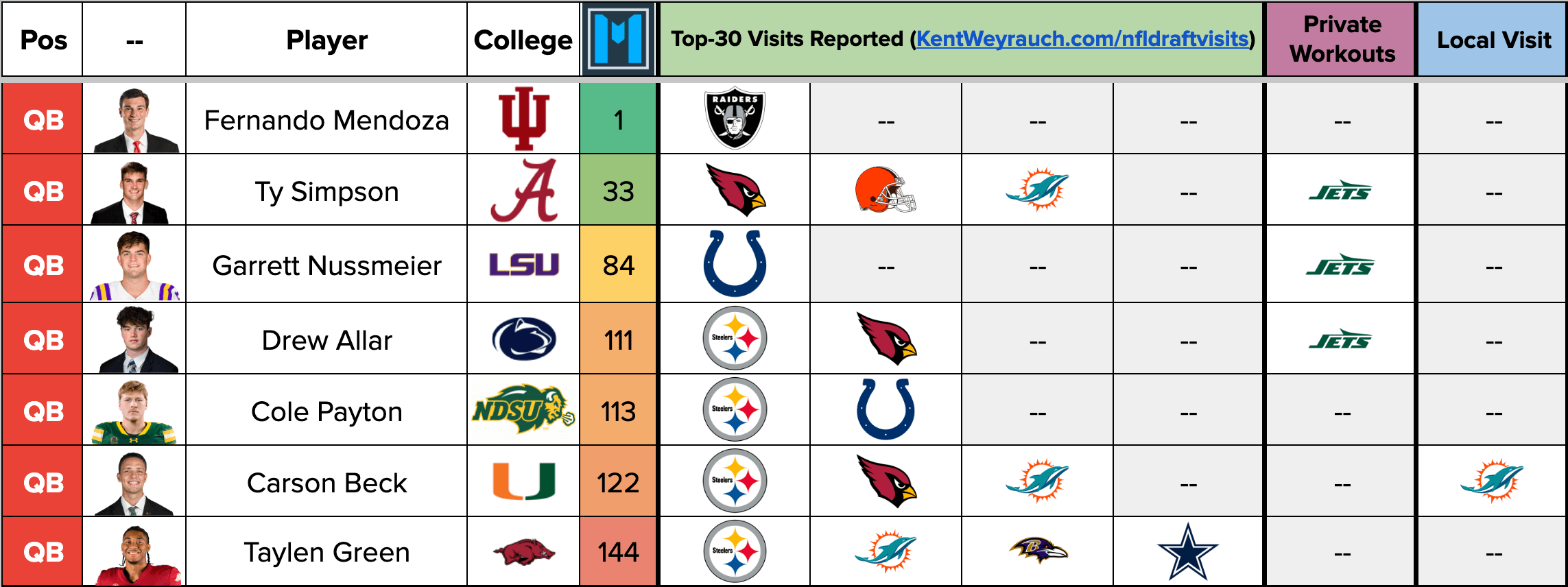
Fernando Mendoza is going to be a Raider. You knew that, your mama had it in her latest mock, so let’s move on. I wrote a monster 3500+ word rookie profile article on Mendoza if you want my thoughts as it relates to fantasy football.
Before we dive into the team-based data, this point is worth highlighting in a year with very few QB prospects.
Every 1st Round QB* over the last decade had a publicly known top-30 visit OR private workout with the NFL team that drafted them. The exceptions* were Tua (taped his private workout per COVID protocols) and the 2021 QB class (virtual meetings and pro days-only). I posted the full list if you want to peruse every name from Jameis Winston and Paxton Lynch to Kenny Pickett and Anthony Richardson and finally Cam Ward and Jaxson Dart last year.
2026 Team Visit Data: QBs
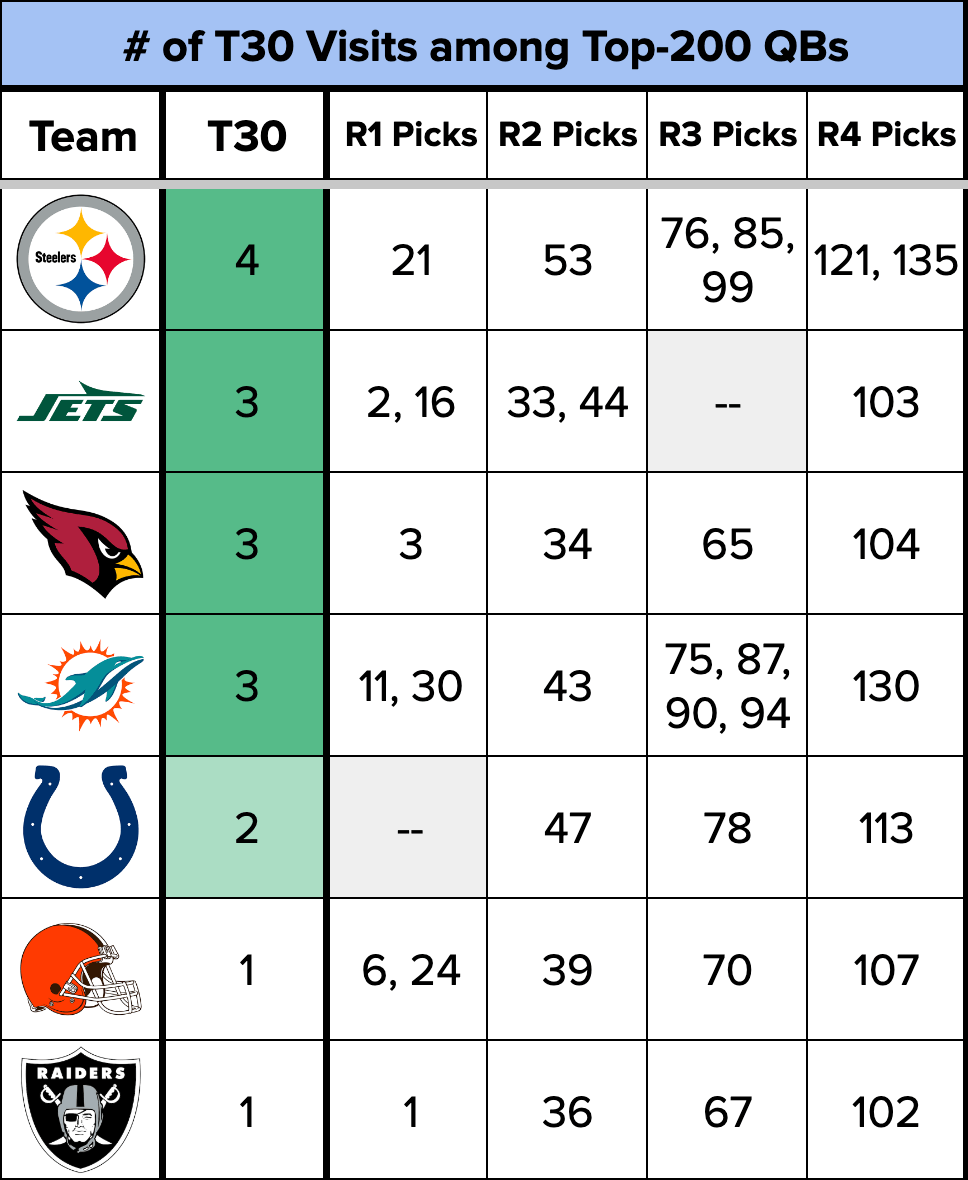
Going back over the last decade, I looked at 79 teams (excluding 2020 COVID year) that used 3+ visits/private workouts on the QB position like the Steelers, Jets, Cardinals, and Dolphins.
- 45 of those teams (57%) drafted a QB at some point in the draft.
- However, if we look at those 45 teams, an overwhelming 90% amount took one in the 1st four rounds of the draft.
In other words, the teams doing due diligence on the QB position are signaling they are willing look at varying tiers of the position.
Main QB Takeaways
Ty Simpson met with ARI/CLE/MIA/NYJ. Ok, so what now?
Using our “1st round data point”, we can connect him to one of those teams. Right? Well, that factoid is useless if Simpson is not a 1st rounder…
This EXACT same “1st round pick” logic was used when describing Shedeur last year. As late as April 16th last year, the Saints were the overwhelming betting favorite to take Shedeur, yet they never met with him. Sanders fell to the 5th round and Mel Kiper is still collecting his tears.
With Simpson seen as a fringe 1st/2nd round pick, you can easily connect him to one of those teams and their “later” 1st round picks. As many have pointed out, “playing chicken” at the QB position by finding “value” is simply not advisable. If you believe someone is a franchise QB, you are willing to take him early rather than gamble. A franchise QB is the rarest commodity in all of sports, right? But let me give you a few data points related to prospect visits to sit with for Simpson:
If he is a first round pick, Simpson would be tied for the lowest final MockDraft Database consensus rank (could change in the next week) over the last decade:
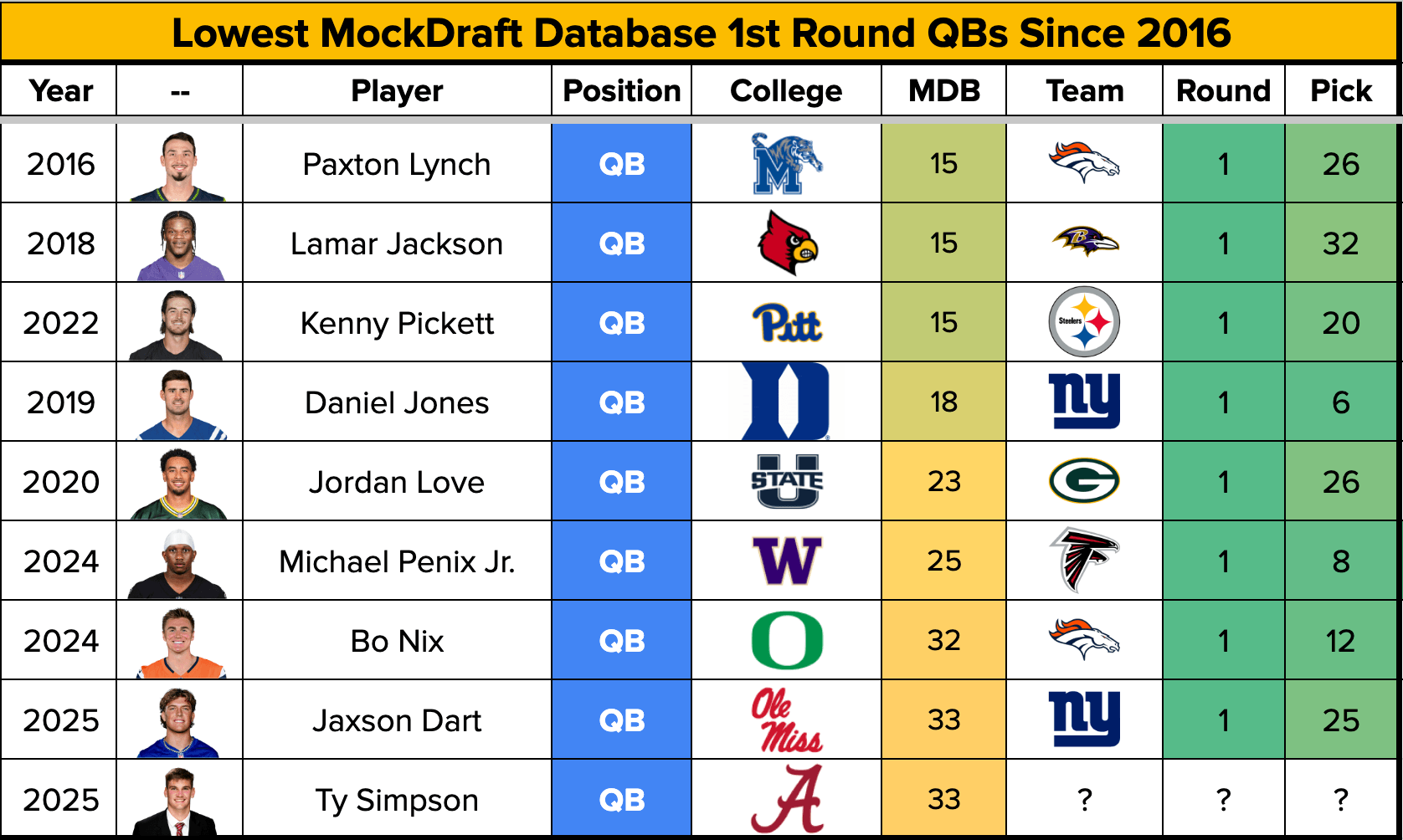
The biggest red flag in Simpson‘s profile is the lack of experience- 15 total starts. In this day and age of NIL, it is rare for someone to remain program-loyal waiting in the wings behind Bryce Young and Jalen Milroe. A number of QB evaluators have pointed this out when comparing to other historical prospects including this stat from Jim Sannes: “Since 2010, 23 QBs have been invited to the combine at age 22.5 or older with 20 or fewer games of experience. Only Mitchell Trubisky, Ryan Tannehill, Mac Jones, and Davis Mills went within the first 120 picks. Ty Simpson and Cole Payton are both in that bucket.”
Simpson’s over/under is currently 24.5 with juice to the over (-275). Teams trading back into the first round for a QB are a rarity despite the Giants accomplishing that feat in 2025 for Jaxson Dart. We have just a few other instances of teams accomplishing that trade feat for a QB in recent history: 2010 Tim Tebow (DEN), 2014 Teddy Bridgewater (MIN), and 2018 Lamar Jackson (BAL). Four times over the last 16 years. Mock Drafting is fun… but the 10,000 mocks you simmed don’t take into account real GMs that value these late 1st round picks and can sniff out QB-needy teams. QB is the one position where if you like a guy as a top-10 guy, you aren’t waiting later just to get “value”.
When you mix in a relatively weak draft class, there could be an NFL team that envisions him as their heir apparent at QB. However, there is recent MDDB history painting nightmare scenarios of Will Levis, Malik Willis, or Drew Lock falling out of the 1st round. On the Dynasty Podcast, we discussed his floor as a passer but raised concerns of his fantasy ceiling due to the lack of rushing. In the Dynasty Pass, Simpson went at the 3.03 in a 1QB league mock draft. In SuperFlex, he likely slides in as a late 1st rounder. Depending on your strategy and team needs, Simpson is not a must-target if you are looking for fantasy upside at the QB position and would prefer selecting the next best RB/WR on your board.
Maybe you’ve heard this before: the Jets need a QB.
The Jets have been in this EXACT situation time and time again.
For example, the 2015 Jets (staying with the team) had 5(!) top-30 visits for QBs and a private workout with Jameis Winston. However, with the Buccaneers selecting him 1st overall, he was off the board. With Mariota also off the board by the time they were on the clock for Pick 6 (Leonard Williams), you can see they moved on to the “next tier” at the QB position. Keep in mind you can’t pick that QB if they aren’t on the board when you are drafting.
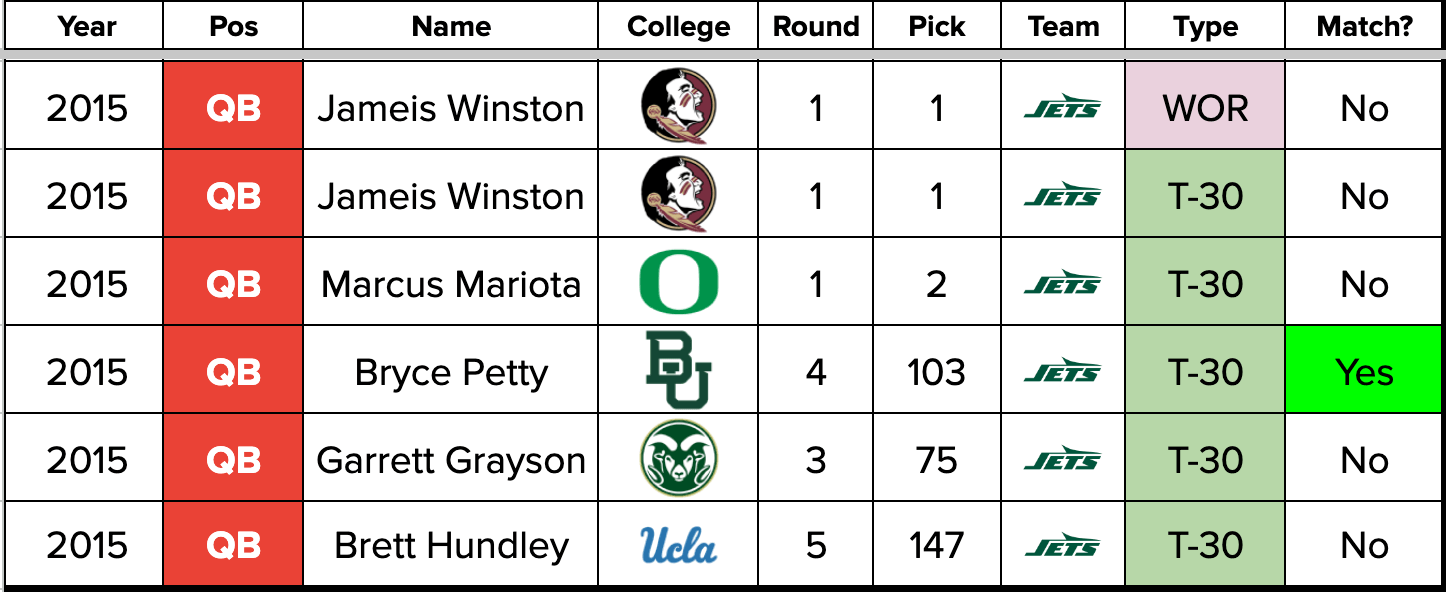
Sorry Jets fans, but Bryce Petty didn’t work out. Oh, and apologies the next year when the Jets did the same thing (5 total QB visits) and selected Christian Hackenberg in the 2nd round. Oh dang, they did it again in 2018 and selected Sam Darnold! Who could forget James Morgan in 2020? Never forget, 2021 with Zach Wilson! In 2024, they also used 3+ visits and selected Jordan Travis in the 5th!
Did the Jets use 3+ visits/workouts on the QB position?
Welp, every year they did? A QB was taken.
Every year they didn't… A QB was not. pic.twitter.com/Bb1HstAgah
— Kyle Borgognoni (@kyle_borg) April 15, 2026
The Steelers are aiming for Day 3.
It is interesting that we see media members connecting Ty Simpson with Pittsburgh. He is among 16 players who will attend the draft in Pittsburgh and the Steelers 1st round pick (21st) is right in the Kenny Pickett zone of QB picks. Ok, so that all makes sense on the surface. Right?
The general thinking is that if you are invited you to the draft, the NFL thinks Ty Simpson is going to go in the 1st round. Going back to our 1st Round QBs and their public visit stat, Pittsburgh has NOT met with him in any fashion. The names connected with Pittsburgh (Allar, Payton, Beck, and Green) all will go past pick 100. If Aaron Rodgers is coming back and reconnecting with Mike McCarthy, will they spend the capital and upset the future Hall of Famer?
The Cardinals are an enigma.
If you are deep in researching mock drafts, the most common scenario recently is the Cardinals trading up for Simpson. The “we’ll just take him with our 2nd pick” strategy does not really hold water considering we have just four 1st round QBs “traded up for” over the last 15 years on teams that also picked in the 1st round earlier. Historically, it would be easy to bet against Simpson to the Cardinals.
Mike LaFleur did have some comments after the combine about Simpson and Simpson publicly agreed that Arizona would be a good connection. I see the Cardinals trajectory more in line with a high upside project like Drew Allar on Day 3 but who knows with this team.
On the final day that prospects are allowed to make pre-draft 30 visits, Alabama QB Ty Simpson is visiting the Arizona Cardinals today. pic.twitter.com/ipwn1Rt5BJ
— Field Yates (@FieldYates) April 15, 2026
Running Backs
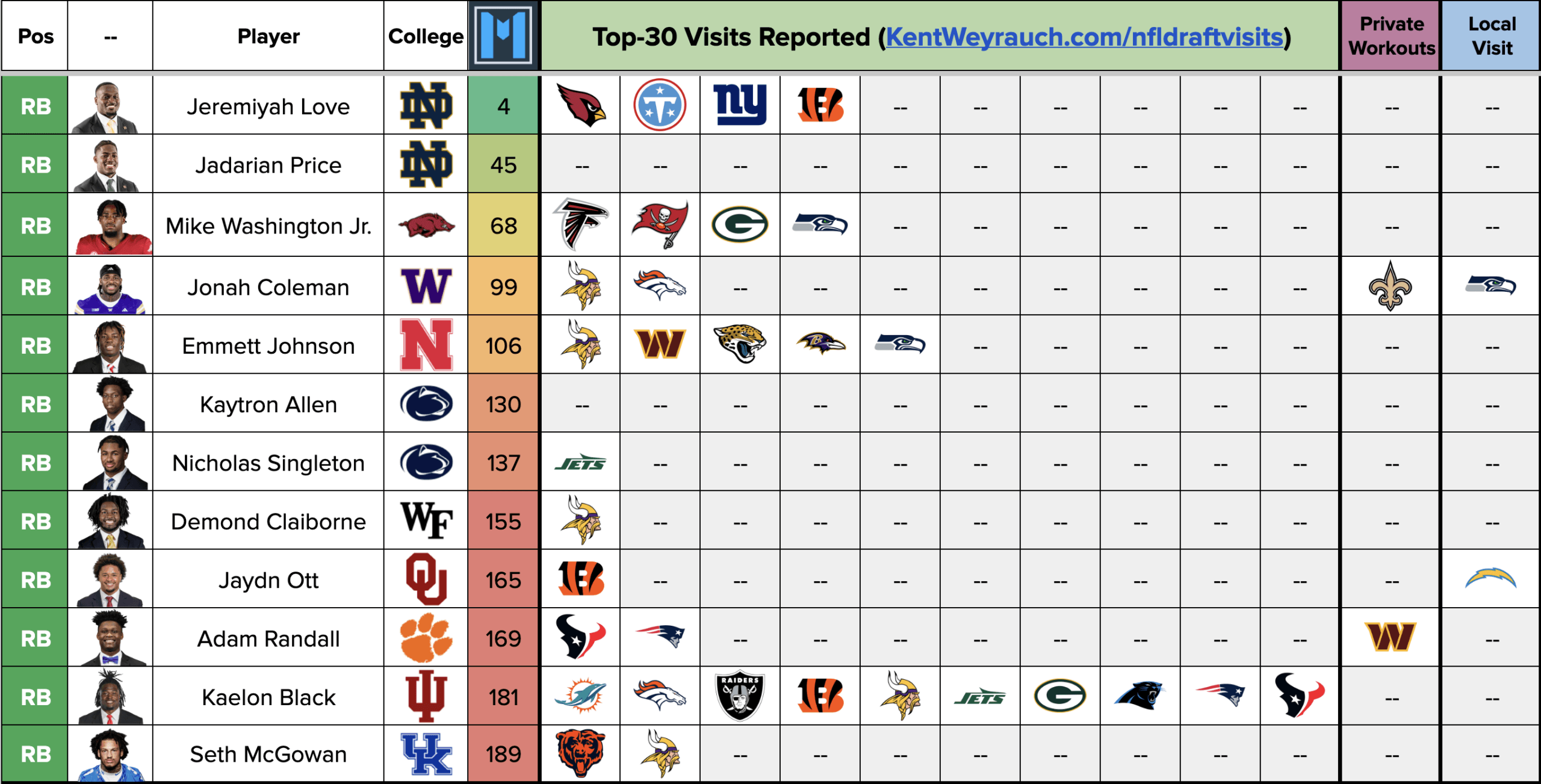
You might be saying to yourself: who is Kaelon Black?! And why is he such a popular man?
Repeating this again: the total number of visits for a prospect is NOT what we should focus on. The number used by teams on RBs is the signal.
2026 Team Visit Data: RBs
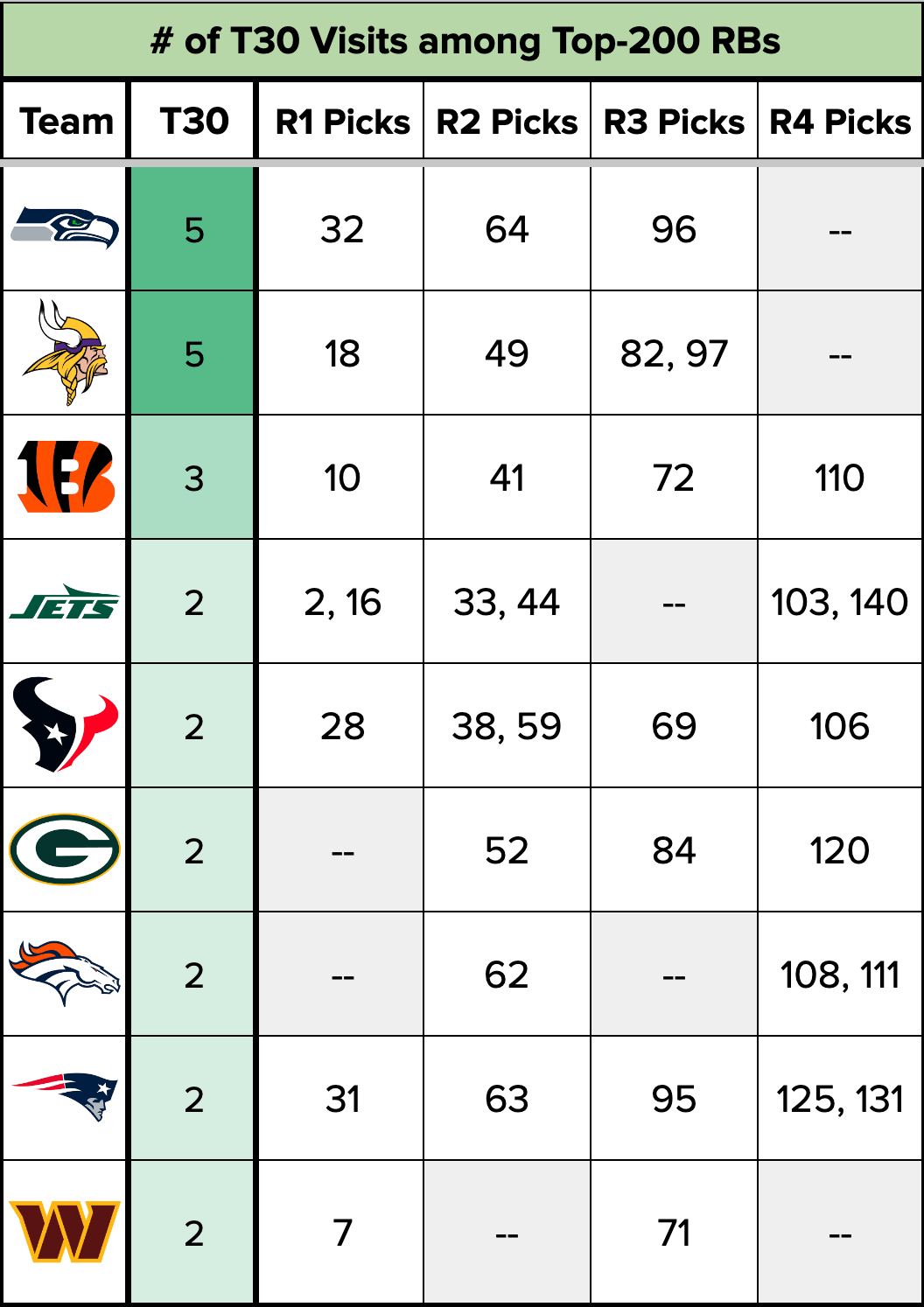
With five top-30 visits for both the Seahawks and Vikings, they seem like the easiest teams to connect with RBs on Day 2 of the NFL Draft. Both teams are currently without Round 4 picks as well boosting the odds they take one on Day 2. How rare is 5+ visits for the RB position? Going back over the last decade, I have just two instances of this occurring: 2025 Steelers (the aforementioned Kaleb Johnson selection) and the 2015 Cowboys, who did not draft a RB that year but followed that up by taking Ezekiel Elliott 4th overall in 2016. It is a rarity but should give us solid confidence they are using Day 2 draft capital.
Seattle met with Mike Washington Jr., Jonah Coleman, and Emmett Johnson but that does not mean they are out on Jadarian Price. I searched and searched trying to find any semblance of connection with Price and Seattle but even my local contacts had nothing beyond fan speculation. Remember that we can use player adjacent data to conclude what a team wants to do and with 5 total RB visits of players including 3 inside the top-100, I expect Seattle to sift through their options and take the best one available at pick 64. This is still solid draft capital for a RB.
Minnesota can certainly has the option to move up in the 2nd round using their extra third round pick as ammo in a trade scenario. They did their homework on a few later prospects (Demond Claiborne, Kaelon Black, and Seth McGowan) but in my study, I found that the total number of visits is more indicative than simply “were they all early projected RBs or later”.
Cincinnati is a curious organization allocating a top-30 visit on Jeremiyah Love and a few later guys. Going back to our dataset, if a team uses 3+ visits on the RB position, they’ve selected a RB in the 1st three rounds 61% of the time and in the first 4 rounds 80+ % of the time. Those are staggering numbers for Chase Brown truthers out there.
Main RB Takeaways
Jeremiyah Love– Every RB drafted in the top-10 since 2016 had a known meeting with the team that drafted them except Bijan Robinson. Love’s top-30 visits (ARI, TEN, NYG, WAS, CIN) paint us a simple picture: it’s going to be one of those teams. Despite recent smoke about the Cardinals eyeing him at 3rd overall, the Titans seem like the easiest spot to connect.
Jadarian Price– For the longest time, we heard whispers of Price as a fringe 1st rounder based on a few mocks that had him to Seattle at 32. I did a bit of digging and looked at every 1st round RB over the last decade. ALL of them had at least one reported top-30 visit/private workout.
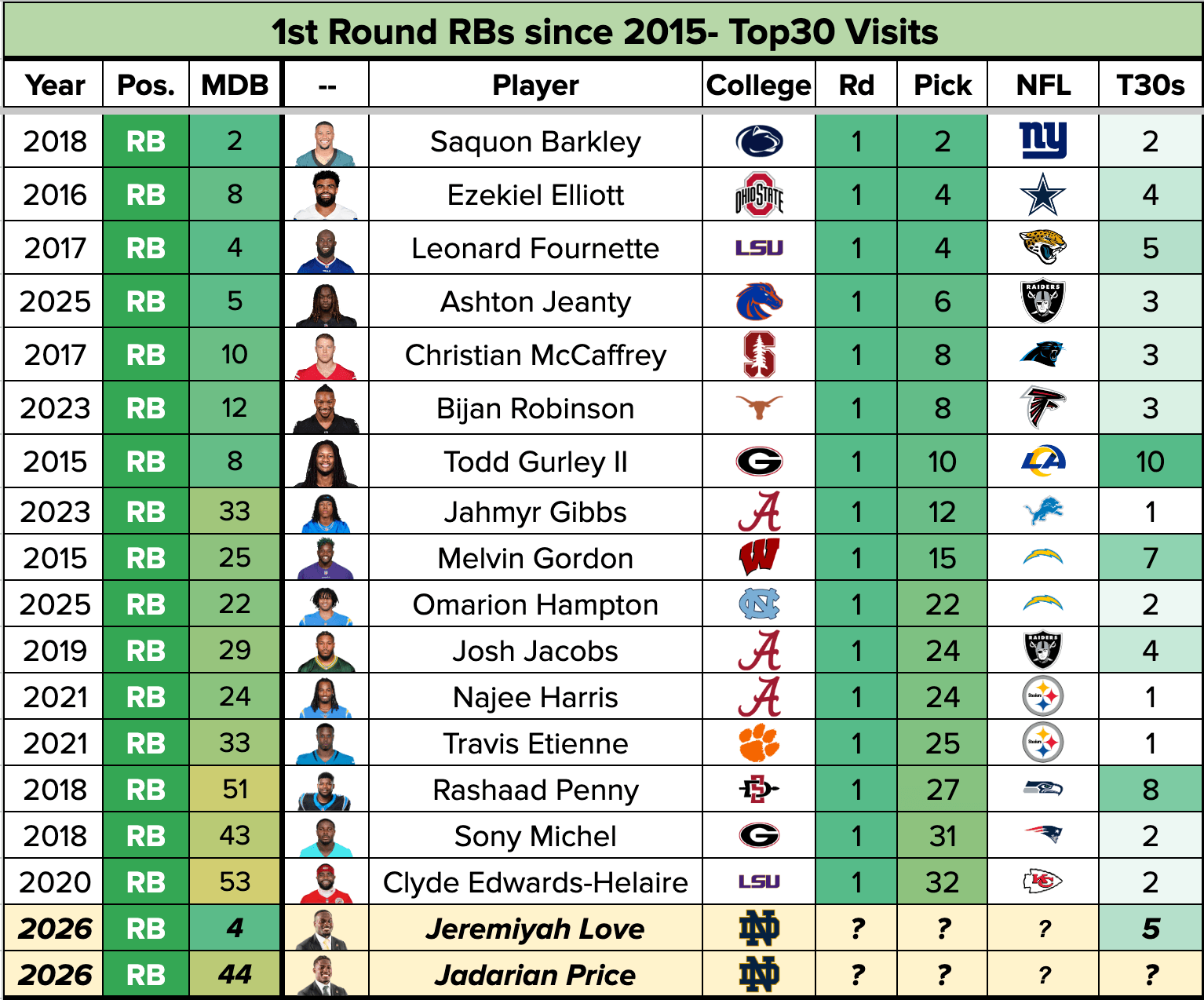
There is a first time for everything but when we see betting markets at U1.5 RBs in the 1st round sitting at -700 currently, I tend to agree. It feels like a Seattle-or-bust scenario for that 1st round status. Nevertheless, if he lands with a RB-needy team in Round 2 as the lone RB in that round, he will create a nice little gap for fantasy as the rookie RB2.
Mike Washington Jr.– Big Mike’s 40-time was blazing but our research shows us combine times aren’t everything. His rise up draft boards is noteworthy but I shared my full thoughts here on the Dynasty Podcast about how he might transition to the NFL. I’m expecting Round 3 draft capital for Big Mike but not in a location that puts him immediately in a muddled committee.
Jonah Coleman & Emmett Johnson– It feels like these two entered the draft process battling it out as the clear fantasy RB2 based on their receiving production. Their scouting reports in our Dynasty Pass and production profiles certainly back that theory up.
In my research, when you survey the list of the rookie RBs drafted in the 3rd round or later of the NFL draft and where managers took them in dynasty, it might cause you to rethink your life.
- Of the 40 RBs selected since 2015 in dynasty rookie drafts, only five became RB1s in their 1st year.
- Yet, 13 of those RBs with that type of NFL draft capital (3rd round or worse) ended up as top-5 rookie picks!
If you want a follow-up on this subject, we have an article I want to point you to: What Matters More for Rookies: Skill or Landing Spot? We wanted to take this idea a step further than just including draft capital. It’s hard to quantify “skill” or “landing spot” but in this methodology, we try to get as close as possible using fantasy points as a metric. The findings for the two major positions were thus:
- Skill and landing spot effects are equal and opposite for RBs
- Skill is much more important for WRs.
Wide Receivers
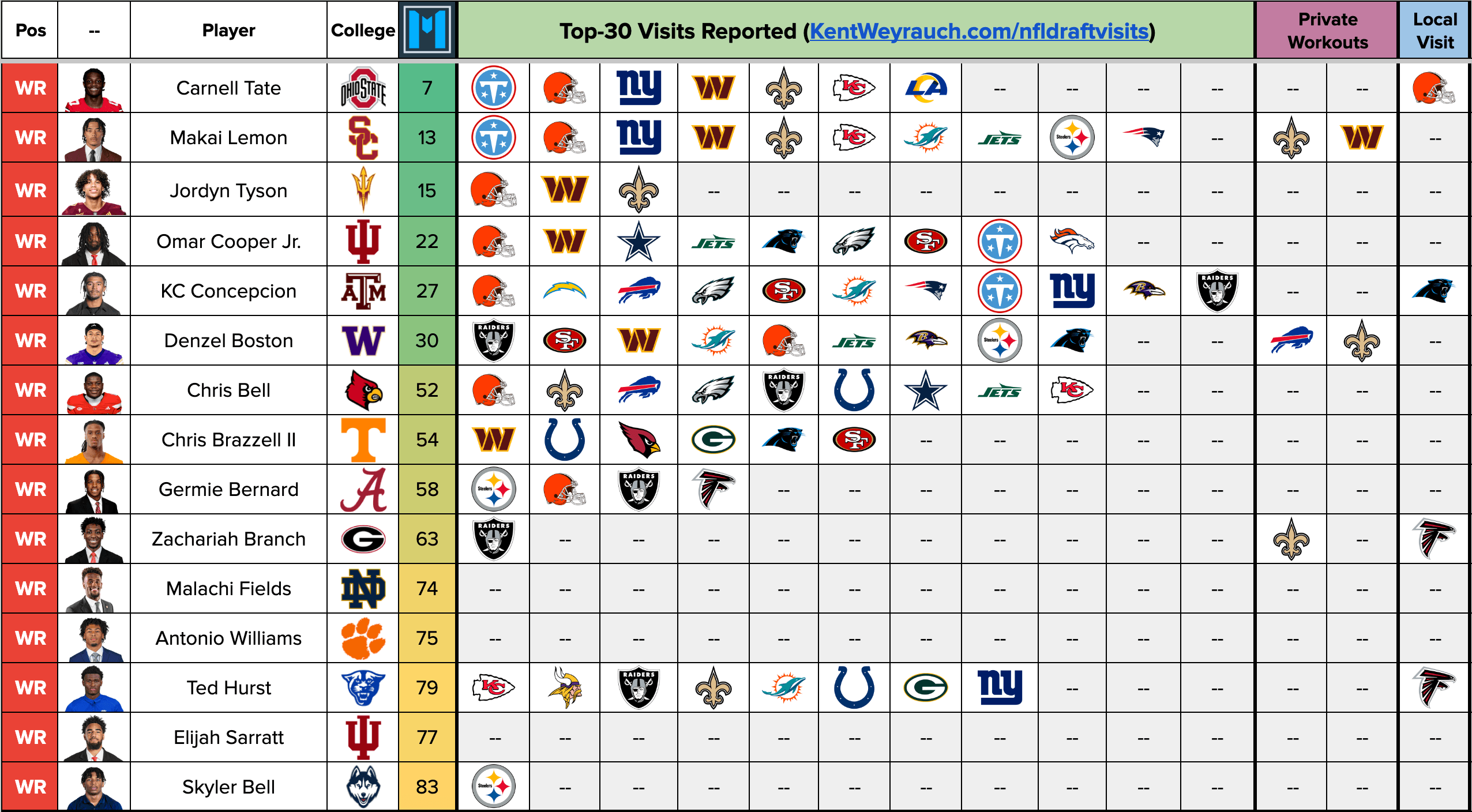
As I stated earlier, this year we have 17 WRs currently in the top-100, 2nd most over the last 6 years.
- 2021- 14
- 2022- 16
- 2023- 14
- 2024- 19
- 2025- 12
This is reflected in the number of reported prospect visits among the top-end prospects For accounting purposes, we have a bevy of players such Carnell Tate, Makai Lemon, KC Concepcion, Denzel Boston and Omar Cooper Jr. lead the pack with 7+ visits for each. There have been reports that we could see six WRs taken in the 1st round including all six before pick 24, something that has occurred just once over the last decade.
2026 Team Visit Data: WRs
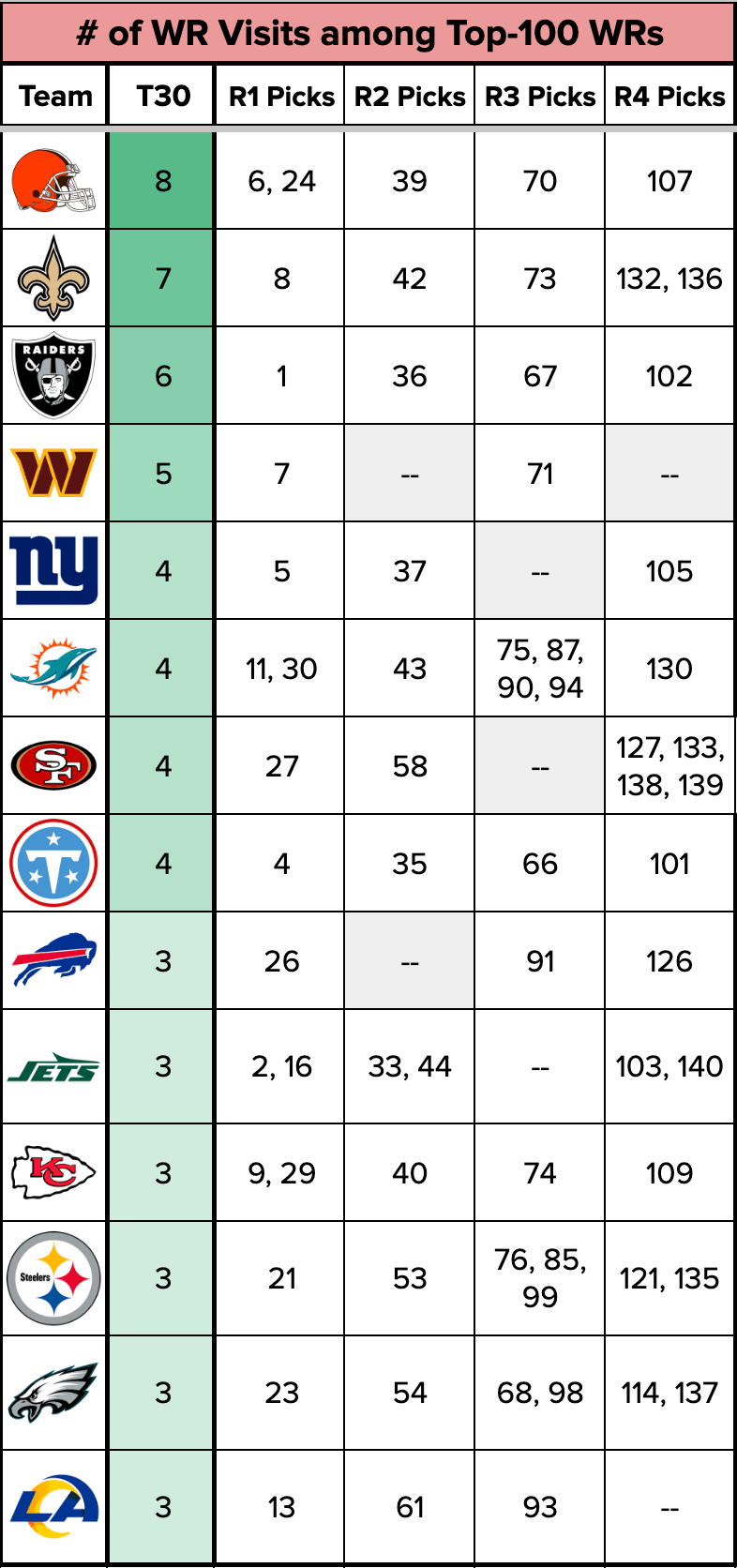
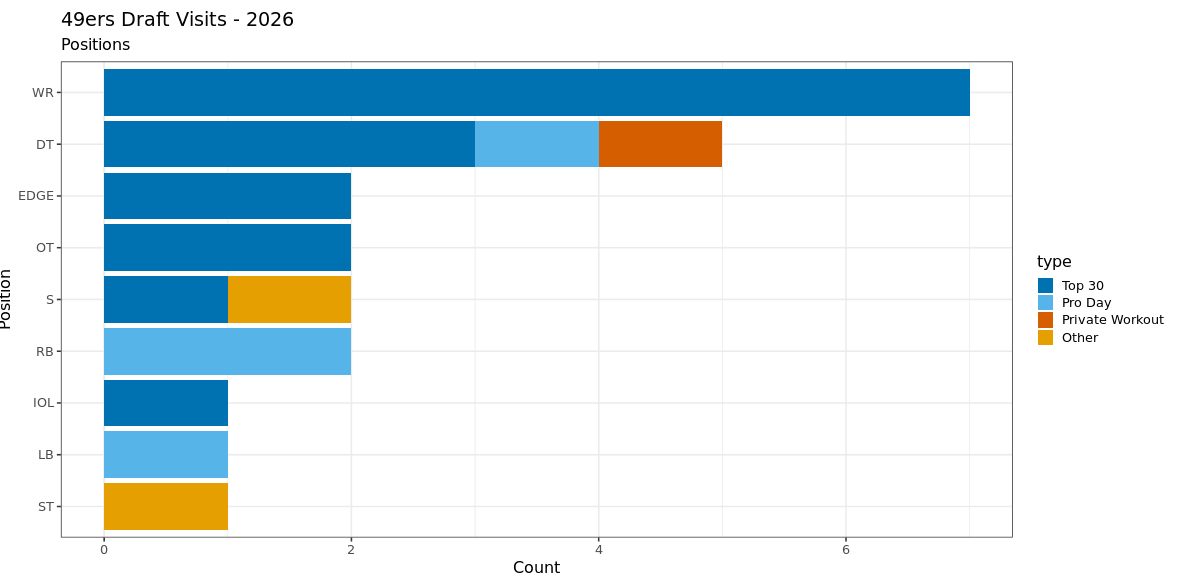
The chart above is showing simply visits among the WRs ranked in the top-100. However, total visits is what we will work from moving forward. I’d encourage you to go to KentWeyrauch.com if you want to play around with teams. For example, this is what the 49ers look like when compare all of their positions:
We’ve already established earlier that 3+ visits as a starting place for teams to use picks in Rounds 1-3 on the WR position. 5+ puts us in the territory we want: 65+ % that a WR was taken historically. But the context for this year’s draft means we need to kick this up a notch.
Looking back over the last decade, here are the teams with 7+ visits and the WR they selected:
- 2015 Miami Dolphins (8 WR visits)– DeVante Parker at 14th overall
- 2015 Carolina Panthers (7)– Devin Funchess at 41st overall
- 2015 Philadelphia Eagles (7)– Nelson Agholor at 20th overall
- 2015 Tennessee Titans (7)– Dorial Green-Beckham at 40th overall
- 2016 Cincinnati Bengals (7)– Tyler Boyd at 55th overall
- 2016 New England Patriots (7)– Malcolm Mitchell at 112th overall
- 2017 Philadelphia Eagles (7)– Shelton Gibson at 166th overall
- 2017 Tennessee Titans (7)- Corey Davis at 5th overall
- 2018 Dallas Cowboys (12!)– Michael Gallup at 81st overall
- 2019 New England Patriots (8)– N’Keal Harry at 32nd overall
- 2022 Kansas City Chiefs (7)– Skyy Moore at 54th overall
- 2023 Buffalo Bills (7)– Justin Shorter at 150th overall
- 2024 Arizona Cardinals (7)– Marvin Harrison Jr. at 4th overall
- 2024 Buffalo Bills (7)– Keon Coleman at 33rd overall
- 2024 Pittsburgh Steelers (7)– Roman Wilson at 84th overall
- 2025 Green Bay Packers (7)– Matthew Golden at 23rd overall
Whew, those were some fun throwback names!
16 teams utilized 7+ visits on the WR position. Of those 16 teams, 13(!) of them selected a WR in the first 3 rounds (81%) and six of those picked a WR in Round 1. Well, seven if you want to count Keon Coleman whom the Bills traded out of the first round to take at the top of the second round. Good luck Keon as your GM just stated he’s “putting all our eggs in [Keon Coleman]’s basket to come back for year three and be a part of this group.”“!
Where are we at with this year’s group?
Cleveland– Eight top-30 visits is pure insanity. The public thinking is that Cleveland will either take a mixture of WR & OT for their two first round picks.
New Orleans– At 8th overall, the Saints are certainly in play for any of the big 3 WRs. They also had private workouts for Denzel Boston and Zachariah Branch and visits with later guys (Chris Bell and Ted Hurst) that are intriguing.
Washington– Their “Top Golf” crew included the big 3 WRs but with a limited number of picks, this team might throw a wrench into our data set. It is rare for a team to pick just twice inside the top-100 and not address the most glaring need for this team: defense. Backwards hat Dan Quinn and the Commanders defense died out in 2025 ranking 32nd in yards per game allowed and 31st in turnovers forced. They addressed some holes in free agency but my money is on a defensive playmaker at 7th overall like CB Mansoor Delane (LSU grad + Washington DC native) or safety Caleb Downs.
San Francisco– They’ve met with Omar Cooper Jr., KC Concepcion, Denzel Boston, and Chris Brazzell II among top-100 prospects. That is the pool of players I’m considering for pick 27 in the 1st round. I mocked KC Concepcion in my latest one.
SF’s confirmed and reported Top‑30 visits, paired with each player’s consensus big‑board ranking.
The 49ers drafted two players from their Top‑30 visits last year. How many will it be this year?
Top-30 Visits via @Coach_Yac, @NFLonCBS & @49erswebzone pic.twitter.com/G3wjljZwTT
— SFdata9ers🏈📊 (@sfdata9ers) April 16, 2026
Las Vegas– Who are they going to pair with Fernando Mendoza? If only five WRs are drafted in Round 1, it seems that Las Vegas will have access to the “leftover” at the top of Round 2.
One more data point to consider: going back a decade, if a team makes at least ONE top-30 visit with a top-100 NFL MockDraftDatabase rank, they’ve selected a WR in the top-3 rounds of the draft 54% of the time. If they meet with 3+, that rate skyrockets to 76%. The supply certainly matches the demand in 2026 with 15 WRs currently projecting to going in the top-100 including a late rise for Ole Miss WR De’Zhaun Stribling.
Main WR Takeaways
Carnell Tate– Locked into the top-10 picks, Tate to the Browns is the current betting favorite. We took him to be the 1st WR drafted in early March as one of our NFL Draft prop bets.
Makai Lemon– Over the last decade, only one WR (Jaylen Waddle) with 67+ % of their snaps in the slot was selected in the top-15 of the NFL. The fact Lemon had 10 top-30 visits with everyone from the Titans (4th) to the Patriots (31st) is wild. I took him to go to the Saints in our betting mock draft on the DFS & Betting Podcast.
Jordyn Tyson– He is a complete mystery as his private workout for NFL teams (Friday April 17th) will likely give teams the final conviction they need. For fantasy, we’ve held steady that he is our WR1. Will the NFL select him in the top-15? The Chiefs have been a trendy name recently at Pick 9.
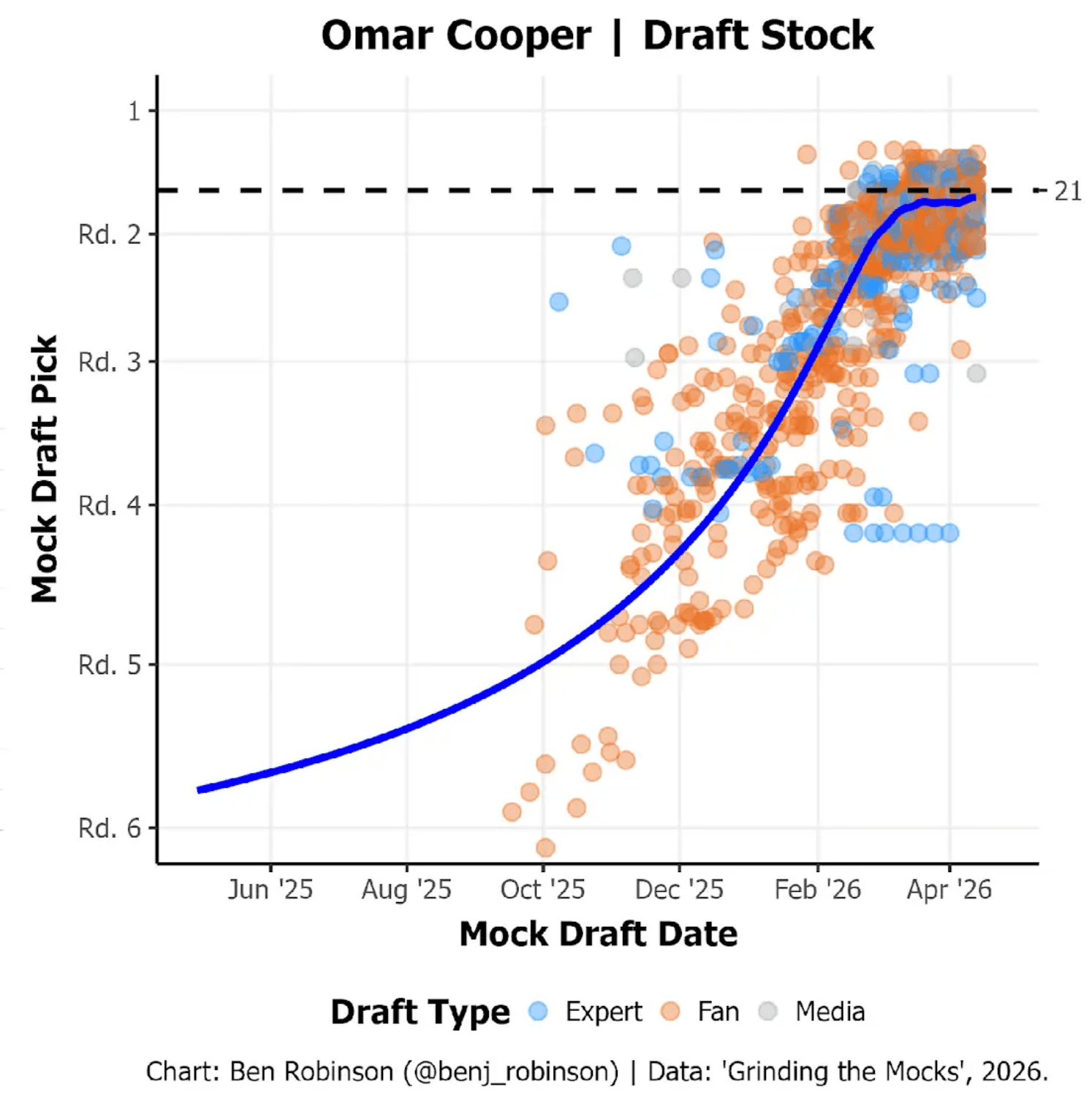
Omar Cooper Jr.– Cooper’s rise up draft boards (as detailed below from GrindingtheMocks) needs to be put in perspective. It feels quite similar to the narrative spun around Matthew Golden last year. Let me be clear: these are very different players in terms of play style and NFL adaptability. Emeka Egbuka was similar to this last year with his final MDDB number sitting at 31.
Denzel Boston– Boston has held firmly as a 1st round pick but there was steam recently that he could go even higher than we imagine. Betz and I both somehow landed on him going to the Jets at 16 in our pre-recorded Betting Mock Draft and then information came out after that Jets insider Rich Cimini also shared this take.
KC Concepcion– Now this is one popular man! KC is currently 26th overall on MDDB putting him in firm territory to go in Round 1. Over the last decade, the only WR with a final MDDB rank inside the top-26 to NOT be drafted in the 1st round was DK Metcalf (21st on MDDB). To layer on another point, Concepcion’s 12(!) reported top-30 visits (the Panthers technically counted as a local since he is from North Carolina) are the most EVER for a WR ranked in the top-32 of MDDB surpassing the great Denzel Mims (11 in 2020). We did see Xavier Legette hit 14 visits + workouts in 2024 because his MDDB rank (40) suggested he would be lower in the draft. For those curious, the most of any WR in the dataset was Anthony Schwartz out of Auburn in 2021. He reportedly met with 16(!) teams
Germie Bernard– Bernard’s visits (PIT, CLE, LV, ATL) firmly establish him as a Round 2 option for a few teams. We are less bullish on his long-term outlook for fantasy purposes but he has held steady in his MDDB ranking throughout this entire process.
Alabama's Germie Bernard currently sitting as a top-60 overall player on consensus boards.
That would be the 2nd lowest final year YPRR of any WR taken in Rounds 1-3 since 2015. pic.twitter.com/4XF01LY4AT
— Kyle Borgognoni (@kyle_borg) February 3, 2026
I wrote a massive article entitled Dynasty WR Thresholds That Matter if you want a full discussion on this topic. Since 2015, WRs in their final* year of college averaged:
- Round 1: 28.1% TPRR, 3.16 YPRR
- Round 2-3: 27.8% TPRR, 2.70 YPRR
Anything sub 20 percent is not optimal when you compare it to other WRs. At its core, TPRR is a measure of efficiency; it tells us a player’s ability either to get open or be a part of the offensive scheme. We say it often: earning targets is a skill. And that skill, expressed as TPRR, has a strong correlation with fantasy relevance. Since 2006, 92% of receivers who finished as a WR2 or better (top 24) had a TPRR of at least 20%.
If you want more content on these year’s WRs, I’ve written an article entitled Route Metrics: Comparing 2026 WR Prospect Route Trees to NFL Players.
Tight Ends
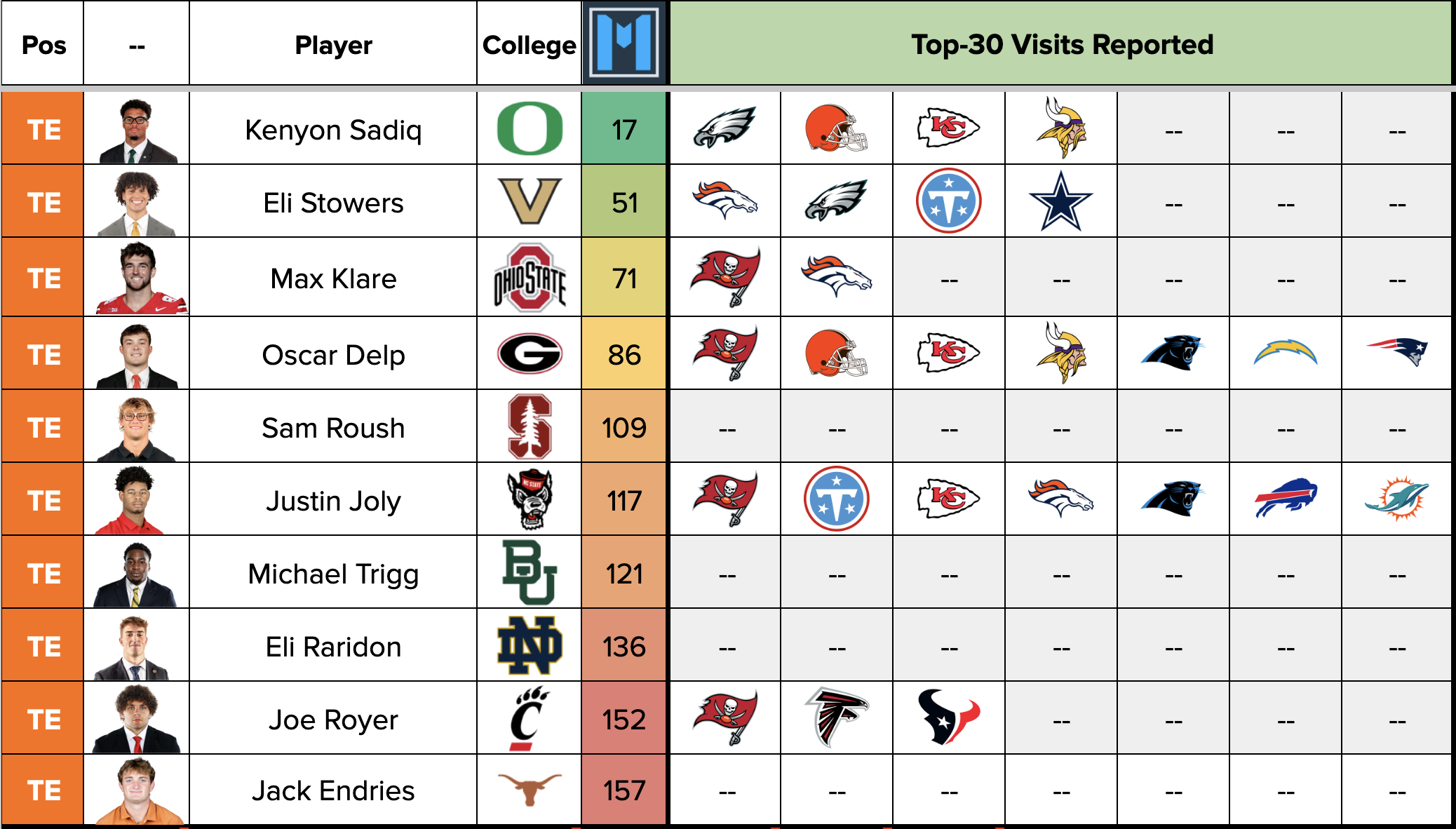
I must confess that TE end feels a bit flimsy in my top-30 visit research. I did NOT include them in my original article last year. This was solely due to time and trying to find a middle ground with how to present the data. We have the recent history of rookie TEs dominating the NFL (LaPorta, Bowers, Warren, Loveland, and Fannin) but on the other hand, utilizing the names for the earlier part of the decade is a mixed bag in terms of actual NFL difference-makers (as a Falcons fan, I’ll never understand Kyle Pitts > Ja’Marr Chase)
The intention of NFL teams and mock drafters is quite clear: we know a 1st round TE when we see one. Since 2015, we’ve had 31 TEs taken in Rounds 1 and 2 of the draft. 22 of those teams (71%) that selected a TE had at least ONE top-30 visit or workout.
That is a strong number to work with but I do needThe recent exceptions to the rule:
- The Raiders had two of the four that didn’t meet that criteria (Brock Bowers and Michael Mayer)
- The Rams do not post their top-30 visits (Terrance Ferguson)
- The Colts and Bears did not publicly meet with a TE prospect last year (Colston Loveland and Tyler Warren)
- The Seahawks also did not meet with a TE (Elijah Arroyo).
If we take out last year’s group, the rate jumps to 85%. Regardless, with I still formulating opinions on how to best utilize this data.
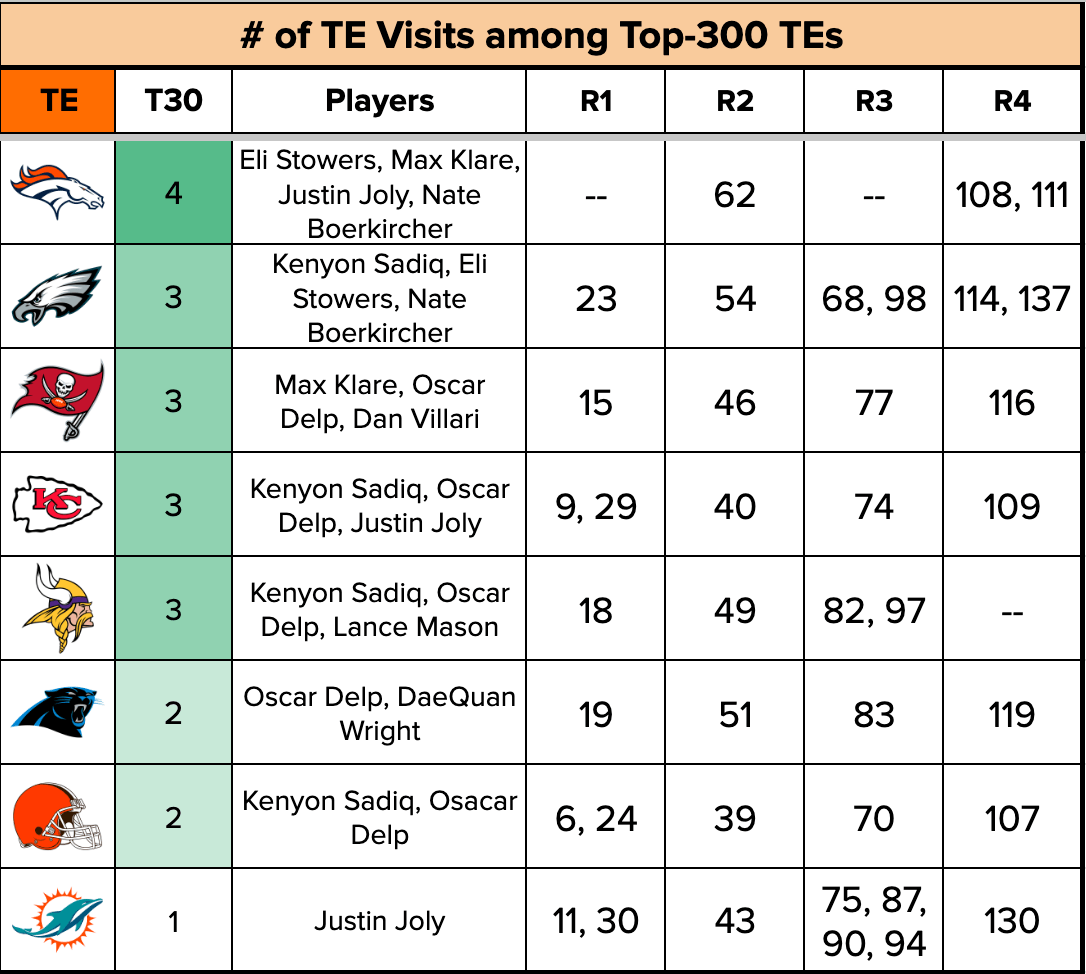
2026 Team Visit Data: TEs