
Dynasty Range of Outcomes: 2026 RB Class (Fantasy Football)


Welcome back to the Dynasty Range of Outcomes series!
This article will take a deeper look at this year’s RB class by utilizing historical prospect data to identify which players are more likely to break out in the NFL. By finding RBs with similar draft capital and production, we can project a player’s potential trajectory as they enter the NFL.
To quickly recap, we will keep the analysis relatively simple by using four data points to find players that most resemble the 2026 rookie class:
- Draft Capital: Draft capital is the most predictive metric. Players selected earlier in the NFL draft are more likely to receive significant playing time and become valuable assets for dynasty managers. Draft capital also represents a team’s investment in a player, which is why day three RBs are often easily replaced.
- Career Production: While there are a few exceptions, players who dominate in college usually produce at the NFL level. In fact, we consistently see higher hit rates when we control the sample size for draft capital and production. Unlike previous versions of this article, this year I will leverage my model’s schedule-adjusted production score, which combines a player’s career EPA per Play, Scrimmage Yards per Team Play (one of the most predictive singular metrics for RBs), and SRS College School Rating into one holistic metric. To find players with similar production profiles, our analysis will apply a 15%-20% threshold in both directions.
- Declare Status: Players entering the league within three years of graduating from high school are classified as early-declare prospects. Why does this matter? Historically, early declare prospects have averaged higher breakout rates in the NFL. This is likely because the most talented prospects enter the league as soon as they are eligible, having already achieved significant success at the collegiate level.
- Weight: This data point has one of the lowest correlations to fantasy production. However, it makes sense to filter by weight to avoid comparing a De’Von Achane to someone like Derrick Henry, who is over 50 pounds heavier. In this analysis, we will apply a five-to-ten-pound threshold in both directions to identify players with similar body types.
For a more detailed breakdown of these metrics, check out our series primer. If you have any questions, feel free to reach out on Twitter @FF_MarvinE. Let’s dive into the 2026 RB class!
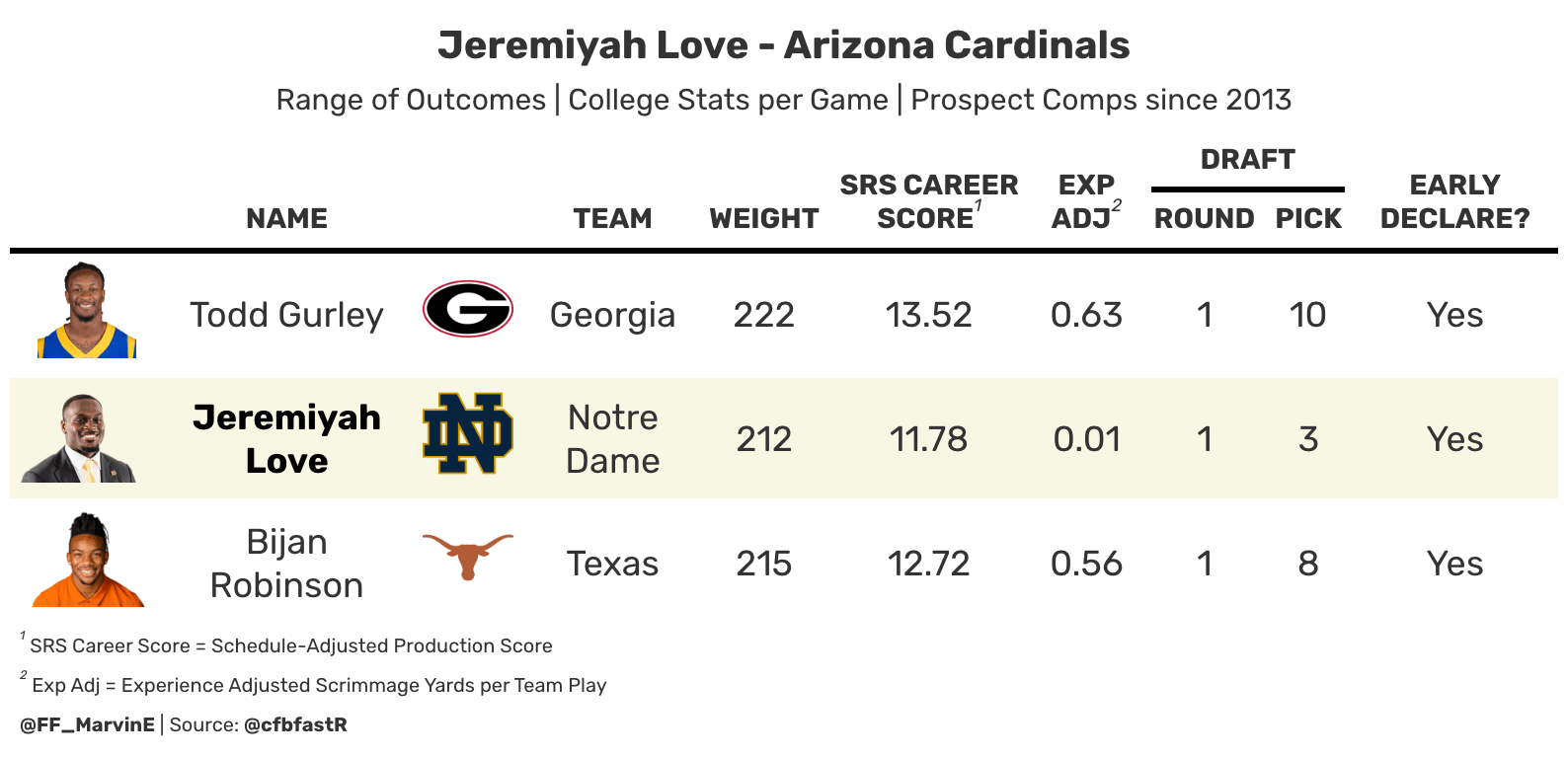
Widely considered the top overall selection in dynasty drafts, Jeremiyah Love enters the year as the consensus rookie RB1. First off, his college production profile is surprisingly unique compared to other day-one prospects. When evaluating all 18 first-round RBs selected since 2013, Love ranks only 12th in Experience-Adjusted Production and 13th in career Scrimmage Yards per Team Play. However, when we adjust his production to account for Notre Dame’s strength schedule and team ecosystem, his profile starts to look a lot more optimistic. In fact, his SRS Career Score ranks in the 92nd percentile, well in line with some of the recent day one RBs. Coupled with his high-end draft capital, Love grades in the 97th percentile in my rookie model, placing him next to players like Todd Gurley and Bijan Robinson. As a result, even though his production profile may not be perfect, I am still confident in his career trajectory. In fact, RBs who rank in the +95th percentile in my rookie model have averaged a 100% RB1 hit rate within their first three years in the league. Given that track record, I expect Love to emerge as an elite option for fantasy managers sooner rather than later.
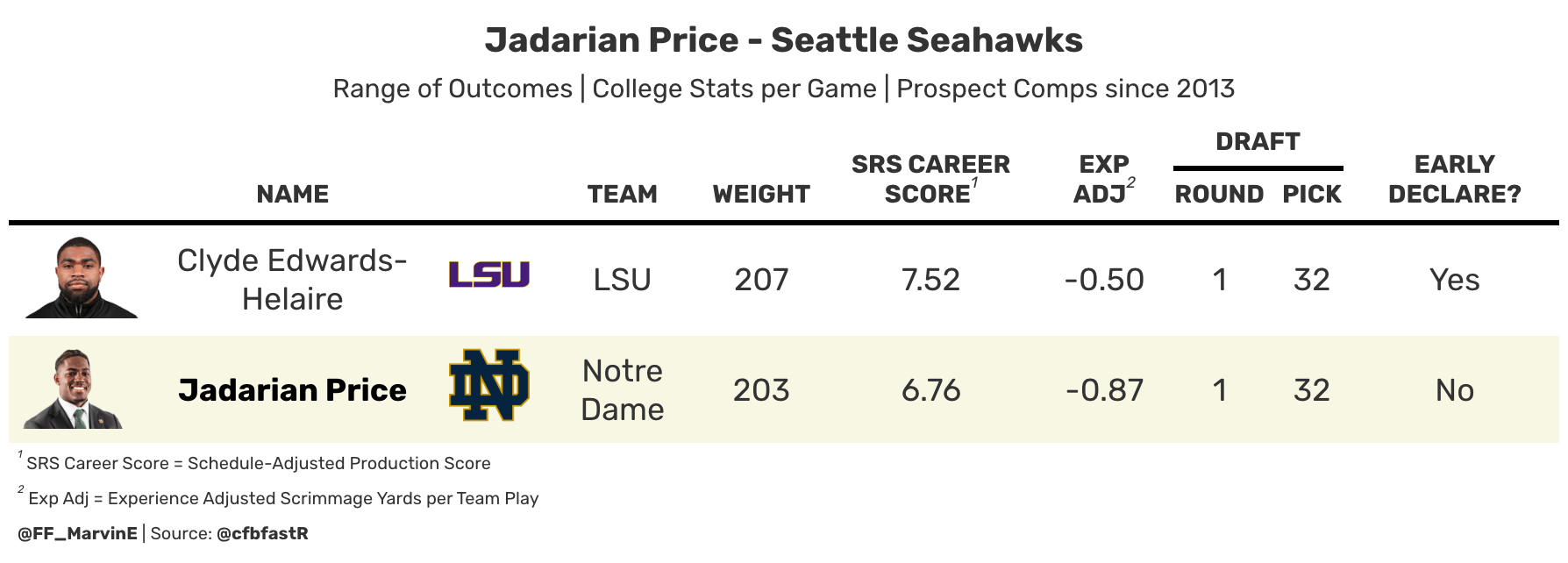
Speaking of unique profiles, Jadarian Price is one of the toughest players to evaluate in this class. A four-year prospect out of Notre Dame, he played behind Jeremiyah Love for the majority of his career. As a result, his production profile ranks at the very bottom among first-round RBs. In fact, I had to remove the “declare status” filter to find at least one player with a similar score. Ironically, that player is Clyde Edwards-Helaire, who was also drafted with the 32nd overall pick. However, this is the perfect example of why context matters. Considering he was in the shadows of Love for the majority of his career, his opportunities for a breakout season were very limited. Could Price have had more success on a different team? Very likely. But because we don’t know that for certain, he enters the NFL as the lowest graded first-round RB in my model, slotting in the 77th percentile. It is worth noting that Josh Jacobs is not on this list because his profile fell slightly outside of our thresholds. However, from a production perspective, Jacobs and Price are very similar in that they never broke out in college after playing alongside multiple NFL-caliber players. So even though Price’s trajectory remains murky, I am cautiously optimistic that his landing spot with the Seahawks could still lead to immediate fantasy production.
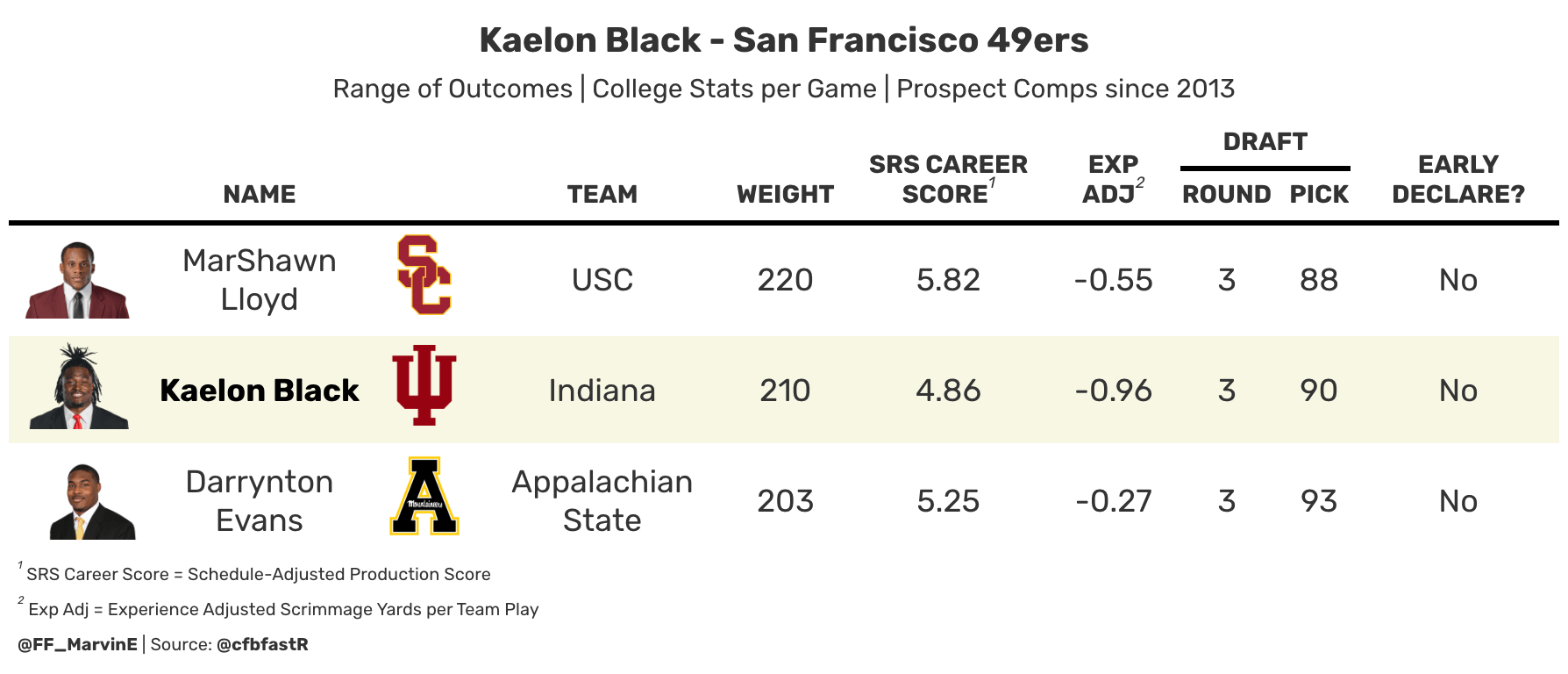
By far one of the most surprising picks in the NFL Draft was San Francisco’s day-two selection of Kaelon Black, considering he wasn’t even the most productive RB at Indiana last year. And while we have seen plenty of third-round RBs emerge in the NFL, most of them were high-end producers at the collegiate level, such as David Johnson, Kareem Hunt, and De’Von Achane. Unfortunately, Black does not belong in that group after failing to break out in his four years at James Madison and Indiana. And while his Senior year stat line of over 1,000 scrimmage yards does stand out, he only accounted for 13.5% of Indiana’s entire offense last season, as UDFA RB Roman Hemby was equally involved for the Hoosiers. Finally, to provide more context on why production matters, day-two RBs with negative experience-adjusted production (similar to Black) have averaged only 29% hit rate for fantasy football. By contrast, those with positive experience-adjusted production have broken out at a 65% rate. And considering his closest comps in my model are MarShawn Lloyd and Darrynton Evans, Black’s 41st-percentile grade has me less confident in his dynasty outlook.
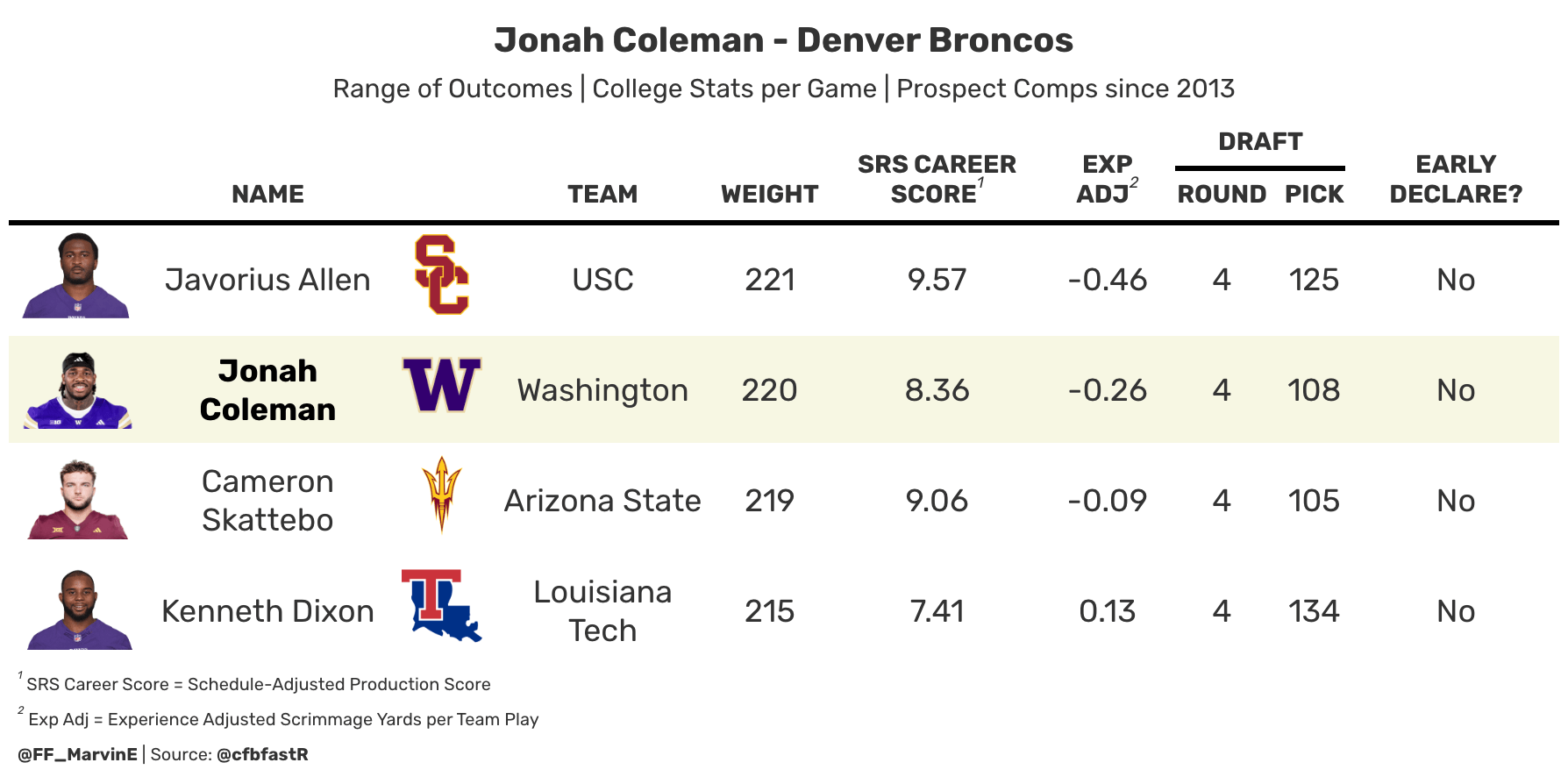
Washington’s Jonah Coleman was one of my favorite RBs in the pre-draft process. However, after falling to the fourth round, we may need to temper our expectations for Coleman’s dynasty outlook. For one, he lands with the Denver Broncos, a team that spent a second-round pick on RJ Harvey and recently re-signed JK Dobbins to a two-year deal. With both likely heavily involved for the Broncos’ offense, Coleman’s opportunities could be limited early in his career. Secondly, we have to keep in mind that day-three RBs rarely emerge for fantasy football. In fact, only 12.2% of fourth-round RBs have broken out since 2013, painting a less optimistic outlook for Coleman. We see that in his prospect comps, as Javorius Allen and Kenneth Dixon never emerged as reliable fantasy options. On a positive note, Cam Skattebo did break out in his rookie year (RB10 in points per game), though he was in a much more favorable landing spot with the Giants. And at his early round-two rookie ADP, I would much rather invest some of the day-two WRs at a similar cost.
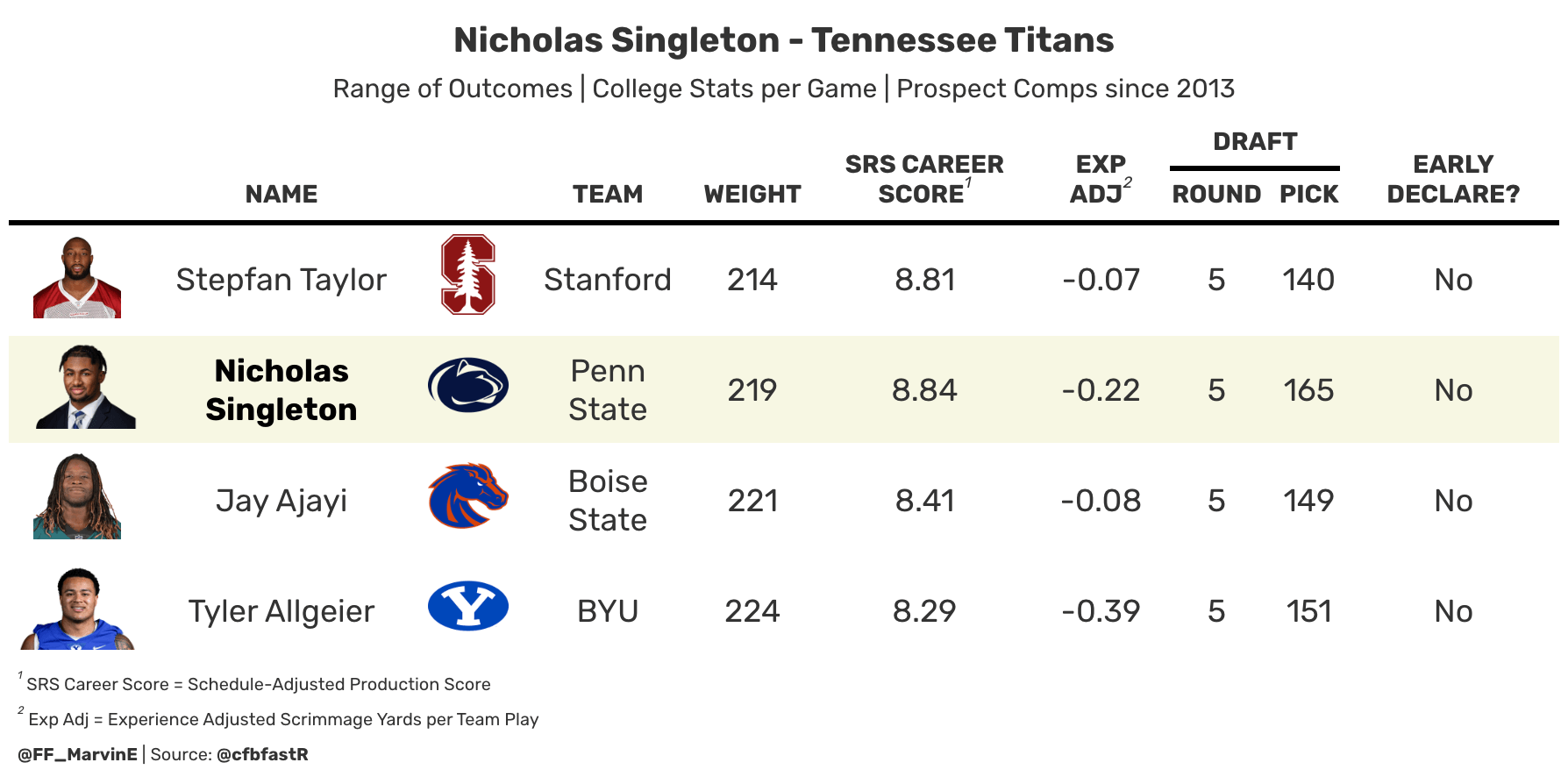
Similar to Jonah Coleman, Nicholas Singleton’s outlook took a significant hit when he slipped to the fifth round of the NFL draft. This comes after an impressive start to his college career at Penn State, producing an 85th-percentile true-freshman season in 2022. However, since then, Singleton’s production and efficiency plateaued to a point where Kaytron Allen finished the 2025 campaign as the most productive RB on their team. As a result, he enters the NFL with a 71st percentile SRS career score, ranking just below the 50th percentile in my rookie model. His prospect comps do provide a more optimistic outlook, as Tyler Allgeier showed signs of fantasy relevance before ultimately being replaced by Bijan Robinson in Atlanta. In the case of Jay Ajayi, he broke out with the Dolphins early in his career before tearing his ACL in 2018. In addition, Tony Pollard is entering the final year of his contract after an inefficient campaign (RB32 in Success Rate last season), so Singleton could carve out an immediate role in the Titans’ offense. And while I am tempering expectations because of his draft capital, Singleton remains an intriguing pick in the middle rounds of dynasty drafts.
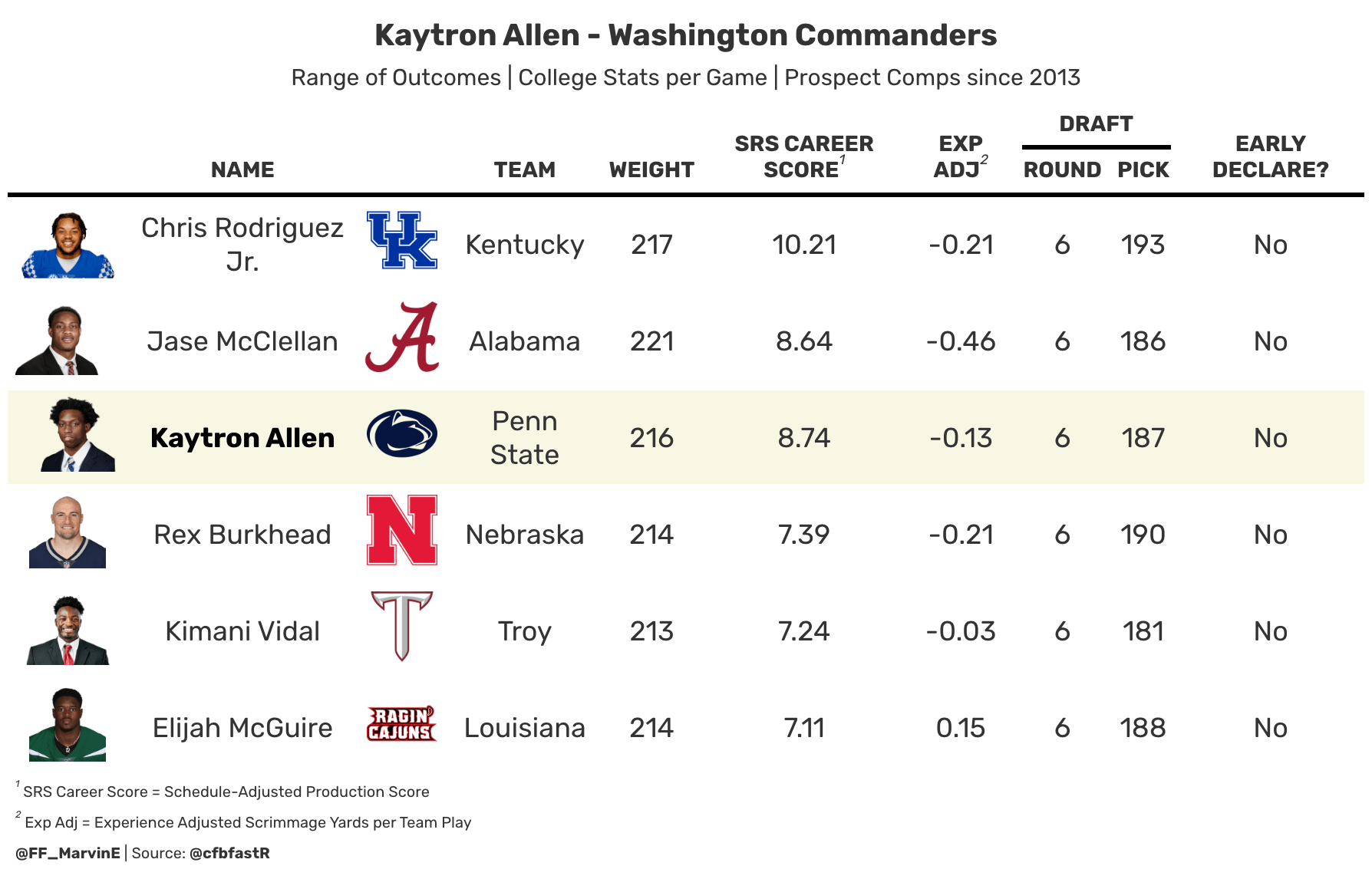
Kaytron Allen, out of Penn State, is yet another RB whose draft stock declined after initially being projected as an early-day two pick. Instead, he finds himself with the Washington Commanders after falling to the sixth round. Historically, the hit rate in round six is extremely low, averaging at 8.1% since 2013. And of the three RBs who have broken out, only Latavius Murray remained fantasy-relevant for an extended period of time. We see that clearly reflected in Allen’s comps above, as most of the players on this list were barely startable for dynasty managers. The most productive was Rex Burkhead, who produced multiple flex-level seasons with the New England Patriots. On a positive note, Allen joins a wide-open Commanders backfield that is looking for a long-term option at RB. Jacory Croskey-Merritt had an inconsistent rookie season, while Rachaad White and Jerome Ford are only signed to short-term deals. As a result, Allen emerging as their lead RB is certainly within the range of outcomes. However, while the landing spot is highly intriguing, keep in mind that his 32nd-percentile grade in my rookie model offers a very low floor from a dynasty perspective.
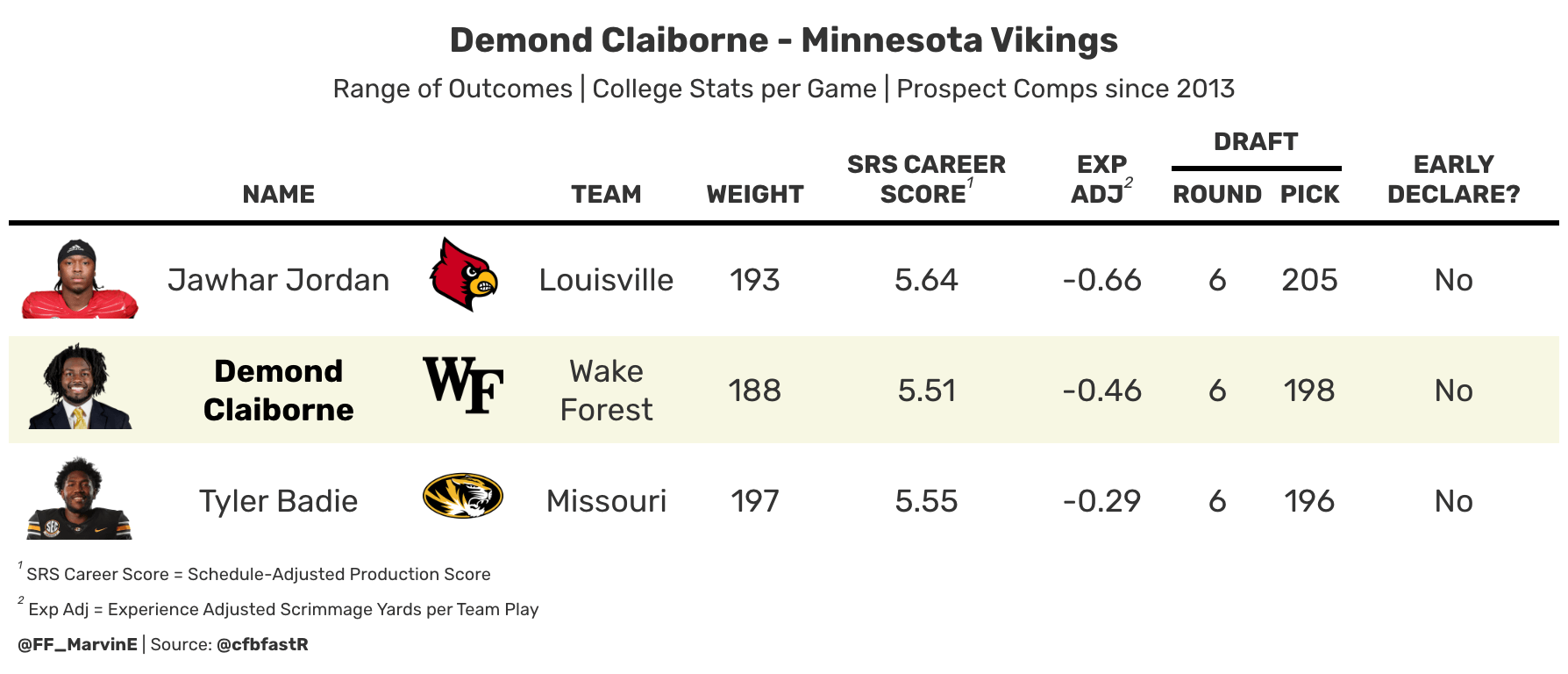
Demond Claiborne has been gaining steam in rookie drafts after being selected by the Minnesota Vikings in the sixth round. After all, he joins a depth chart that is led by Aaron Jones, who is almost 32 years old, and Jordan Mason. Considering they are both in the final year of their respective contracts, there is an opportunity for someone new to emerge as their RB1 in 2027. Until then, I still expect Jones and Mason to split carries in this offense as both RBs ranked within the top 16 in Rush Success Rate last season. On top of that, Mason was also the RB3 in Explosive Rush Rate (11.3%), behind only De’Von Achane and Blake Corum in 2025. As a result, barring an injury, Claiborne will likely remain the RB3 for the majority of the season. And while the backfield is open for taking in 2027, I would not be shocked if the Vikings drafted another RB in a much more talented 2027 class. In short, as a 23rd-percentile prospect in my rookie model, dynasty managers should temper expectations for Claiborne’s dynasty outlook.
Final Notes: To wrap this up, there are a few RBs in this class with distinct profiles that I couldn’t find direct comparisons for in my database. That includes the Baltimore Ravens’ Adam Randall, who enters the league with a 6th percentile schedule-adjusted production score. While his profile is partially skewed by a late positional switch from WR, his senior campaign remained highly underwhelming from a production standpoint. As a result, Randall only grades as a 28th-percentile prospect in my rookie model. On a more positive note, Eli Heidenreich had a similar trajectory at Navy, playing both RB and WR throughout his collegiate career. Unlike Randall, however, Heidenreich possesses one of the most efficient receiving profiles (99th percentile) in my database. In fact, because Heidenreich is essentially a WR among RBs, it is nearly impossible to find a player with a similar profile. Especially in PPR leagues, his receiving upside makes him one of my favorite late-round targets in dynasty drafts.