
The Path to a WR1 Season: Christian Watson (Fantasy Football)


Trust your gut in the offseason. For me, that means going all-in on Green Bay Packers WR Christian Watson. To skeptics, he is an injury-plagued fantasy trap. To truthers, he is a league-winning force multiplier preparing for a full-season runway.
The Packers made their stance clear with a four-year, $110.5M extension, cementing Watson as the primary anchor for QB Jordan Love‘s development. By analyzing his hyper-efficient 2025 sample and balancing his rare individual capability against a shifting team infrastructure, we can project a highly realistic path to a WR1 ceiling in 2026.
Editor’s Note: This profile is part of our annual Path to a Fantasy WR1 Season series. The goal is to determine the likelihood of a top-12 fantasy season from a number of off-the-wall candidates. For our methodology and an outline of the process, make sure you read the 2026 Path to WR1 Series Primer. Find out the full statistical projections for the Footballers Consensus WR1s in the Ultimate Draft Kit.
2025 Season Recap
The Numbers
| Season | G | GS | Tgt | Rec | Yds | Y/R | TD | 1D | R/G | Y/G | Ctch% | Y/Tgt |
| 2025 | 10 | 10 | 55 | 35 | 611 | 17.5 | 6 | 28 | 3.5 | 61.1 | 63.6 | 11.1 |
Evaluating Watson’s 2025 campaign requires separating raw surface metrics from true on-field efficiency. Skeptics point to a 35-reception, 611-yard box score as proof of a capped ceiling, leaning on the narrative that he has never topped 620 receiving yards. On paper, six TDs on 55 (!) targets scream TD-dependency.
But look closer at the context. Watson sat out the first six games of the season, executing a cautious post-ACL recovery track. Those stats were built in just 10 games. Scale that efficiency over a standard 17-game schedule, and his true pace looks completely different: 93 targets, 60 receptions, 1,038 yards, and 10 TDs. Keep in mind, this included four games with Malik Willis at QB.
A 13.2 PPR PPG pace establishes a strong WR2 baseline, but advanced metrics hint at an elite WR1 ceiling. Watson’s 88.5 PFF receiving grade ranked sixth among NFL WRs, and his 17.5 YPR ranked second. Jordan Love was lethal going downfield to Watson, turning an 18-yard aDOT into a spectacular 122.6 deep passer rating. Watson also proved his versatility across slot and screen concepts, finishing with an 86.7 overall offensive grade. The high-end talent is unquestionable—he just needs the volume.
The Path
The Target
Mapping out a true WR1 ceiling demands a clear mathematical anchor. Over the past three seasons, the low-end WR1 baseline has shown a stable historical blueprint, established by vertical threats and intermediate weapons like Nico Collins, Ladd McConkey, and Jameson Williams.
| Metric | G | Tgts | Recs | Yds | TD | YPR | Catch % | YPT | PPR FPts | PPG |
| 2023 Nico Collins | 15 | 109 | 80 | 1,297 | 8 | 16.2 | 73.4% | 11.9 | 257.7 | 17.2 |
| 2024 Ladd McConkey | 16 | 112 | 82 | 1,149 | 7 | 14 | 73.2% | 10.3 | 238.9 | 14.9 |
| 2025 Jameson Williams | 17 | 102 | 65 | 1,117 | 7 | 17.2 | 63.7% | 11 | 218.7 | 12.9 |
| 3-Year WR12 Average | 16 | 107.7 | 75.7 | 1,187.7 | 7.3 | 15.8 | 70.1% | 11.1 | 238.4 | 15 |
| Watson 2025 (17-G Pace) | 17 | 93.5 | 59.5 | 1,038.7 | 10.2 | 17.5 | 63.6% | 11.1 | 224.9 | 13.2 |
| Watson 2026 Projection | 17 | 121 | 82 | 1,272 | 9 | 15.5 | 61.7% | 10.5 | 263.2 | 15.5 |
Reaching that historical average of 238.4 PPR points means Watson needs a modest volume surge of two to three targets per game over his 2025 pace. Critics will call a 61.7% catch rate a fragile foundation for a high-volume asset, but the model proves his big-play variance can take a lower reception total and run with it. By pushing his volume to 132 targets in a consolidated hierarchy, a minor regression to 15.5 YPR still manufactures 263.2 PPR points (15.5 PPG)—vaulting him comfortably into the WR1 conversation.
Infrastructure Changes
David Reginek-Imagn Images
The most compelling reason to buy Watson in 2026 is the massive transformation of Green Bay’s offensive architecture. Over the past two seasons, Matt LaFleur’s high-rotation depth chart routinely diluted individual fantasy upside. That logjam has evaporated, paving the way for a highly concentrated passing distribution.
-
The Target Catalyst: Romeo Doubs (85 targets) is now a Patriot and Dontayvion Wicks (46 targets) is an Eagle, creating a 131-target vacuum. With only Watson, Jayden Reed, and sophomore Matthew Golden anchoring the primary WR room, Watson is locked into a career-high route participation rate.
-
The Schematic Blueprint: Vacated targets are only half the equation; the schematic fit unlocks the true ceiling. LaFleur’s outside zone foundation stretches defenses horizontally to set up vertical play-action shots and deep bootlegs. Watson’s unmatched deep speed and inside/outside versatility make him the ideal asset to trigger explosive gains on concepts like Dagger (which involves Seam, Drag, and Over routes), clearing his runway to be the explosive alpha of this passing offense.
Capability x Infrastructure
LaFleur’s scheme is built to weaponize vertical speed, but its execution remains tethered to a run-first philosophy. In 2025, Green Bay ranked near the bottom of the league with a -2.8% neutral Pass Rate Over Expected (PROE). While restricted passing volume typically caps pass-catchers, this infrastructure serves as the ultimate launchpad for Watson’s distinct Capability.
$110 million WR Christian Watsonpic.twitter.com/VIKlwHZyMI
— Ian Hartitz (@Ihartitz) June 4, 2026
He isn’t a traditional, static perimeter asset. Instead, with Jayden Reed locking down the slot and Matthew Golden developing, Watson functions as an all-formation chess piece. By pushing safeties deep, he isolates cornerbacks and cracks open the intermediate passing game. The on-field efficiency impact is undeniable:
-
Packers Offensive EPA/play with Watson: +0.088
-
Packers Offensive Efficiency without Watson: +0.024
The team is simply far more lethal with him on the field. From Week 11 onward, Watson’s target share surged to 24%, proving he is an alpha option regardless of his QB. In fact, his efficiency catalyzed Malik Willis’ lucrative offseason opportunity in Miami; during their four-game overlap, Willis logged a flawless 145.5 passer rating when targeting Watson, yielding an 85.7% catch rate for 422 yards and three TDs.
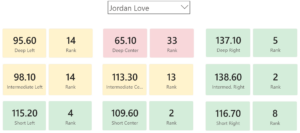
If he did that with Willis, what could he do with Love? Looking at Love’s passer rating per PFF at various areas of the field, we can see that he was very efficient. Even in the deep corners of the field, he ranked 14th or better (Min. 160 pass attempts). These deep corners are where those explosive Over and Go routes end up, which are strengths in Watson’s route tree.
Watson does not need to be a flawless route technician. His raw size-speed profile slows down defensive processing and commands heavy off-coverage cushions, giving him a massive edge on quick outs, curls, and slants that transform into explosive gains. He doesn’t require a 150-target buffet to clear a WR1 ceiling—his macro-efficiency handles the heavy lifting.
The Kraft Wrinkle
Let’s not forget about Tucker Kraft, who is returning from injury. He figures to return to that wonderful pre-injury trajectory from 2025. While they work very different areas of the field and in very different ways, Kraft will attract some of that desirable target volume in a low-density environment. On the surface, this is a net negative for Watson, but I think there is a sneaky schematic usage synergy here.
These two did not have much overlap, but during that two-week stint (Weeks 8-9), Watson had 71.5 YPG and an explosive 23.8 YPR while Kraft went off for 143 yards and two TDs on National TEs Day. This is more complimentary than many give credit. Simply put, defenses have to pick their poison between these two size mismatches on the field. The hope is that when they choose to focus on Kraft, Jordan Love makes them pay by connecting with Watson deep downfield.
Expectations and Recommendations
Assuming Watson plays 17 games, he should produce something like this:
- 132 targets
- 82 receptions
- 1272 yards
- 9 TDs
- 263.2 PPR FPts
This would be good enough for WR7 in 2025. If the injury demons continue to haunt Watson, he will have a bit of a cushion to still get above the WR1 entry threshold.
Conclusion

Junfu Han / USA TODAY NETWORK via Imagn Images
Christian Watson enters 2026 with massive financial backing, elite athletic traits, and a clear path to tier-breaking fantasy stardom. While injury history and Green Bay’s run-balanced volume present valid headwinds, the team’s concentrated passing attack clears the runway for an absolute breakout. Watson has already proven he can dominate with limited volume. With over 130 targets vacated, this is the year he operates as the true alpha WR the front office paid him to be.
Redraft Recommendation: Watson is currently valued as an affordable WR3 due to lingering health concerns and a misunderstanding of his 2025 volume limitations. If he remains active, he is an absolute smash-buy with WR1 upside at a major draft-day discount. Draft Watson aggressively as a high-ceiling WR2 in the 6th round. His elite weekly ceiling can win leagues, and the investment risk is fully insulated by his depressed cost.
Dynasty Recommendation: Green Bay’s extension locks Watson in as QB Jordan Love’s primary perimeter weapon through his physical prime. At 27, his athletic traits are fully mature, and correcting his hamstring asymmetry secures a stable long-term durability outlook. Buy now. Injury fatigue is living rent-free in your league-mates’ minds. Channel your inner Howie Roseman and exploit this market inefficiency by trading away secondary veteran assets or mid-round rookie capital to secure a certified WR1 ceiling.