
Fantasy Football Target Practice: The 2026 Green Bay Packers


For the past three seasons, Matt LaFleur and Jordan Love ran a “peanut butter spread” offense built on a frustrating brand of passing-game socialism. While forcing defenses to gameplan for five different weekly receiving leaders drove a real-life postseason run, it was a fantasy nightmare. A deep collection of young talent—Christian Watson, Jayden Reed, Romeo Doubs, Dontayvion Wicks, and Tucker Kraft—cannibalized each other’s weekly upside, leaving managers guessing who would score the game-winner and who would finish with a single target.
In the spring of 2026, the Packers’ front office moves may indicate that the era of passing-game socialism in Green Bay is officially over.
The departures of Romeo Doubs (four-year, $68M deal with the Patriots) and Dontayvion Wicks (traded to the Philadelphia Eagles on a one-year, $12.5M contract) show a violent consolidation. Rather than draft replacements, GM Brian Gutekunst chose to invest heavily in his core. These moves, combined with the lack of draft investment, instantly create a massive 138-target vacancy. Management’s moves were punctuated by signing Christian Watson to a lucrative four-year, $110.5M extension (featuring a $31M signing bonus) and securing Jayden Reed to a three-year, $50.25M extension.
Former first-round pick Matthew Golden has an opportunity for a sophomore leap, and All-Pro TE Tucker Kraft is targeting a Week 1 return from an ACL tear. Love’s passing game appears concentrated into a highly predictable, high-value hierarchy. In this edition of Target Practice, we break down the passing game environment, project the passing pie, and dissect the fantasy implications of Green Bay’s core offensive weapons.
1. The Macro View
By first analyzing the structural constraints of Matt LaFleur’s offense, we can begin to project the fantasy value of Green Bay’s pass-catchers. Since signing RB Josh Jacobs in 2024, the Packers have played a more run-focused brand of football. Green Bay’s pass rate under LaFleur has fluctuated from a pass-heavy 58.1% in 2023 down to a run-heavy 48.8% in 2024, before ticking back up to 51.3% in 2025.
However, several critical variables project a significant passing-game boost in 2026:
- The Backfield Legal Volatility: In late May 2026, Josh Jacob’s arrest introduced uncertainty. While the legal process plays out, Jacobs’ availability is in question. If he becomes unavailable, the Packers could be forced to shift away from their heavy ground attack, elevating passing volume.
- Extreme Target Concentration: PFF data reports the Packers’ top three wideouts accounted for just 45.2% of Love’s targets in 2024. With Wicks and Doubs now gone, Watson, Reed, and Golden represent the Packers’ only experienced WRs. They, alongside TE Tucker Kraft, project to command over 74% of the team’s total targets.
- Pace of Play Inflation: The Packers’ 2025 pace was sluggish, averaging just 59.4 plays per game (19th). With Jordan Love entering his prime and a consolidated receiving room, we project an increase to 60.5 plays per game, but more importantly, a pass rate jump to 53.5%, translating to a seasonal baseline of 550 pass attempts.

Mark J. Rebilas-Imagn Images
The Jordan Love Adjustment
Jordan Love drives Green Bay’s offensive efficiency. According to historical tracking from PFF, Love has improved his adjusted completion percentage in each of his three seasons as a starter: 2023 (72.9%) > 2024 (74.7%) > 2025 (77.6%)
Furthermore, his adjusted yards per pass attempt have steadily climbed from 7.4 to 8.0 and finally to 8.1 in 2025. Film-heavy analysis from The QB School highlights Love’s exceptional comfort inside the pocket, his off-platform arm talent, and his advanced processing of intermediate zone coverages.
The critical risk to Love’s QB1 projection is the transition of Green Bay’s offensive line. Former first-round tackle Jordan Morgan is finally stepping in at left tackle, and newly paid center Sean Rhyan must anchor an interior unit that struggled with pass-blocking efficiency in 2025. If they struggle, Love’s processing clock will shrink, forcing him to check down more frequently and capping the deep-ball opportunities that drive his fantasy ceiling.
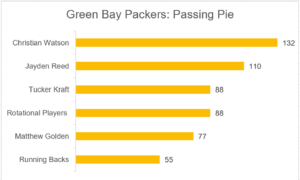
2026 Projected Passing Pie: 550 Pass Attempts
LaFleur’s historical tendencies and a consolidated roster line up a massive 2026 campaign for Jordan Love: 350 completions on 550 attempts for 4,332 yards and 32 TDs. Here is how the target pie is distributed:
2. Target Beneficiaries: Capability x Infrastructure
Christian Watson: The Consolidated Alpha WR1
- Expected Role: Perimeter Alpha X Vertical Threat
- 2026 Projection: 132 tgts | 24.0% tgt share | 79 recs | 1,224 rec yds | 10 TDs | 261.4 FPts
The Optimism: In 2026, I am betting on Watson’s high-end athletic profile. Standing 6’4” and 208 lbs with 4.36 speed, he possesses a true athletic ceiling of a top NFL WR. When on the field in 2025, Watson was remarkably efficient. In 10 games, he posted 611 receiving yards and six TDs, averaging 17 yards per catch (fourth*) and a top-tier 2.28 YPRR (10th*). His 17.4-yard aDOT (third*) gives Love a premier vertical weapon who routinely breaks defensive caps. Watson can do more than terrorize the perimeter; last season saw many highlight plays in the intermediate middle of the field (MOF).
* minimum 50 targets
$110 million WR Christian Watsonpic.twitter.com/VIKlwHZyMI
— Ian Hartitz (@Ihartitz) June 4, 2026
The Critique: Watson’s availability may cause pause. His lower-body durability is an existential reality in our risk calculus. His specialized training at UW-Madison’s Badger Athletic Performance Center reduced his strength asymmetry from ~20% to 10-12%, but doubts may still linger. He is worth the risk as the re-injury potential is baked into his FantasyPros ADP at 55th overall (WR27). Beyond injury, the previously mentioned pass-protection risk could choke out Watson’s vertical route tree, turning him into a volatile, TD-dependent fantasy asset.
Jayden Reed: The High-Efficiency Slot Sparkplug
- Expected Role: Slot receiver, pre-snap motion chess piece, and quick-passing engine
- 2026 Projection: 110 tgts | 20.0% tgt share | 72 recs | 972 rec yds | 8 TDs | 217.2 FPts
The Optimism: Jayden Reed’s explosive profile excels as a dynamic slot receiver, meeting an under-center play-action scheme that leverages his high-efficiency capability. In his sophomore campaign, Reed posted a team-high 857 receiving yards with a 15.6-yard average, with six TDs, ranking in the top six among all NFL receivers with 11.4 yards per target. If TE Tucker Kraft’s recovery is delayed at all, the MOF is wide open for Reed to dominate intermediate targets and maximize his YAC ability. Jordan Love could look to Reed as his premium hot-read, ensuring a safe PPR floor with low-end WR1 upside.
The Critique: Reed’s fantasy ceiling remains capped by slot exclusivity (70% career usage) and cumulative injuries increasing availability risk. Heavy slot usage means Reed is on the sideline in heavy personnel sets, thus fewer snaps. After missing the majority of 2025 on IR following a Week 2 collarbone fracture, Reed underwent additional surgery to repair a foot Jones fracture. While his late-season return was efficient—catching 16 of 17 targets over his final five games—lingering foot issues or a Matthew Golden rise could threaten his playing time, trapping Reed in a low-volume WR3 role.
Mike Dinovo-Imagn Images
Matthew Golden: The Sophomore First-Round Breakout
- Expected Role: Primary “Z” WR3
- Stat Projections: 77 tgts | 14.0% tgt share | 45 recs | 590 yds | 4 TDs | 128.0 FPts
The Optimism: Golden represents a deviation from Packers’ philosophy as the franchise’s first first-round wideout since Javon Walker in 2002. Golden possesses elite speed—running a 4.29-second 40-yard dash with an explosive 1.49-second 10-yard split at 191 lbs. Given the capital, the Packers will ensure Golden has every opportunity. With a modest, injury-plagued rookie season in a crowded WR room, he still flashed explosive talent in the Wild Card game against the Chicago Bears. This four-catch, 84-yard, and one-TD performance was something that LaFleur believes was “just a glimpse” of Golden’s capability. Perhaps a Year 2 leap from the Texas product is incoming.
Every Matthew Golden touch against the Bengals…
It's happening. pic.twitter.com/ga50G5Z4h8
— Eli Berkovits (@BookOfEli_NFL) October 13, 2025
The Critique: Kalon Barnes, Jerome Mathis, Brenen Thompson, John Ross III, Xavier Worthy… These are the names I think about when any unproven WR’s most prominent trait is sub-4.3 speed. Even with the optimism of vacant target opportunity, right now, Golden is closer to these names than a 2026 breakout. His rookie metrics were inefficient, putting his sophomore leap in doubt. Per PFF, Golden’s TPRR sat at ~16%, and his YPRR vs Zone was a low 1.48. The NFL’s high percentage of Zone defense demands Golden improve here. If he struggles to prosecute soft spots, Love will continue to prefer other options, including our next player.
Tucker Kraft: The All-Pro TE Recovery
- Expected Role: In-line/seam-stretching “move” TE and high-value possession and red-zone weapon
- Stat Projections: 88 tgts | 16.0% tgt share | 63 recs | 770 yds | 6 TDs | 176.0 FPts
The Optimism: Kraft carries high excitement for me as one of the most dangerous YAC TEs in the NFL. Before his ACL injury, Kraft was dominating, averaging a 14.3 YPR and logging an elite 9.6 yards after contact per reception compared to Trey McBride‘s 4.7. He is a devastating seam-stretcher who uses his massive 6-foot-5, 259-pound frame to box out defenders and break arm tackles with ease. LaFleur’s system ran 33.76% 12-personnel looks, giving Kraft many opportunities to leverage his ability. If Kraft returns to form, he will hardly leave the field. Love will lean on Kraft, who had a 70% first down conversion rate (12/17), 4 TDs (third), and a league-leading 4.16 YPRR vs Man looks in 2025 (min. 30 targets).
7 catches.
143 yards.
2 TDs.Tucker Kraft wrapped up National Tight Ends Day with a BANG 🙌 pic.twitter.com/WTu7EMgLUQ
— NFL (@NFL) October 27, 2025
The Critique: Perhaps the Packers are cursed with injuries. The injury issue has been a primary hurdle for most of these players to succeed. The reality is that the ACL recovery timeline is a critical obstacle to Kraft’s 2026 upside. While GM Gutekunst noted that Kraft is ahead of schedule in his rehab, players returning from late-season ligament tears often face a slow start to the season or risk opening on the PUP list. Do not concern yourself with early Luke Musgrave performances during Kraft’s early absence. The drop in production was palpable in 2025.
The Backfield: Josh Jacobs, MarShawn Lloyd, & Chris Brooks
- Expected Role: Feature Jacobs as a 3-down RB or committee of Lloyd and Brooks
- Stat Projections: 55 tgts | 10.0% tgt share | 41 recs | 340 yds | 2 TDs | 87.0 FPts
The Optimism: Prudence dictates we plan for a Jacobs absence. Historically, the starting RB in LaFleur’s system has been a highly productive asset in the passing game, creating an elite opportunity for sophomore back MarShawn Lloyd. If Jacobs is suspended or released, the starting role is assumed to fall to Lloyd, a 2024 third-round pick who possesses explosive and high-end athletic traits, including a 179.3 PFF elusive rating in his final year at USC. If he can seize the job, his dynamic playmaking profile could fill a featured role well.
The Critique: Injury concerns would be a valid claim here, considering Lloyd’s history, but the injury bug would be a cop-out here. The downside for Lloyd is the third-down and checkdown opportunities. Lloyd lacks a compelling receiving profile, and his backfield teammate, Chris Brooks, is reportedly a good pass protector. This could lock him into obvious passing downs over Lloyd, reducing any hope of pass-catching upside. At the end of the day, neither Brooks nor Lloyd has a prominent pass-catching resume. More likely, Jacobs’ absence benefits Jayden Reed more than either portion of this likely committee.
3. Target Projection Summary
| Player | Position | Targets | Receptions | Yards | TDs | Target Share % |
| Christian Watson | WR | 132 | 79 | 1,224 | 10 | 24% |
| Jayden Reed | WR | 110 | 72 | 972 | 8 | 20% |
| Tucker Kraft | TE | 88 | 63 | 770 | 6 | 16% |
| Matthew Golden | WR | 77 | 45 | 590 | 4 | 14% |
| Backfield (Jacobs/ Lloyd/ Brooks) | RB | 55 | 41 | 340 | 2 | 10% |
| Rotaional Players | WR/TE | 88 | 32 | 345 | 2 | 16% |
| TOTAL | 550 | 332 | 4,241 | 32 | 100% |
4. The Fantasy Strategy
Christian Watson: Watson is a smash-buy. If the leg strength asymmetry training has truly cured his hamstring issues, his consolidated high-value target share in this offense makes him a locked-in candidate for a mid-WR2 to low-end WR1 fantasy finish.
Jayden Reed: Reed profiles as a solid WR2/WR3. He could be one of the most efficient receivers in 2026, but his slot-exclusive role limits his raw snap ceiling, making him a high-floor PPR option.
Matthew Golden: Golden is a late-round breakout target. With 131 vacated targets and the backing of Matt LaFleur, he is the definition of a ‘Sleeper’ in that the chances of massive upside appear low, but he could pop if his capability, the infrastructure, and the situation collide in a perfect storm.
Tucker Kraft: Kraft represents a high-risk, high-reward TE1. Keep your eyes peeled for news regarding his ACL recovery this summer; however, I would buy now if you can at a suppressed price. His elite marks vs Man and virtual necessity in this offense are a sensible bet.
MarShawn Lloyd / Chris Brooks: Either could be a good handcuff option from a rushing perspective. We will all be keeping a close eye on the Jacobs legal situation. A suspension would instantly elevate one of these RBs into a low-end RB2 draft target due to a lack of proven receiving ability. If it ends up being a legit committee, I would bet on Chris Brooks‘ snap-earning ability in pass protection on obvious passing downs.
Comments
Great article, enjoyed reading this.
I am hopeful we get the targets condensed to this group, will be interesting if they find some random WR’s to throw in there to make things difficult.