
Dynasty Range of Outcomes: 2026 TE Class (Fantasy Football)


Welcome back to the Dynasty Range of Outcomes series!
This article will take a deeper look at this year’s TE class by utilizing historical prospect data to identify which players are more likely to break out in the NFL. By finding TEs with similar draft capital and production, we can project a player’s potential trajectory as they enter the NFL.
To quickly recap, we will keep the analysis relatively simple by using four data points to find players that most resemble the 2026 rookie class:
- Draft Capital: Draft capital is the most predictive metric. Players selected earlier in the NFL draft are more likely to receive significant playing time and become valuable assets for dynasty managers. Draft capital also represents a team’s investment in a player, which is why day three TEs are often easily replaced.
- Career Production: While there are a few exceptions, players who dominate in college usually produce at the NFL level. In fact, we consistently see higher hit rates when we control the sample size for draft capital and production. Unlike previous versions of this article, this year I will leverage my model’s schedule-adjusted production score, which combines a player’s career EPA per Opportunity, their best season in Receiving Yards per Team Pass Attempt, and SRS College School Rating into one holistic metric. To find players with similar production profiles, our analysis will apply a 15% to 20% threshold in both directions.
- Declare Status: Players entering the league within three years of graduating from high school are considered early-declare prospects. Why does this matter? Historically, early declare TEs have averaged higher breakout rates in the NFL. This comes as no surprise, as the most talented prospects enter the league as soon as they are eligible after achieving significant success at the collegiate level.
- Weight: This data point has one of the lowest correlations to fantasy production. However, it makes sense to filter by weight to avoid comparing a Jordan Addison to Drake London, who is over 40 pounds heavier. In this analysis, we will apply a five-to-ten-pound threshold in both directions to identify players with similar body types.
For a more detailed breakdown of these metrics, check out our series primer. If you have any questions, feel free to reach out on Twitter @FF_MarvinE. Let’s dive into the 2026 TE class!
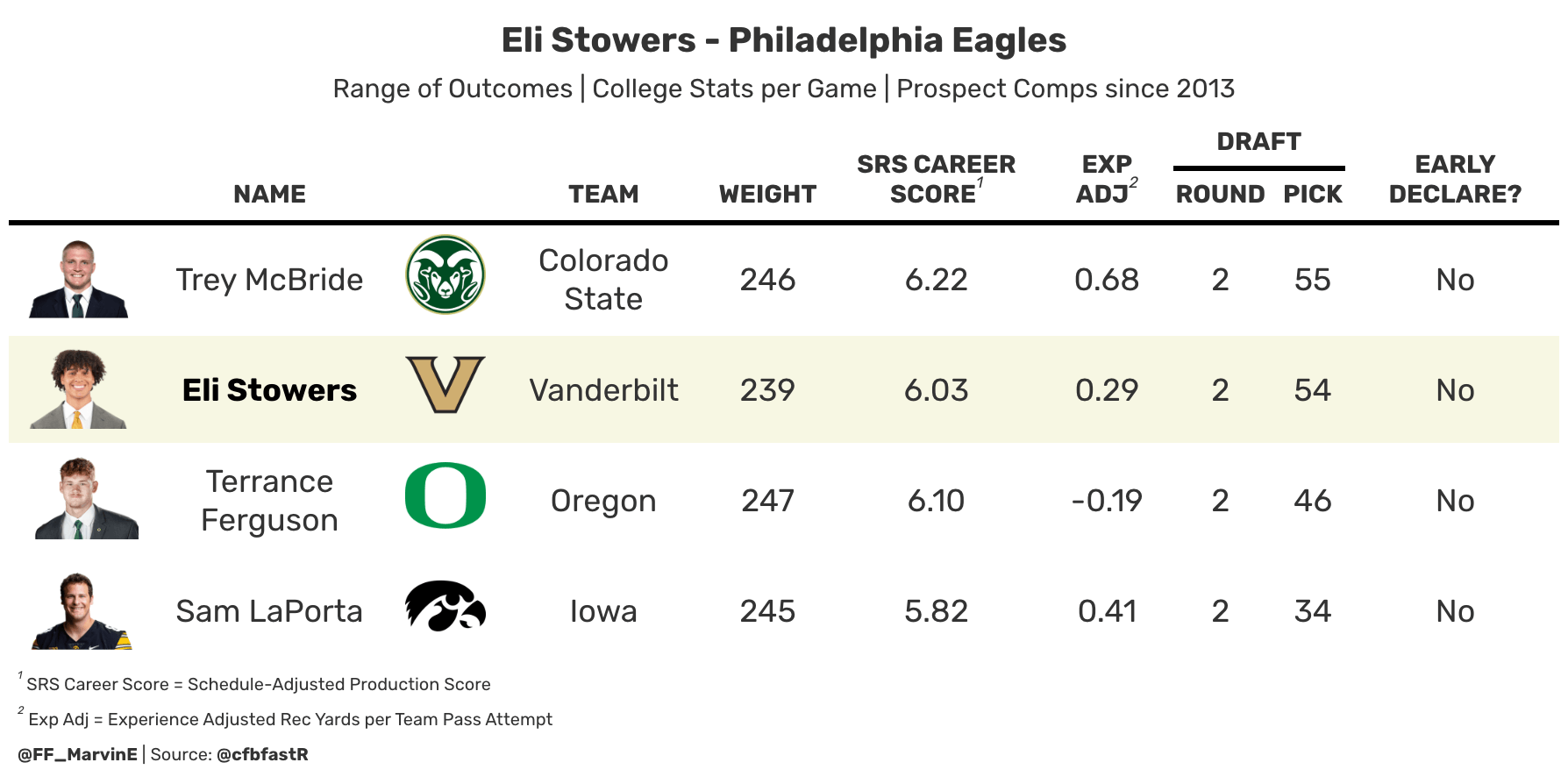
Eli Stowers joins the NFL after a unique career path. After starting his collegiate journey as a QB for both Texas A&M and New Mexico State, Stowers eventually transitioned to TE and flourished following his move to Vanderbilt. His 2024 production was truly elite, as he secured first-team All-SEC honors while commanding an impressive 27.5% market share of his team’s receiving yards. And in his final season, he maintained his impressive production, posting a 97th-percentile campaign with Vanderbilt in 2025. On top of that, Stowers leads this class in Yards per Route Run (2.34), highlighting his elite efficiency throughout his career. Fast forward to this off-season, and he now lands with the Philadelphia Eagles after being selected in the second round. Naturally, we immediately think of the presence of Dallas Goedert, who could limit his opportunity early in his career. However, considering Stowers’ receiving versatility, I would not be shocked to see him utilized all over the formation. To provide an even more optimistic perspective, Stowers ranks in the 88th percentile in my rookie model. While he narrowly misses the 90th percentile mark, he still grades very closely to Trey McBride (92nd percentile) and Sam LaPorta (93rd percentile), two players who also finished their college careers with positive experience-adjusted production. Coupled with an elite athletic profile, Stowers possesses significant upside if and when he emerges as the Eagles’ TE1.
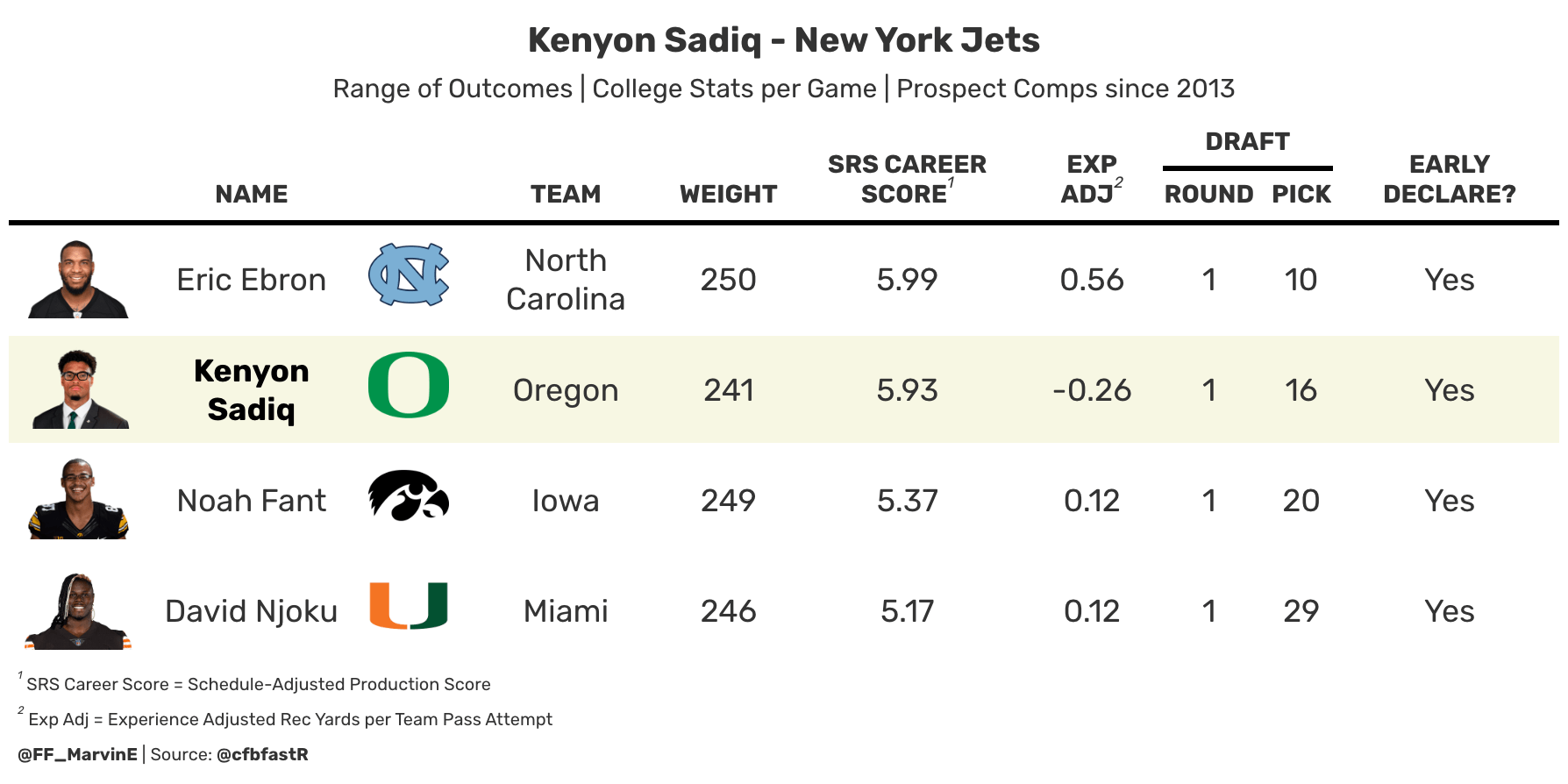
Kenyon Sadiq entered the league as a polarizing TE1. Despite being a first-round selection for the New York Jets, many dynasty managers remain skeptical of his rookie ADP. This hesitation stems from a production profile that is a significant outlier for a day-one selection. Sadiq never exceeded a 20% market share of his team’s receiving yards, topping out at just 15.2% during his 2025 season. As a result, he possesses a 51st-percentile experience-adjusted production score—a concerning mark compared to other first-round prospects. It is important to note, though, that Sadiq’s opportunities were limited in part because of the talent around him. Not only did he play alongside Terrance Ferguson, Troy Franklin, and Tez Johnson, but he also shared targets with Jamari Johnson, a potential first-round TE in the 2027 NFL Draft. On a positive note, when given the opportunity, Sadiq averaged an elite 131.4 QB Rating when targeted, ranking in the 95th percentile in this metric. And when we also account for his mid-first-round capital and elite athletic traits (which are equally predictive for TE prospects), Sadiq ultimately grades as a 95th-percentile prospect. As you can see above, his list of historical comps illustrates both the risk and the reward of his profile. While Noah Fant has struggled to meet expectations and Eric Ebron has only produced one TE1 season, his ceiling is best represented by David Njoku, who has finished as a top-10 fantasy TE multiple times in recent seasons. On top of that, 94% of TEs who grade above the 90th percentile have produced at least one top-12 campaign in their NFL career. In short, despite the production concerns, Sadiq offers TE1 upside as he looks to establish himself as the second receiving option for the Jets behind Garrett Wilson.
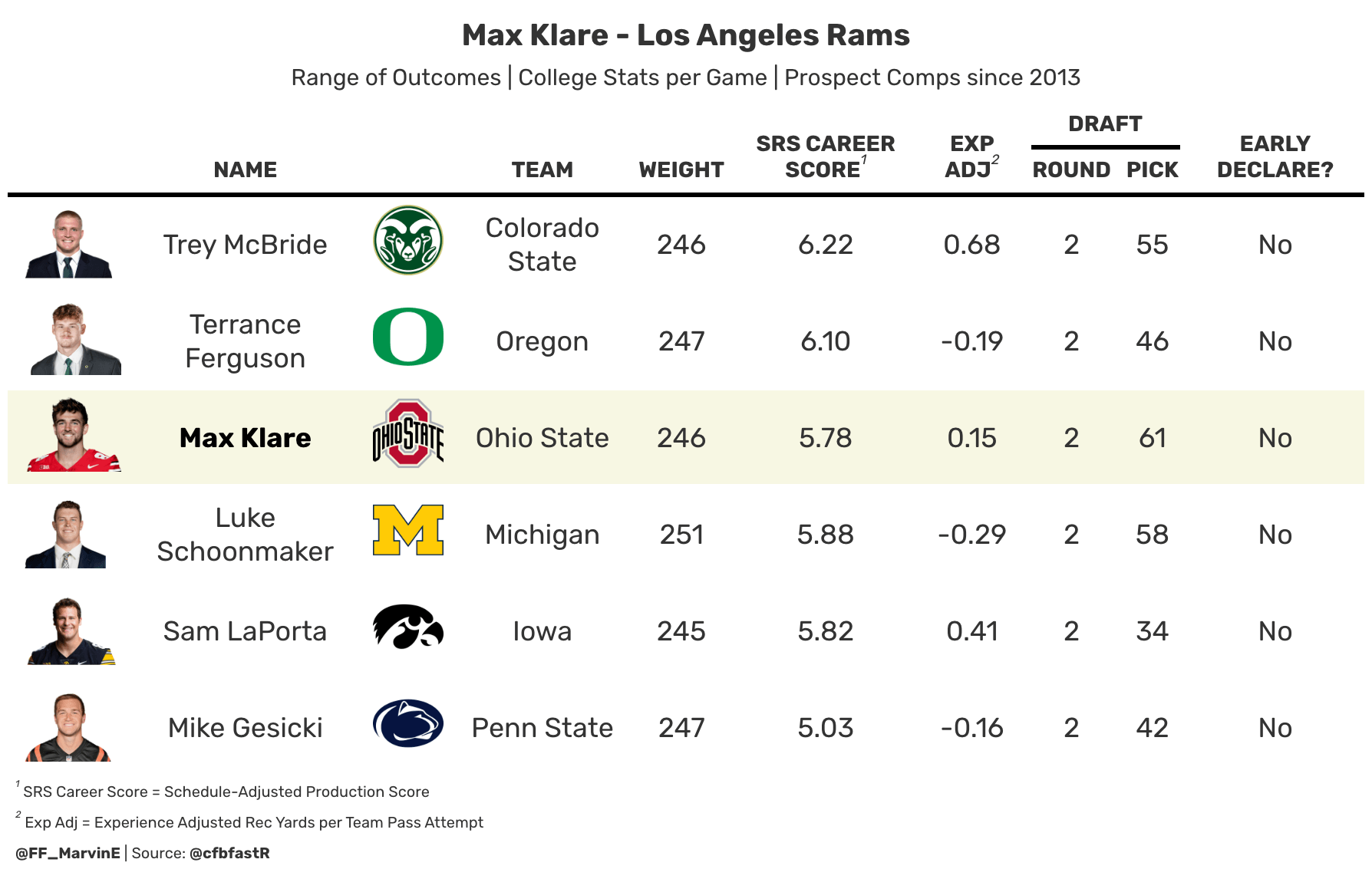
Max Klare enters the NFL as a second-round pick for the Los Angeles Rams after a four-year collegiate career with Purdue and Ohio State. From a landing spot perspective, dynasty managers may have valid concerns regarding Klare’s immediate volume, as he joins a roster already featuring multiple established receivers. On top of that, the Rams recently added Terrance Ferguson, who commanded similar draft capital just a year ago. Interestingly, both players grade nearly identically in my model, though Klare maintains a minor advantage with an 85th-percentile grade. Despite the murky depth chart, Klare’s statistical profile remains highly encouraging. Specifically, his 2.08 Receiving Yards per Team Pass Attempt in 2024 ranks in the 95th percentile, representing the second-highest single-season mark among TEs in this class. Furthermore, he belongs to a group of just five 2026 prospects with positive experience-adjusted production—a subset that historically yields much higher success rates at the next level. Thanks to this top-tier production, his historical comps include several TE1 producers like Trey McBride, Sam LaPorta, and Mike Gesicki. So while I am tempering expectations given the Rams’ crowded rotation, Klare’s profile suggests significant ceiling, making him a potential value at his current rookie ADP.
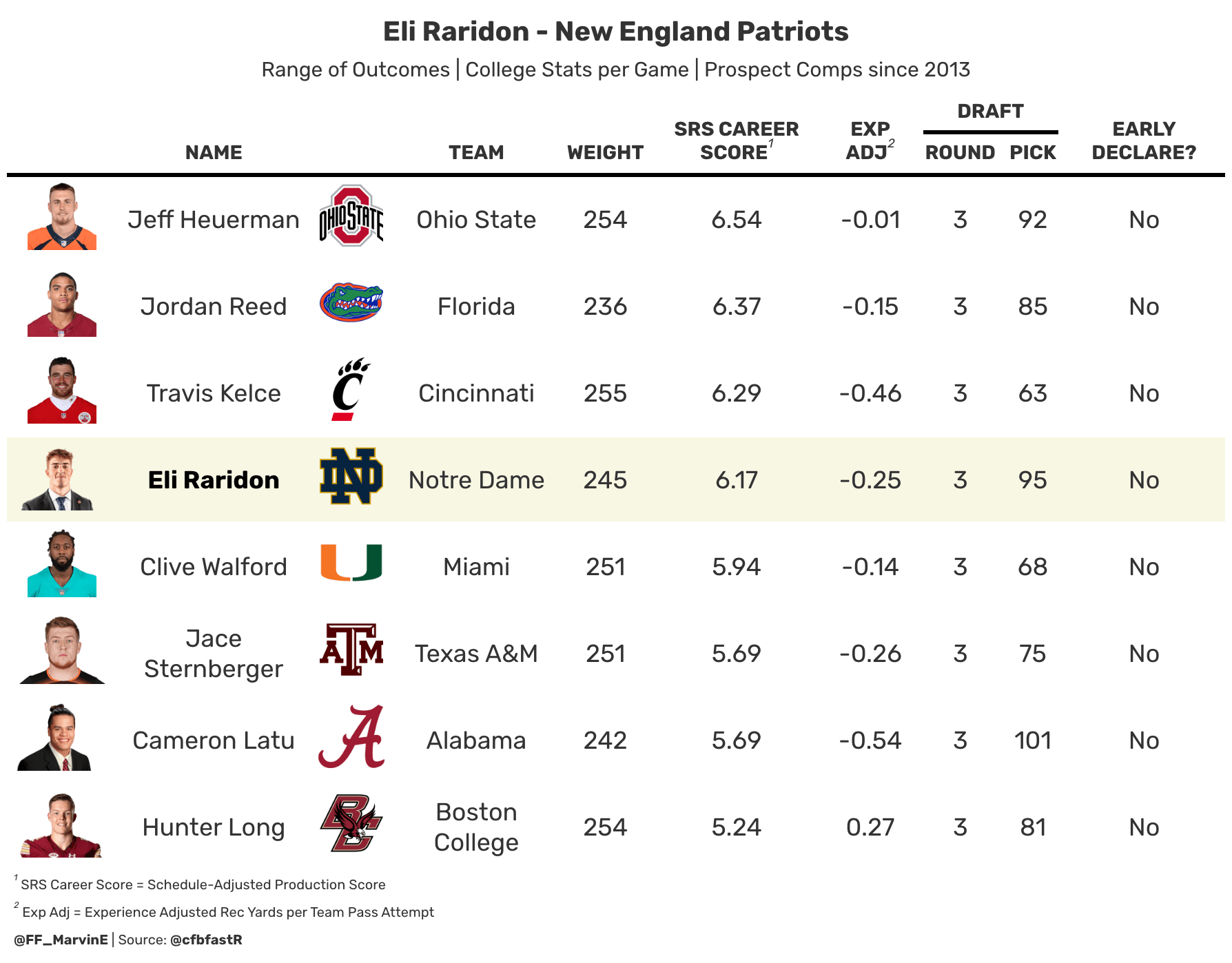
A four-year prospect out of Notre Dame, Eli Raridon was selected in the third round by the New England Patriots. This comes after his breakout season in 2025, in which he averaged 1.80 receiving yards per team pass attempt with the Fighting Irish. When we also factor in team ecosystem and strength of schedule, he enters the NFL with an 87th-percentile SRS Production Score (6.17). Why does this matter? Historically, TEs selected in the third round have only produced a breakout season at a concerning 20% clip. However, the outlook improves significantly for prospects who boast an SRS score above the 75th percentile, as they have averaged a breakout rate of 50%. Considering Raridon exceeds that threshold, history suggests he could develop into a fantasy-relevant asset. This upside is also evident in his historical comps, as he grades remarkably close to Jordan Reed and Travis Kelce. While the list also suggests a lower floor, Raridon possesses a clear path to becoming the Patriots’ TE1, particularly with Hunter Henry entering the final year of his contract.
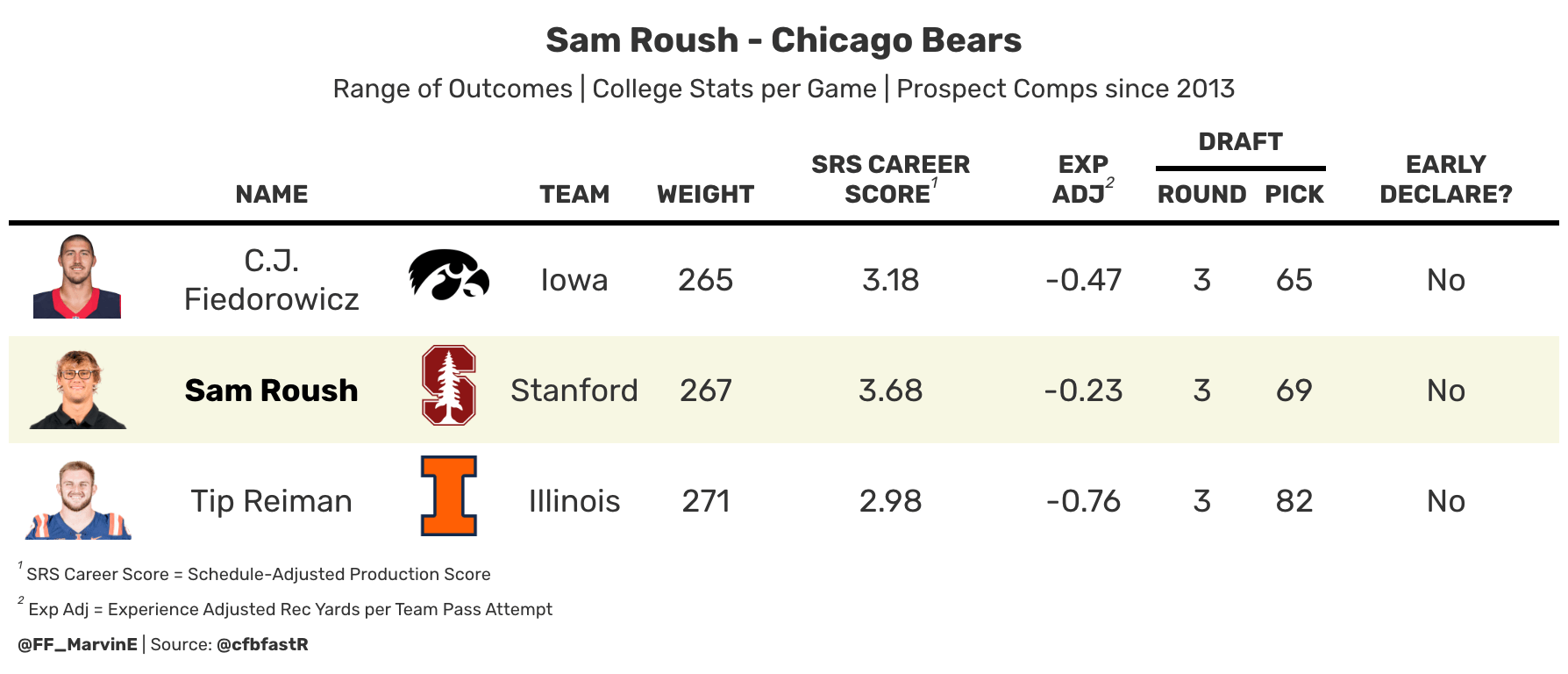
Sam Roush had one of the more successful pre-draft processes, improving his draft stock significantly after a stellar performance at the NFL Combine. As a result, Roush was selected in the third round by the Chicago Bears. Naturally, this was one of the worst landing spots for any prospect, considering the Bears already have two reliable receiving TEs in Cole Kmet and Colston Loveland. Beyond the depth-chart concerns, Roush’s collegiate production at Stanford was also uninspiring, resulting in an SRS score in the 19th percentile. His lack of analytical upside, combined with the presence of a healthy Kmet and Loveland, suggests that Roush is unlikely to carve out a meaningful role in the Bears’ passing game, severely limiting his upside for dynasty managers.
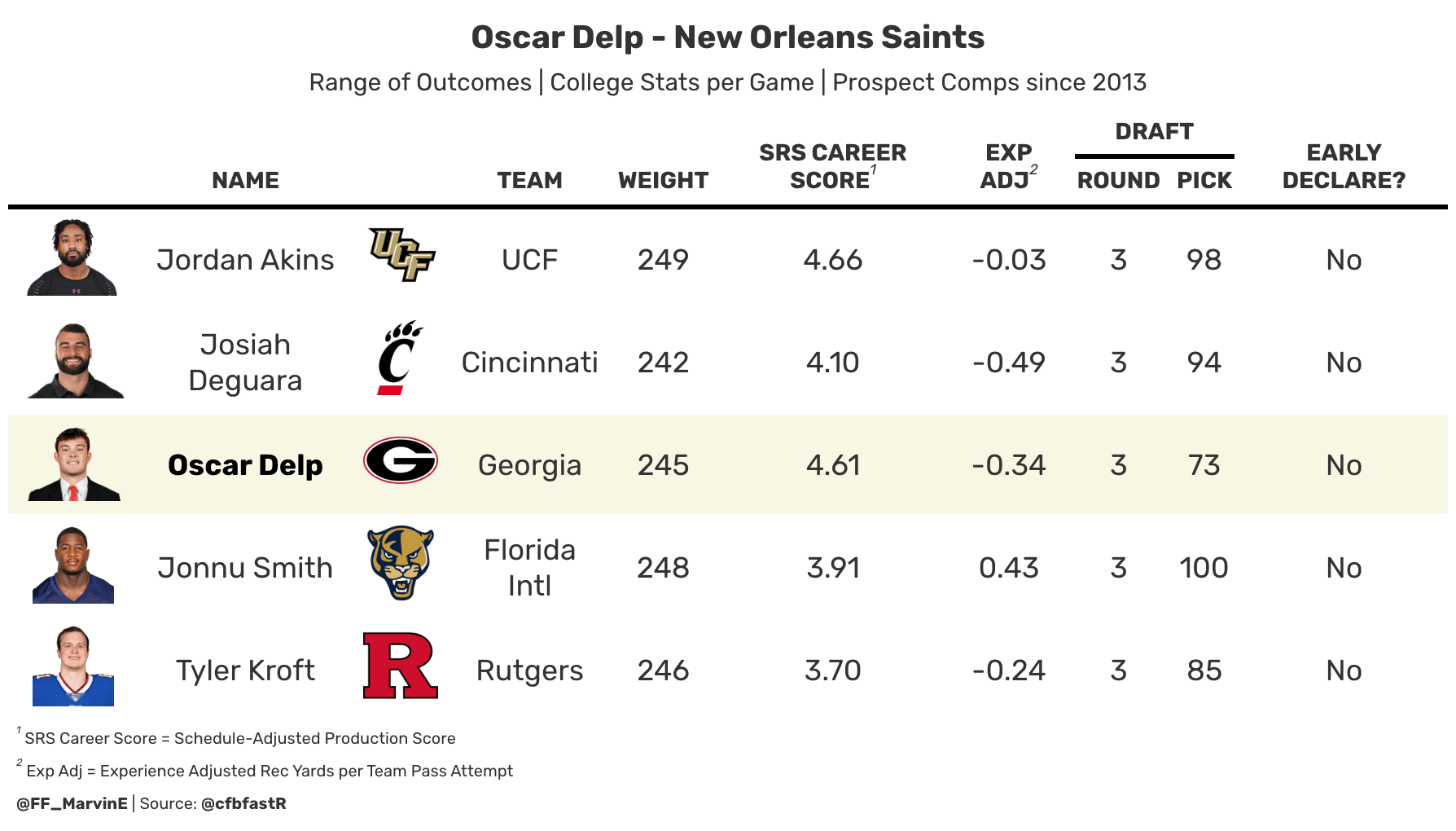
Similar to Roush, Oscar Delp has one of the most intriguing athletic profiles in this class, ranking in the +90th percentile in multiple metrics. Unfortunately, his production profile was very underwhelming despite playing for a successful Georgia team. While he did play behind Brock Bowers to start his career, Delp’s inability to break out in his final two seasons (without Bowers in the lineup) is the main reason he finished with a 47th percentile SRS career score. To put that into context, third-round prospects who failed to cross the 50th percentile in my production score have only averaged a 7% breakout rate in the NFL. We can see that clearly depicted in his player comps above, as three of the four players listed have failed to emerge at the next level. On a positive note, Jonnu Smith represents some upside after producing multiple TE1 seasons throughout his career. As a result, while Delp’s athletic ability is very tantalizing, I am still tempering expectations for his dynasty outlook.
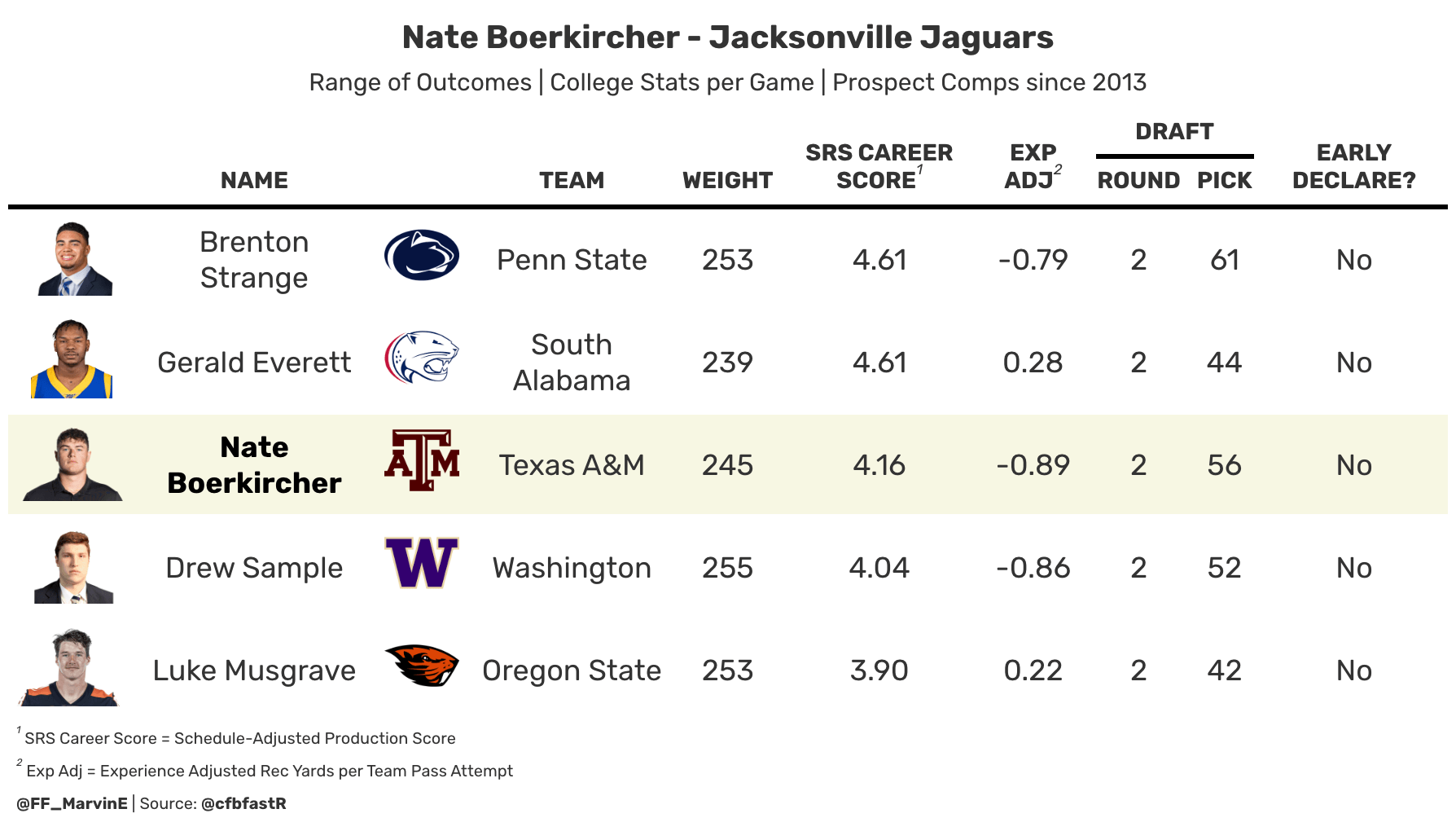
If there is one recurring takeaway from this year’s analysis, it is that collegiate production is a critical indicator for TE prospects. As a result, it should not come as a surprise that Nate Boerkircher’s outlook is fairly bleak, considering he enters the NFL with only a 33rd-percentile SRS Career Score. For starters, he enters the league as a five-year prospect who struggled to find his footing at both Nebraska and Texas A&M. Even during his peak collegiate campaign, he only managed a meager 11% market share of his team’s receiving production. To provide perspective, we generally look for TEs to surpass a 20% threshold, which signals their potential as a primary receiving weapon. Consequently, his low floor is glaringly evident in his historical comps, which include several players who failed to transition successfully to the NFL. Ironically, Boerkircher now lands in Jacksonville alongside Brenton Strange, who currently projects as the Jaguars’ primary TE1 for the 2026 season. Given his lackluster production profile and limited analytical upside, I have very little confidence that Boerkircher will develop into a fantasy-relevant asset for dynasty rosters.
Final Thoughts & Day Three TE Prospects
Hopefully, this article provided some insight into what matters at the TE position. While athletic measurables and, especially, draft capital are highly predictive of NFL success, college production is equally important when evaluating TE prospects. And even though I did not explicitly mention them in this article, Marlin Klein and Will Kacmarek fall into the category of underwhelming producers, lowering their upside as fantasy TEs despite receiving day-two capital. Lastly, we have to keep in mind the significant drop-off in hit rates for day-three prospects. Since 2013, only 4.8% of day-three TEs have produced a TE1 season in the NFL. In other words, it is very rare for a player with non-premium capital to emerge for fantasy football. Digging deeper into the data, TE prospects with an SRS career production score below the 50th percentile have averaged a meager 2% breakout rate, whereas those exceeding that mark have broken out at an 11.5% clip. Among that group, Justin Joly and Matthew Hibner stand out as the highest-graded players in my model. While history suggests their probability of emerging remains low, both TEs offer intriguing value for dynasty managers given their affordable rookie ADP.