
Dynasty Report: An Early Look At The 2027 RB Class (Fantasy Football)


Coming off a 2025 class that featured Ashton Jeanty, Omarion Hampton, Quinshon Judkins and TreVeyon Henderson, the 2026 draft proved to be one of the shallowest groups in recent memory. While Jeremiyah Love shined as an elite 97th-percentile prospect, the talent pool cratered quickly thereafter, with RB2 Jadarian Price landing in just the 77th percentile. To put that into perspective, the 2026 class represents the widest gap between the top two RBs in my rookie model since 2013, underscoring a significant lack of high-end depth. Fortunately for dynasty managers, the 2027 draft looks to be a massive bounce-back year, with several RBs projected in the first three rounds of the NFL draft. In addition, from an analytical perspective, multiple RBs are projected to finish their careers with positive experience-adjusted production, a threshold that typically signifies a higher breakout rate in the NFL. For comparison, Jeremiyah Love was the only RB prospect who met that threshold in the 2026 draft. With that in mind, let’s take an early look at the most productive 2027 RB prospects who could have an immediate impact for dynasty managers.
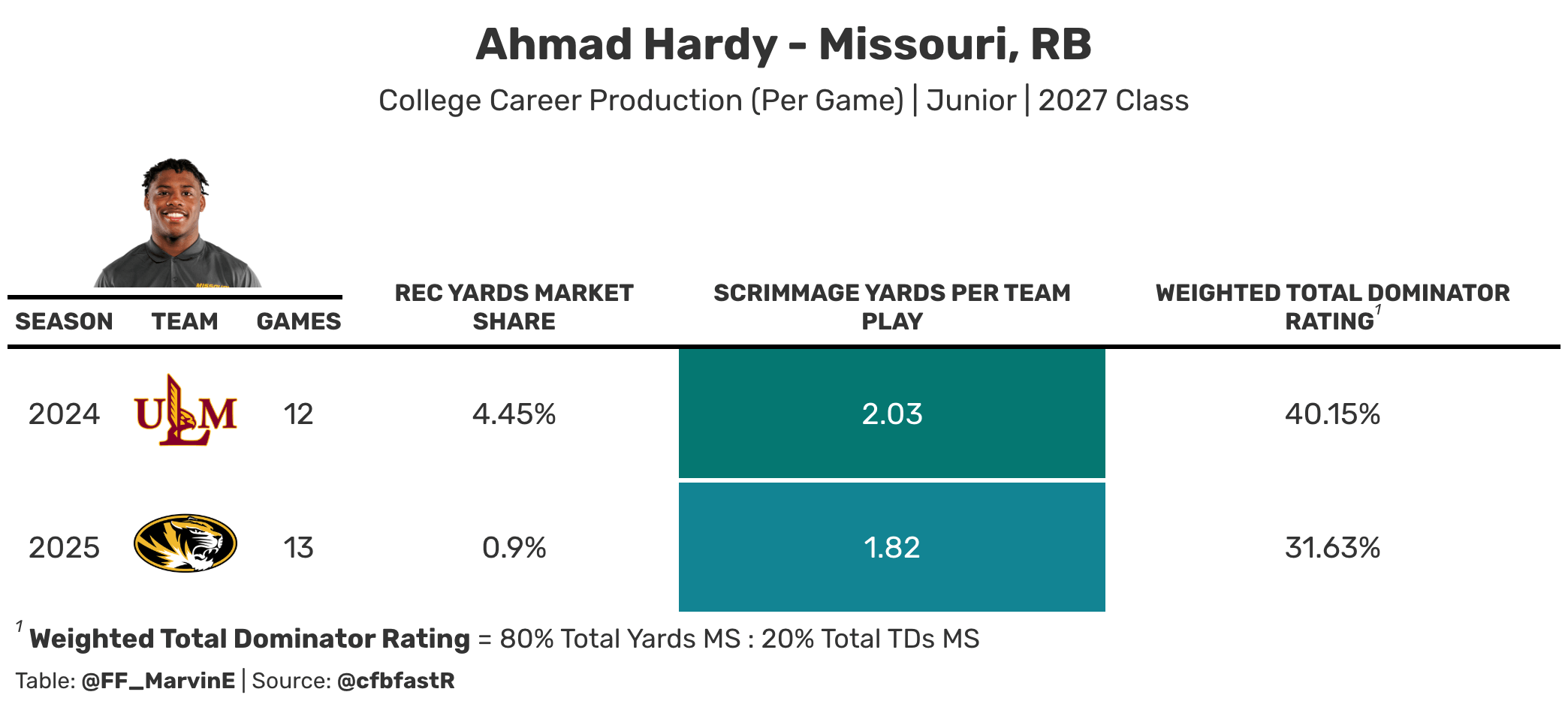
By far the most accomplished RB in the 2027 class is Ahmad Hardy, a powerful and shifty prospect who dominated the college football landscape over the last two years. Hardy’s journey began at UL Monroe, where he delivered one of the most prolific freshman campaigns in recent history, ranking in the 99.5th percentile with 2.03 Scrimmage Yards per Team Play. To put his production into perspective, he managed to outproduce the freshman seasons of Saquon Barkley, Nick Chubb, and Jonathan Taylor, three elite prospects who were immediate producers at the collegiate level. After operating as the focal point of the Warhawks’ offense and earning All-Sun Belt honors, Hardy transferred to Missouri for the 2025 season. Immediately taking over as their RB1, he accounted for over 30% of Missouri’s offensive production, ranking in the 87th percentile with 1.82 Yards per Team Play. And while he failed to surpass his freshman season production, he was still one of the most efficient RBs in college football last season. In short, after two dominant campaigns, Hardy is on track to be one of the top prospects in next year’s class. Especially if he is selected in the first two rounds of the NFL Draft, Hardy projects as a 95th-percentile prospect in my rookie model, grading very similarly to Joe Mixon, Nick Chubb, and Melvin Gordon. Assuming his injury does not linger into the season, Hardy should find plenty of success in his Junior campaign as he cements his status as the overall RB1 in the 2027 class.
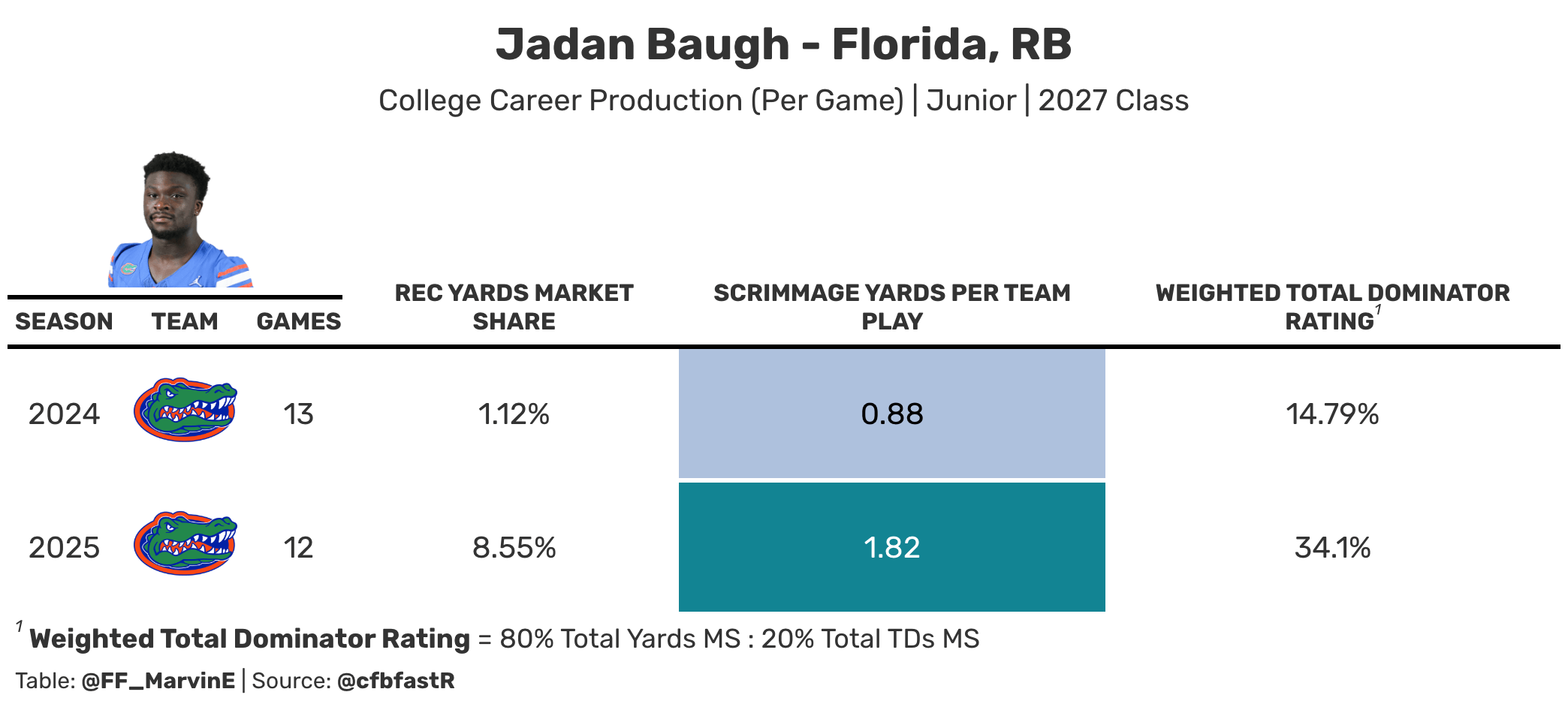
After splitting touches in his freshman season, Jadan Baugh of the Florida Gators had one of the most impressive breakout campaigns last season. Measuring in at 6’1” and 232 pounds, Baugh possesses a unique blend of size, strength, and short-area quickness, which makes him extremely difficult to tackle in the open field. That was on full display in his 2025 campaign as he handled over 250 touches out of the backfield. He finished with over 1,300 scrimmage yards and averaged 1.82 Scrimmage Yards per Team Play, ranking in the 87th percentile. By far his most dominant game was against Florida State, finishing with the second-most rushing yards (266) in a single game in Florida history, behind only Emmitt Smith’s 316 yards against New Mexico back in 1989. Equally impressive, Baugh was also heavily involved as a receiver, accounting for 8.5% of Florida’s receiving yards and over 11% of their receiving TDs. Considering the premium placed on versatility, Baugh certainly checks the box as a three-down RB and has the upside to be a fantasy RB1 in the NFL. Assuming he continues to dominate in his final season with Florida, Baugh already projects as a 92nd percentile prospect, with the upside to overtake Hardy as next year’s RB1.
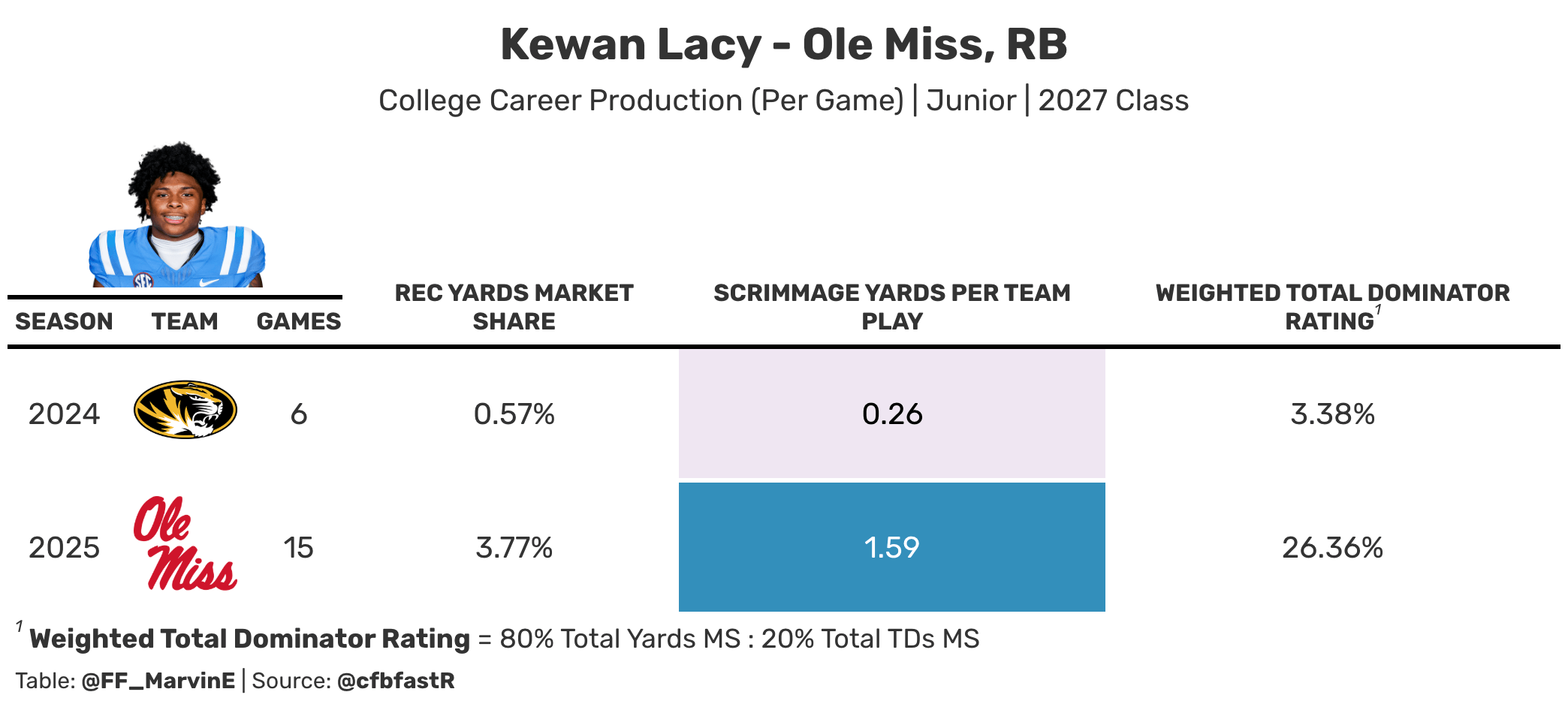
Similar to Baugh, Ole Miss’ Kewan Lacy had a massive breakout season in 2025 after a relatively quiet true freshman season. With the Rebels, Lacy led the SEC in total rush attempts (306) and rushing TDs (24), totaling over 1,700 scrimmage yards in his second season. Per PFF, he was also second in the Power Four in yards after contact (1,010) and forced missed tackles (89), highlighting his ability to consistently generate explosive plays. While those numbers are very positive, there are two areas of improvement. For one, Lacy averaged only a 3.8% receiving yards market share, underscoring his limited involvement as a receiver. Secondly, when adjusting his production for team market share, he only finished with 1.59 Scrimmage Yards per Team Play (77th percentile), indicating that his production was somewhat dependent on volume. However, overall, it was still a highly impressive campaign, as his elevated usage and production put him in the early conversation as a top-three RB in the 2027 class. Assuming he remains the focal point of the Rebels’ offense, Lacy has the potential to be a day-one selection, which would lock him in as a borderline ~90th percentile prospect in my rookie model.
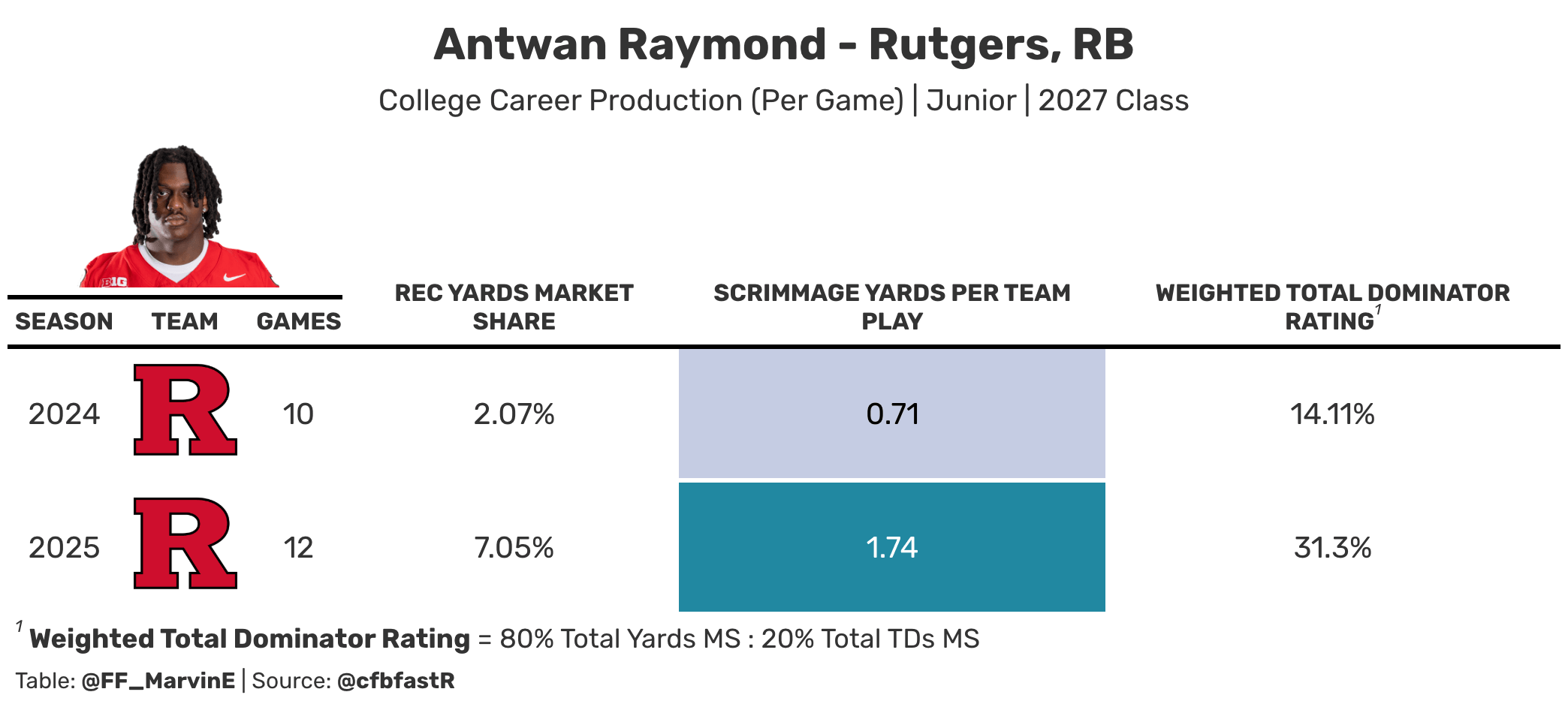
After playing behind Kyle Monangai in his true freshman season, Antwan Raymond assumed the RB1 role for Rutgers in his second campaign. In 12 games, he finished with nearly 1,500 scrimmage yards, 15 total TDs, and a 33% Total Dominator Rating. In addition, his 1.74 Yards per Team Play ranks in the 84th percentile as he was the true focal point for the Scarlet Knights. He would finish his Sophomore year earning Second-team All-Big Ten honors, ranking top three in the conference in both yards from scrimmage and total TDs. While those numbers certainly stand out, I am looking forward to seeing Raymond elevate his production even further in his final year at Rutgers. For context, the threshold that typically signifies an elite season is 2.00 Yards per Team Play, a mark that most elite NFL RBs achieve at some point during their collegiate careers. Top-tier prospects like Ezekiel Elliott, Bijan Robinson, and Derrick Henry all cleared this hurdle. In addition, Generational talents such as Christian McCaffrey, Saquon Barkley, and Jonathan Taylor surpassed that elite threshold multiple times. Fortunately, Raymond should have every opportunity to match or even exceed his sophomore-year production in 2026 as he enters the year as the RB1 for the Scarlet Knights. Assuming he can take that next step, Raymond has the potential to grade in the +80th percentile in my rookie model, placing him within the top five of the 2027 RB class.
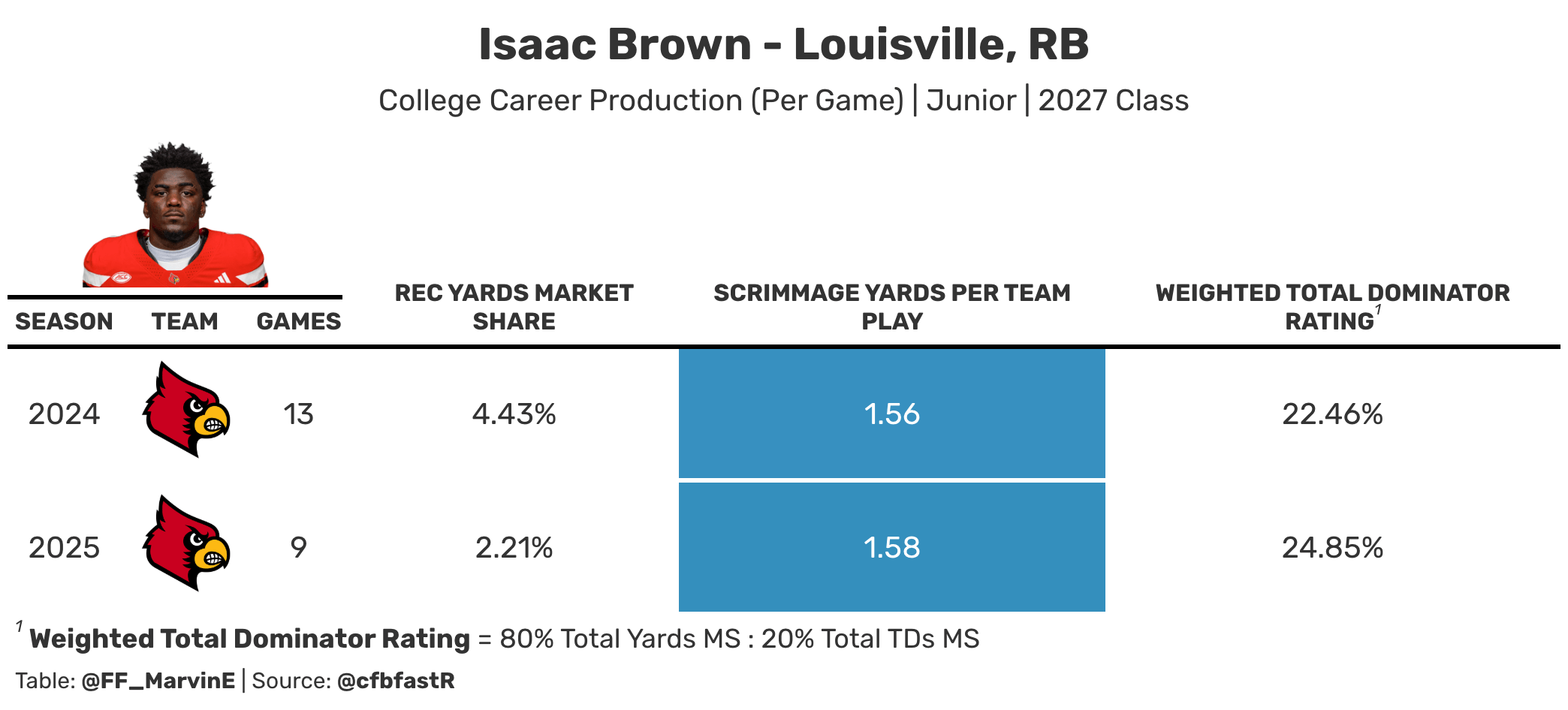
Isaac Brown is a unique prospect in that he only measures in at 5’9” and 190 pounds. Despite a lighter frame, Brown dominated in his first two seasons with Louisville. In his true freshman campaign, he totaled over 1,300 scrimmage yards and 12 TDs, averaging an impressive 1.56 Scrimmage Yards per Team Play. While that does trail Ahmad Hardy’s freshman numbers, Brown’s first season still ranks in the 94th percentile among RB prospects drafted since 2013. Fast forward to his 2025 campaign, he set career-highs in multiple metrics last season despite dealing with several lower-leg and hamstring injuries that eventually forced him to miss the final four games of the season. Despite that, his efficiency still ranked at the very top of the class, averaging 8.2 yards per touch and a 39% forced-missed-tackle rate in his sophomore year. And in total, Brown is currently the RB3 in Experience Adjusted Production in the 2027 class after two highly productive seasons with the Cardinals. As a result, Brown is currently projected in the 82nd percentile in my RB prospect model, ranking right next to De’Von Achane, who is likely his closest comp based on his size, production, and efficiency profile.
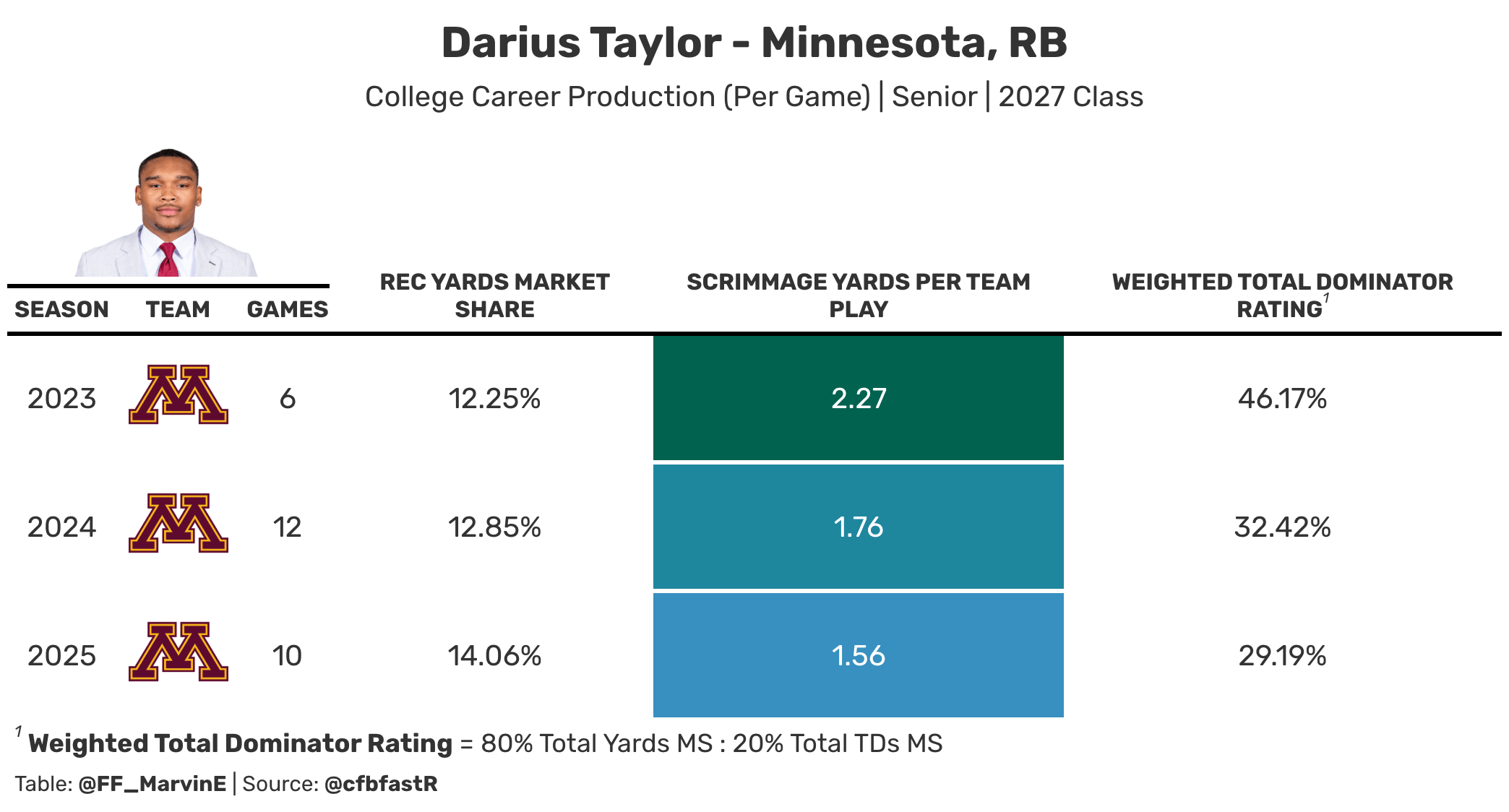
If you have been following the Dynasty Report over the last three seasons, you likely have already heard of Darius Taylor out of Minnesota. Going back to 2023, Taylor was one of the most efficient and productive RBs that year, averaging an elite 2.27 Scrimmage Yards per Team Play. Even on a smaller sample size of only six games, his campaign still ranks as the most productive true freshman season (on a per-game basis) since 2013. Unfortunately, Taylor’s career has since been defined by multiple leg injuries, which have led to declines in efficiency over the last two years. On a positive note, when Taylor returned to the lineup late last season, he averaged an elite 2.01 Yards per Team Play in his final three games, providing a glimpse of the player who dominated in his freshman year. Putting aside his health concerns, I still believe in Taylor’s talent and upside as one of the top RBs in this class. In fact, even after multiple injury-riddled seasons, Taylor still ranks as the RB2 in Experience-Adjusted Production and still projects as an 85th-percentile prospect. Assuming he can bounce back in his final year at Minnesota, I would not be shocked to see his draft stock improve as we head into the 2027 NFL Draft.