Fantasy Football Dynasty Report for Week 14


Welcome back to another edition of the Dynasty Report!
Every week, this article will highlight the most impactful storylines from a dynasty perspective, as changes throughout the regular season can significantly impact a player’s value beyond this year. To give you a holistic view of the dynasty landscape, you can expect the following segments each week:
- Rookie Opportunity Dashboard: Overview of Rookie Performances in the NFL
- Dynasty Stock Report: Recap of the Risers & Fallers in the Dynasty Landscape
- Prospect Watch List: Production Profiles & Analysis for CFB Prospects
And if you are looking for an even deeper look into dynasty football, be sure to tune in every week to the Fantasy Footballers Dynasty Podcast with Borg, Betz, and one of the Ballers!
Rookie Opportunity Dashboard
To keep the dashboard concise, I will focus only on the most fantasy-relevant rookies at each position.
For reference:
- Expected Fantasy Points (xFP) is a metric closely tied to volume and usage. We want to target rookies that rank highly in this metric, as it could potentially signal future opportunity and fantasy success.
- Fantasy Points Over Expected or FPOE signifies efficiency relative to a player’s usage. FPOE is the variance between their actual production and expected fantasy value. This metric will generally fluctuate and regress to the mean (zero), which is why we isolate it from their baseline production (xFP) to determine which players we can rely on each week.
- Opportunity Share represents the percentage of targets and rush attempts a player accounts for on their team.
If you want me to include other metrics or have any questions on the data below, let me know on Bluesky @MarvinJE or Twitter @FF_MarvinE.
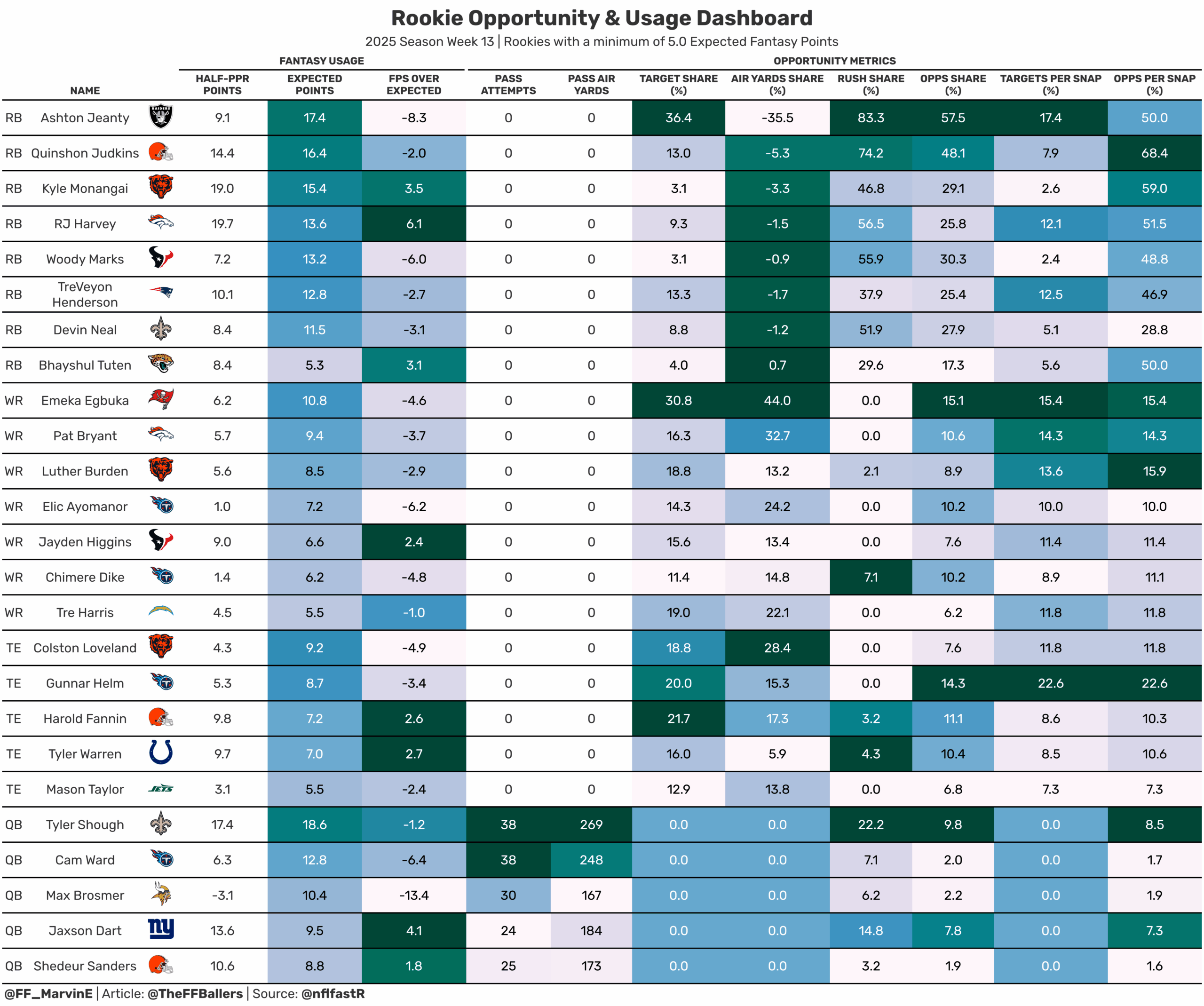
Rookie Stats and Observations from Week 13:
- This now marks four straight games in which Ashton Jeanty has received over 15% of the Raiders’ targets. In fact, he finished Week 13 with a career-high of 36.4%. While his targets are primarily short-yardage opportunities, it still raises his floor in PPR leagues and keeps him involved even in negative game scripts.
- Quinshon Judkins is averaging 19.9 opportunities per game this season as the focal point of a run-heavy Browns offense. While a majority of his touches have come on the ground, Judkins is still a top 20 option as long as the Browns remain committed to the running game. In fact, even with Shedeur Sanders as their starting QB, Cleveland continues to rank near the bottom in Pass Rate Over Expected at -11.5% (last in the league).
- RJ Harvey has emerged as the Broncos’ lead back since the injury to J.K. Dobbins, most recently finishing as an RB1 against the Washington Commanders. More importantly, over the last two games, his average of 13.1 Expected Fantasy Points firmly establishes him as an RB2 option.
- I mentioned it last week, and I stand by it again as we head into Week 14. Emeka Egbuka will eventually regress to the mean as he continues to dominate the targets and air yards for the Bucs. In fact, Egbuka has finished with over 25% of the team’s targets and over 30% of their air yards in four of his last five games.
Peter Casey-Imagn Images
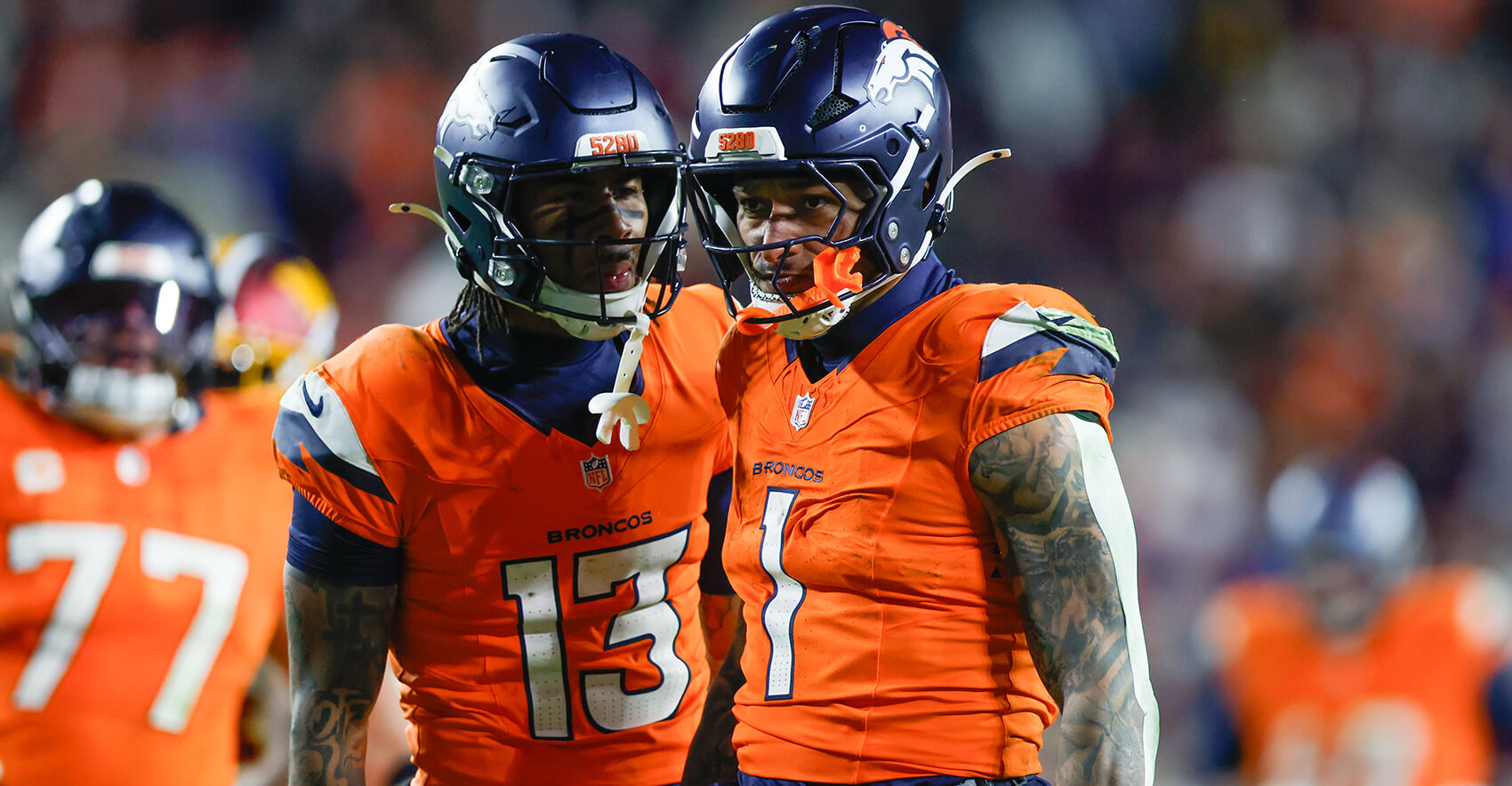
- Pat Bryant has quietly emerged as the WR3 for the Broncos (ahead of Marvin Mims), averaging a 71% route rate in their last three games. As a result, he finished with a career-high in air yards share at 33% in Week 13, while also tying his career-high in target share at 16%. Keep in mind that Troy Franklin and Courtland Sutton remain ahead of him on the depth chart, which will continue to limit his weekly upside.
- Luther Burden’s dynasty value continues to trend in the right direction as he just set a career-high in target share at 18.8% against the Eagles. In addition, he also leads all Bears WRs in Targets per Route Run (23%) this season. As a result, even though Chicago’s offense is centered around its RBs, Burden remains one of my favorite trade targets in all dynasty formats.
- In his first opportunity as a starter, Max Brosmer finished the week as one of the most inefficient QBs. In fact, his -29.1 Expected Points Added (EPA) is the lowest by a QB in a single game this season. On a positive note, barring an injury, this almost guarantees that J.J. McCarthy will remain Minnesota’s starting QB for the foreseeable future.
Dynasty Stock Report
Jahmyr Gibbs – Detroit Lions, RB – Stock Up
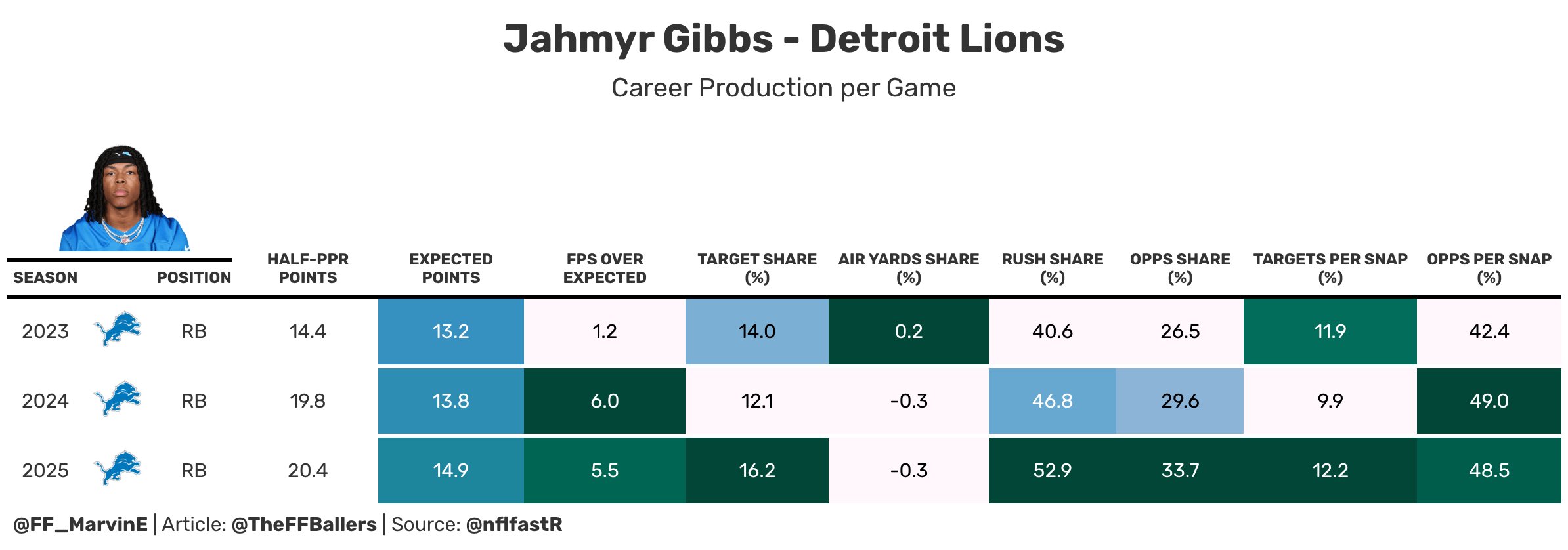
After starting his career splitting touches with David Montgomery, the Lions have fully committed to Gibbs as their RB1 this season, leading their backfield in opportunity share at 33.7%. And among all RBs this year, Gibbs currently ranks as the:
- RB3 in Half-PPR Points (20.4)
- RB2 in Fantasy Points Over Expected (+5.5)
- RB4 in Target Share (16.2%)
- RB5 in Expected Fantasy Points (14.9)
On top of that, Gibbs is the only RB to score over 35.0 fantasy points in three games this season, producing multiple week-winning performances for fantasy managers. As a result, while Bijan Robinson and Jonathan Taylor are in contention to be the dynasty RB1, Jahmyr Gibbs is arguably the more valuable asset, considering his age and production this season. Long-term, Gibbs will remain the focal point for the Lions as Montgomery could be approaching the final year of his contract. And at only 23 years old, barring any injuries, Gibbs should continue to dominate for dynasty managers for many years to come.
Cooper Kupp – Seattle Seahawks, WR – Stock Down
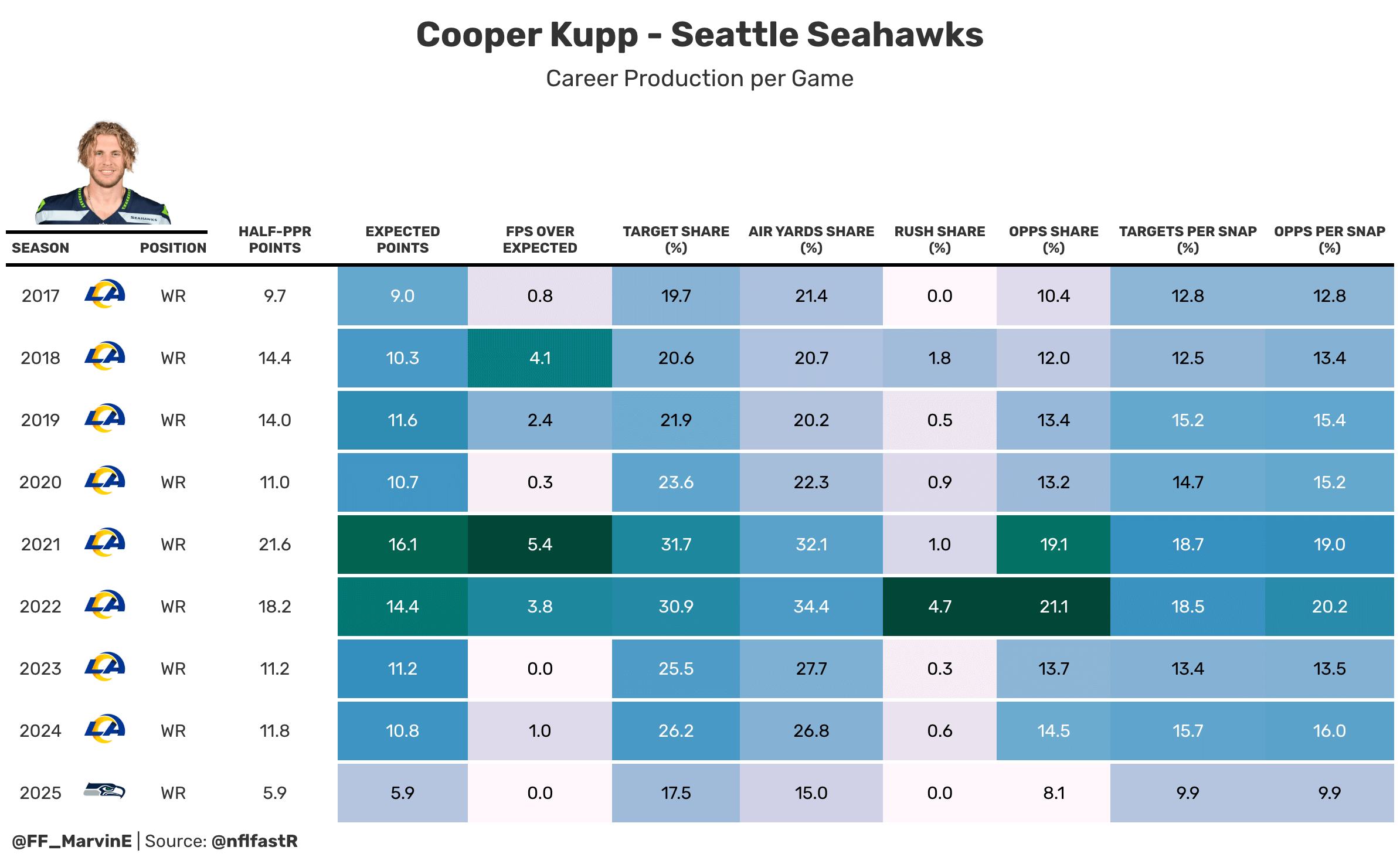
After eight years with the Rams, Cooper Kupp signed a three-year deal to join the Seattle Seahawks. And while his production did taper off towards the end of last season, I did not expect Kupp’s fantasy value to decline so drastically with Seattle. Through 11 games, Kupp has failed to finish within the top 24, producing double-digit fantasy points in only two matchups. In fact, Kupp is currently the WR64 in fantasy points per game, averaging a career-low 17.5% target share. In addition, despite signing a long-term deal, his contract also provides some uncertainty, as Seattle could release him to save over $9 million per season over the next two years. And after the recent acquisition of Rashid Shaheed and the continued ascent of Jaxon Smith-Njigba, Kupp’s dynasty value will continue to decline as we quickly approach the end of the season.
Kyle Monangai – Chicago Bears, RB – Stock Up
As the Bears have focused on the running game this season, Kyle Monangai has quietly emerged as a key piece to their offense. As a seventh-round prospect out of Rutgers, fantasy managers were likely not expecting him to make an immediate impact for their dynasty team. After all, day three prospects rarely produce in the NFL. In the case of Monangai, he has taken advantage of every opportunity, currently ranking as the RB4 in EPA per Rush Attempt (0.07). As a result, even though he continues to share touches with D’Andre Swift, Monangai has managed to finish as an RB2 or better in five of his last seven games. With his usage and production trending positively, he has quickly become one of the most valuable handcuffs in fantasy football, most recently finishing as an RB1 against Cincinnati when Swift was unavailable. Long-term, it is also worth noting that Swift does not have a guaranteed contract beyond this year, potentially opening up an expanded opportunity for Monangai. However, even if they do release Swift, I would be shocked if the Bears did not add some competition to their backfield next season, especially with some talented RB prospects entering the 2026 class. In other words, I would be shocked if Monangai entered next season as the only viable RB in their rotation. And considering the track record of day-three prospects who rarely retain their dynasty value year over year, fantasy managers may be better off trading Monangai away before the season ends.
Justin Jefferson – Minnesota Vikings, WR – Stock Down
While Justin Jefferson remains one of the more valuable dynasty WRs, he is no longer the unquestioned dynasty WR1. Especially with the struggles of J.J. McCarthy, Jefferson’s production has been heavily impacted in recent weeks. For context, the Vikings rank 29th in EPA per Play (-0.15) and 30th in Dropback Success Rate (36.2%) with McCarthy as their starting QB since Week 9. As a result, Jefferson has failed to exceed double-digit fantasy points in each of those games. On top of that, Jefferson has only finished within the top 10 once this season, a threshold he exceeded multiple times with Sam Darnold last year. However, while his situation seems very bleak, I would expect the Vikings to eventually find a solution at the QB position. Whether McCarthy finally figures it out (as the Vikings do have a favorable schedule to close out the year) or Minnesota brings in competition next season, Jefferson should bounce back at some point in the near future. Until then, he will remain in a tier below Ja’Marr Chase and Jaxon Smith-Njigba as they find themselves in a much more favorable situation long-term.
Prospect Watch List
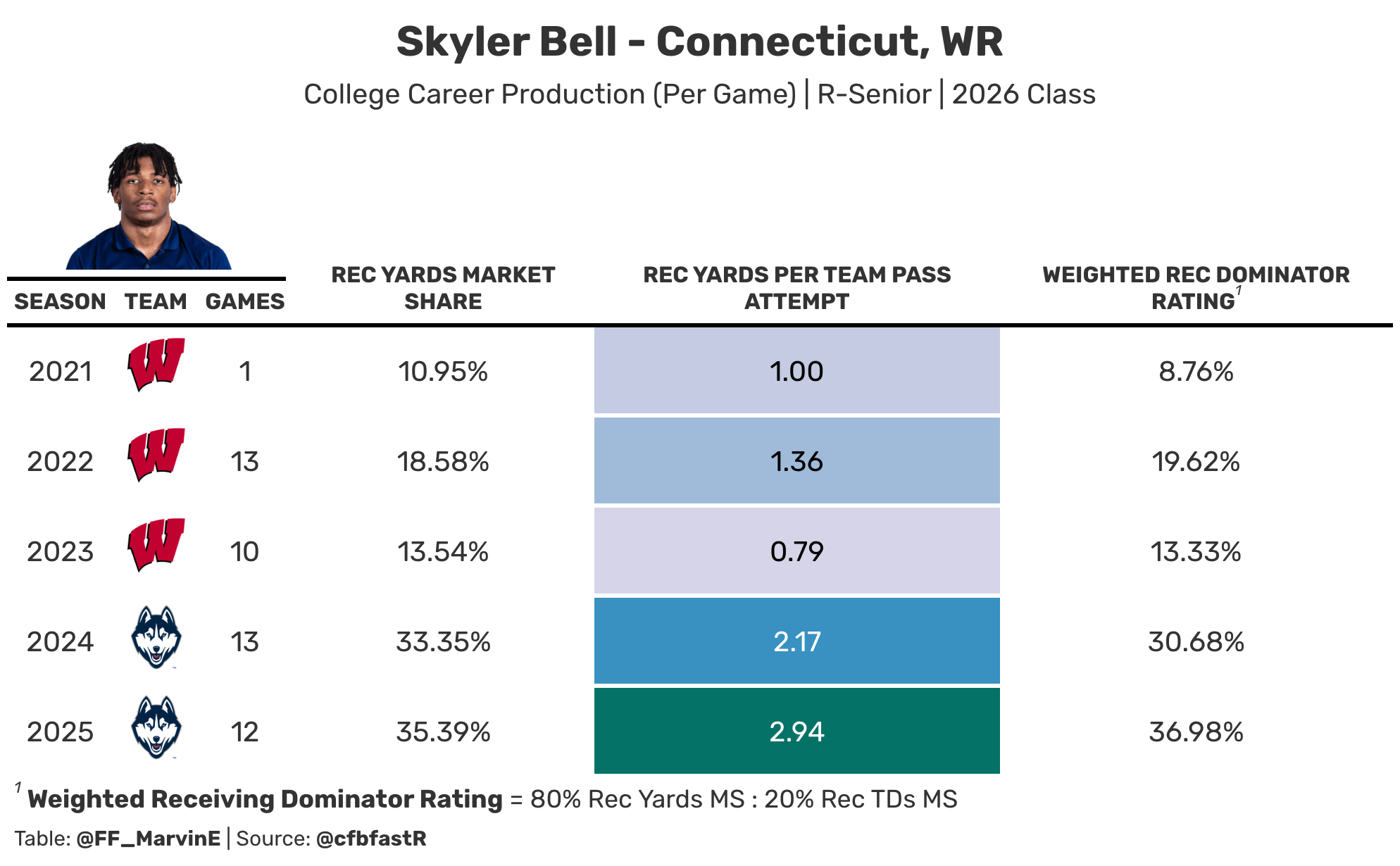

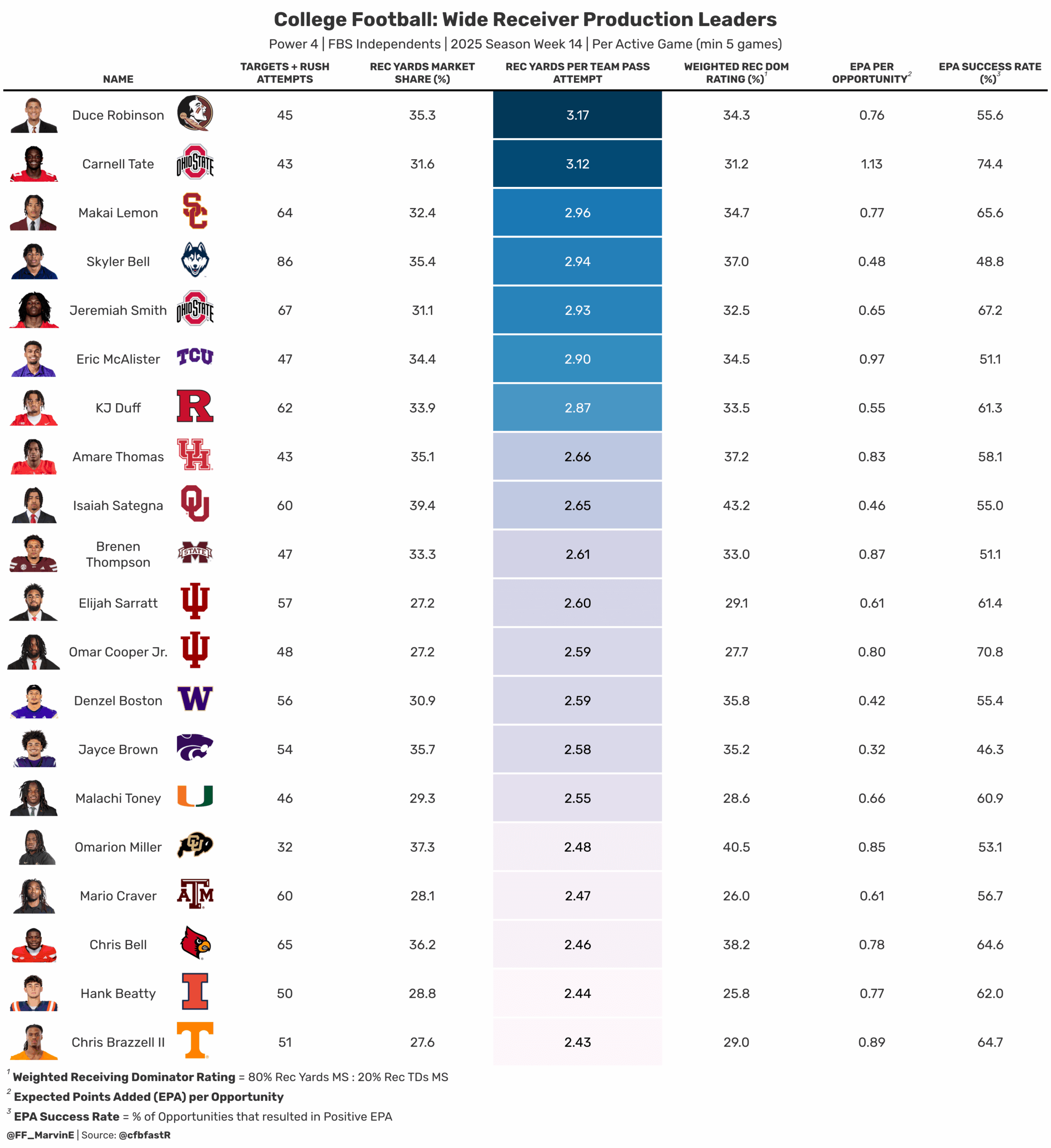
Recently announced as one of the Biletnikoff Award finalists, Connecticut’s Skyler Bell has been one of the most dominant WRs in the nation. In 12 games this season, Bell set career highs in multiple metrics, including Receiving Yards Market Share (35.4%) and Receiving Yards per Team Pass Attempt (2.94). To put that into context, the only college WRs currently ahead of him in adjusted production are Duce Robinson, Carnell Tate, and Makai Lemon. Considering all three of them are locked in as day one or two picks in the 2026 NFL Draft, it should not come as a surprise that Bell’s draft stock has significantly improved over the last few months.
While this likely locks him in as a top 20 pick in dynasty drafts, he still enters the NFL with a slightly flawed profile. Firstly, Bell will enter the draft with negative experience-adjusted production after only breaking out in his fourth season. For context, the most successful NFL WRs typically break out early in their college careers. Secondly, he will be one of the oldest WR prospects in next year’s class at nearly 24 years old. Why does that matter? Of the 117 WRs drafted since 2010 at age 23 or older, only 10.2% have broken out for fantasy football. If we filter on day one or two WRs with a negative production profile, hit rates remain below average at only 22%. In other words, while Bell should be considered a top 10 WR in his class, he still profiles as one of the riskier picks in dynasty drafts next season.
As we approach the 2026 NFL Draft, here is a list of the most productive college football WRs this season: