
2026 Risk Baked Into ADP: WRs (Fantasy Football)


Welcome back to the Risk Bakery. This year, we have already covered the RBs and QBs, and now it is time to see what is cooking in the WR oven.
Risk can manifest in many different ways in the WR realm. Sometimes it is an aging superstar coming off an injury-plagued season. Sometimes it is a younger player who has never stayed healthy long enough to earn our trust. And sometimes it is a former first-round pick whose early-career struggles have become so deeply attached to his name that fantasy managers refuse to acknowledge what he has done since.
Those concerns are not imaginary. The goal of this series is not to pretend risk does not exist. It is to determine whether a player’s ADP has fallen far enough that the possible reward now outweighs the cost of being wrong.
This year’s group includes three veteran receivers who are either approaching the dreaded age cliff or already over it, and three younger players with very different combinations of injuries, inconsistency, and weekly volatility. None of them is safe. But at their current prices, none of them needs to be.
And of course, do not forget to check out the Fantasy Footballers UDK+, complete with rankings, projections, and a Risk Meter for every player.
The oven is ready. Let’s see which WRs have their risk baked into the price.

Stephen Lew-Imagn Images
Terry McLaurin – Washington Commanders
ADP
Overall
2025 Finish
WR24
54
WR54
Terry McLaurin followed his WR14 season in 2024 with the worst fantasy finish of his career. A quad injury limited him to ten games, and he finished with only 38 receptions, 582 yards, and three TDs. Washington’s offense also took a major step backward, and now McLaurin will turn 31 during the season while Stefon Diggs arrives to compete for targets. There is plenty here for fantasy managers to dislike.
But the final numbers make McLaurin’s decline look much worse than his actual play. Among 109 qualifying WRs, he ranked 13th in yards per route run, fourth in first downs per route run, and 26th in route win rate. His 24% targets-per-route-run rate also ranked 25th. In other words, the injury affected his availability, but there is little evidence that McLaurin suddenly forgot how to earn targets or win routes. Diggs adds competition, but Deebo Samuel and Zach Ertz are gone. McLaurin should still have a major role, and we already know what that role can produce alongside Jayden Daniels. Before last year’s injury, McLaurin had five consecutive 1,000-yard seasons.
At WR24, we are not paying for a complete return to his 2024 peak. We are paying for a low-end WR2 immediately after the first injury-shortened season of his career. If McLaurin remains healthy and his per-route efficiency carries into a full season, his WR54 finish will look like an obvious outlier rather than the beginning of the end.

Jayne Kamin-Oncea-Imagn Images
Davante Adams – Los Angeles Rams
ADP
Overall
2025 Finish
WR26
58
WR8
Davante Adams is entering his age-34 season, caught only 60 passes for 789 yards last year and missed the final three games with a hamstring injury. That would already be enough to make him risky. Then we get to the biggest concern: he scored 14 TDs on those 60 receptions. Adams led the NFL with 30 red-zone targets through Week 14, including 16 from inside the five-yard line, the most recorded by any player since at least 2000. Nearly one out of every four receptions became a TD. Nobody should project that rate to continue.
But we should also avoid treating those scores as pure luck. Adams has 117 receiving TDs in his career, and his 42 scores from inside the five are the most by any player since 2000. Sean McVay and Matthew Stafford did not accidentally throw him the ball near the goal line over and over again. That was an intentional and extremely successful part of one of the NFL’s best offenses. In fact, it is one of the main reasons the Rams brought him to Los Angeles.
There is also room for his receptions to bounce back. Only 61.4% of Adams’ 114 targets were considered catchable. He caught 60 of the 70 passes he had a realistic chance to catch, an 85.7% rate. More importantly, he ranked first among qualifying WRs in both separation score and route win rate. His fantasy production may have depended too much on TDs, but his underlying route-running metrics do not resemble those of a washed receiver. The TDs will regress. They almost have to. But at WR26, Adams can lose five of them and still beat his price if better target quality helps him recover some of the receptions and yards he left behind. Fantasy managers are drafting the reigning WR11 as a mid-range WR3 because they expect the age cliff and TD regression to arrive simultaneously. That is a lot of risk already baked into the ADP.

Kim Klement Neitzel-Imagn Images
Mike Evans – San Francisco 49ers
ADP
Overall
2025 Finish
WR27
62
WR77
Mike Evans has practically become a leitmotif of the Risk Bakery. He was the perfect example for this series after falling to WR31 in 2023 and finishing as the WR5. I decided to include him again in 2024 because apparently ten consecutive 1,000-yard seasons were not enough. Now he is back after the first truly disastrous season of his career.
For the first time, the risks are impossible to dismiss. Evans will be 33 when the season begins. He is changing teams, QBs, and offensive systems after 12 years in Tampa Bay. A hamstring injury and a broken clavicle limited him to eight games last season, ending his streak of eleven consecutive 1,000-yard campaigns. He also suffered a quad injury in training camp, although he returned to practice this week. The market is understandably asking whether 2025 was the beginning of the end. His underlying performance, however, tells a different story. In his seven full games, Evans earned a 24.4% target share and a 30.6% first-read share. Both rates would have ranked 13th among qualifying WRs over a full season. He also ranked second in separation and route win rate, while only 70.9% of his targets were catchable.
The opportunity in San Francisco has also become clearer. Ricky Pearsall will miss the entire season, and although Deebo Samuel has returned, Evans has a legitimate path to leading the 49ers’ WRs in targets, yards, and TDs. Christian McCaffrey and George Kittle will command volume, but they also make it almost impossible for defenses to focus entirely on Evans. Brock Purdy has never had a receiver with this combination of size, contested-catch ability, and red zone production.
Evans is not being drafted at WR27 because he suddenly stopped winning routes. He is being discounted because he is 33, has changed teams, and is coming off the first injury-ravaged season of his career. Those are real concerns. But betting against his consistency has been one of fantasy football’s least profitable traditions, and his current price allows us to do the opposite without spending a premium pick.
Christian Watson – Green Bay Packers
ADP
Overall
2025 Finish
WR29
65
WR42
Christian Watson is one of the easiest players in fantasy football to label as risky. He has missed time in every NFL season, sat out the first seven weeks last year, and has never produced more than 620 receiving yards. Green Bay has also spent years spreading the ball around enough to make every Packers WR difficult to trust.
If you have drafted Watson before, you have probably experienced the entire ride: a huge game that makes him look like a future superstar, followed by an injury or a two-catch performance that makes you question why you did this to yourself again. But when Watson returned last season, he finally started to look like the player fantasy managers had been waiting for. From Week 8 through Week 18, he was the WR19 in points per game despite running a route on only 68% of Green Bay’s passing plays. During that stretch, he averaged 61.1 receiving yards per game and produced 2.67 yards per route run.
That efficiency was not merely good. Among 109 qualifying WRs, Watson finished fourth in yards per route run, sixth in fantasy points per route run, and tenth in first downs per route run. The problem was not what happened when he was on the field. It was getting him on the field often enough. That could change in 2026. Romeo Doubs and Dontayvion Wicks are gone, Green Bay gave Watson a massive four-year extension, and his 68% route participation leaves obvious room for a larger role. Jayden Reed and Matthew Golden will remain involved, but the Packers did not pay Watson like a complementary deep threat.
The injury history is not going away, and neither is the possibility of frustrating weekly volume. But Watson is being selected as the WR29 immediately after producing like a top-24 option in a limited role. If his routes increase while his efficiency remains anywhere close to last year’s level, WR29 will look much more like his floor than his ceiling.
IMAGN IMAGES via Reuters Connect
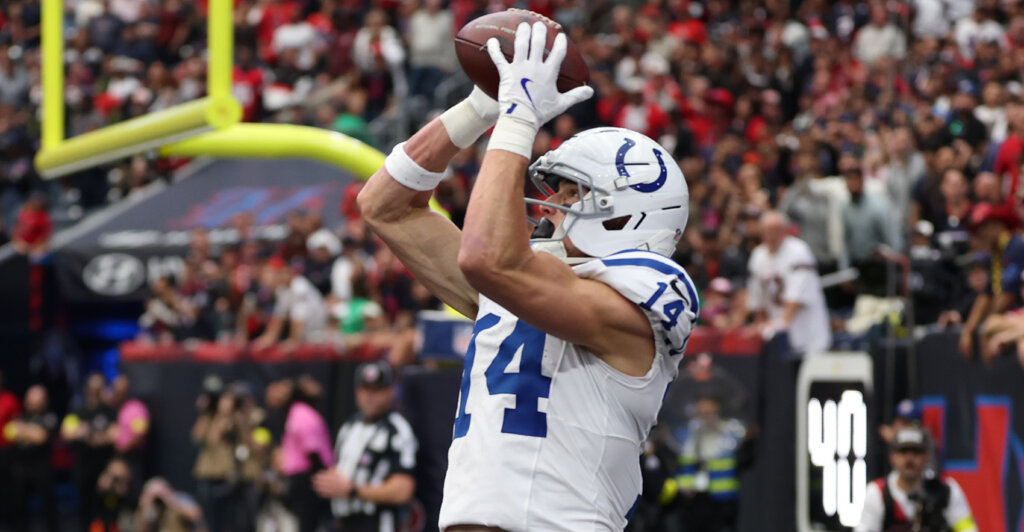
Alec Pierce – Indianapolis Colts
ADP
Overall
2025 Finish
WR37
91
WR24
Alec Pierce finally delivered the breakout fantasy managers had been waiting for. He caught 47 passes for 1,003 yards and six TDs, finished tied for WR20 in Half-PPR, and produced ten games with at least 65 receiving yards. Indianapolis then paid him like their new WR1 and traded Michael Pittman Jr. away.
So why is a 26-year-old WR coming off his first 1,000-yard season still available as the WR37? The first reason is health. Pierce underwent ankle surgery in March and remains on the PUP list. The latest reports are encouraging: he has started doing conditioning and individual work, and the Colts still expect him to be ready for Week 1, but he has not returned to full practice.
His QB adds another layer of uncertainty. Daniel Jones tore his Achilles in December, creating legitimate offseason concerns about whether he would be ready for the start of 2026. Jones has since been fully cleared for training camp, has participated in 11-on-11 work, and has reportedly moved well. That lowers the risk, but returning less than nine months after an Achilles tear is still not something we should treat as completely normal.
Pierce’s role also creates weekly volatility. He averaged 21.3 yards per reception last season, and a receiver built around lower-percentage deep targets will always produce some quiet weeks when the big play does not connect. Josh Downs and Tyler Warren can dominate the shorter and intermediate areas of the field, potentially leaving Pierce with fewer easy receptions.
But Jones consistently looked for Pierce downfield before his injury. Their connection is not a theoretical offseason projection; it already produced 1,000 yards. Pierce also showed signs that he could become more than a one-dimensional deep threat, including multiple double-digit-target games last season. With Pittman gone, he does not need to become a target hog. He only needs to retain the valuable opportunities Jones already gave him while absorbing a reasonable portion of the available volume.
The ankle, Danny Dimes’ Achilles injury, and the nature of Pierce’s role make him risky. They are also the only reasons a young receiver who just finished 14 spots above his current ADP remains available in the eighth round.
DANNY DIMES DEEP BALL TO ALEC PIERCE.
ATLvsIND on @NFLNetwork
Also streaming on @NFLPlus pic.twitter.com/offSgAe7ul— NFL (@NFL) November 9, 2025
Quentin Johnston – Los Angeles Chargers
ADP
Overall
2025 Finish
WR42
102
WR31
“Quge” may never escape his rookie-season reputation. Fantasy managers remember the drops, the limited route tree, and the first-round WR who looked completely unprepared for the NFL. Even after consecutive seasons with more than 700 yards and eight TDs, the general reaction to his name remains the same: Ladd McConkey is Justin Herbert‘s WR1, so Johnston must be an afterthought. McConkey, A.K.A. Jason’s little lad, did lead the Chargers in targets, receptions, and receiving yards last season. But Johnston produced nearly the same total fantasy points in two fewer games and finished as the team’s highest-scoring WR on a per-game basis. He also delivered three top-eight weekly finishes, including WR2 in Week 1 and WR7 in Week 16.
The problem was everything in between. Johnston also produced finishes of WR68, WR86 and WR106. He caught only 51 of 85 targets, and his eight TDs in consecutive seasons may be difficult to sustain. McConkey, Oronde Gadsden, and the rest of the Chargers’ pass catchers will prevent him from becoming a traditional target hog. The Fantasy Footballers’ consistency chart ranks Johnston as the WR30 in consistency, only two spots behind Ladd McConkey. In other words, inconsistency was not unique to Johnston. It was a feature of the entire Chargers’ WR room.
However, the full-season numbers hide how much a hamstring injury affected his usage. In the games in which Johnston was presumably healthy (Weeks 1-4 and 9-18), he led the Chargers in target share, first-read share, red zone targets, deep targets, yards per route run, and missed-tackle rate. During those games, he earned a 20.3% target share and a 24.8% first-read share. That is not the profile of a player disappearing from Herbert’s offense.
New offensive coordinator Mike McDaniel also gives Johnston a path to expand his game without taking McConkey’s role. Almost half of Johnston’s receiving yards during his final college season came after the catch, but the Chargers have rarely used that ability consistently in the NFL. McDaniel’s offense is designed to create space and favorable angles for receivers after the catch, exactly the area Johnston has said excites him most about the new scheme. McConkey can remain Herbert’s most reliable receiver, and Johnston can still destroy a WR43 ADP. They do not need to play the same role. McDaniel does not need to transform Johnston into a 140-target player, either. He only needs to manufacture a few more opportunities for Johnston to use the traits that made him a first-round pick back in 2023.
The drops, inconsistency, and target competition are all real. But after two consecutive top-36 seasons, Johnston is being drafted as if his disappointing rookie version is still the only possible outcome. At the end of the ninth round, the weekly ceiling is worth far more than the price of finding out.
Comments
Fantasy Question: I am allowed to keep 10 players in my fantasy draft as of now my 9 keepers are
QB: Williams, Ward
RB: Irving, Henderson
WR: Ebuka, Odunze, G Wilson, Waddle, Harrison Jr.
I am in a dilemma for the last spot between D. Adams and Golden. Any help would be greatly appreciated!!