
Snap Count Observations: Transactions for Week 2 (Fantasy Football)


Welcome to the 2026 fantasy football season!
If you are new here, the mission of this column is simple: we hunt for hidden volume. We dig into the snap counts, study the tape, and track playing-time trends to give you an edge on the waiver wire and in your weekly start/sit decisions. You will not find a generic, team-by-team summary here. Instead, this space is strictly reserved for the notable shifts, surprising utilization, and underlying data that actually impact your roster.
We will not waste time talking about backfields or receiving corps that look exactly like the team’s official depth chart. If a team plays it entirely as anticipated (like the New York Jets did in Week 1), I move on. We also look past those intentionally misleading team depth charts that bury exciting rookies behind fading veterans just to make a point. We care about reality and market perception, not coach-speak.
Because Week 1 gives us our very first taste of real regular-season data, this opening edition is intentionally deeper and more comprehensive than usual. Strap in. As the season progresses, many teams will fall into predictable patterns, and we will shift our focus toward the injuries and role changes that disrupt those patterns.
This exercise works. In the debut year of this column, this exact process allowed us to identify and buy into Justin Jefferson before his massive breakout. The goal is to keep that streak alive and spot this year’s league-winners before your opponents even know they are on the field.
Okay, let’s dive into Week 1.
Seattle Seahawks
Jadarian Price (48% snaps) | George Holani (46% snaps)
I should learn by now, but I admit I fell for the hype coming out of the Seattle camp about Jadarian Price being a workhorse back. Instead, right off the bat, Seattle deployed a frustratingly even split against the Patriots. Price touched the ball on the very first play from scrimmage, ripping off a decisive 13-yard run. He looked highly efficient, averaging 5.2 yards per carry. But despite the hot start, the coaching staff wouldn’t let him shoulder the load, giving George Holani a hefty eight carries of his own. What makes this truly alarming is the game script. This was not a blowout where the starters were pulled early. This was a tightly contested, low-scoring 13-10 battle. If the coaching staff doesn’t trust Price in a close game right now, this backfield situation does not bode super well for his volume floor once Zach Charbonnet returns to healthy game action. That being said, I am still a believer in Jadarian Price. The explosiveness is there. Cream rises to the top, and elite talent will eventually take over this backfield.
Conclusion: Hold strong on Price. Bet on the talent here.
New England Patriots
Mack Hollins (70% snaps)
It is the same old story with Mack Hollins when he gets an opportunity. Step onto the field, catch the football, and grind out tough yards. With A.J. Brown hitting injured reserve with a high-ankle sprain, the Patriots needed someone to absorb those perimeter targets. Against the stingy Seattle secondary, Hollins quietly paced New England’s passing attack with a team-high 51 receiving yards on four catches. It wasn’t flashy, but in a completely locked-down game, Drake Maye trusted Hollins. Meanwhile, Romeo Doubs gave fantasy managers an absolute donut. Fresh off signing a massive four-year, $68 million contract in the offseason, Doubs was ineffective (to say the least) in his Patriots debut. He finished the night with zero catches on three targets. To make matters worse, he committed a brutal fourth-quarter drop that would have picked up a chunk of 25 yards, and he was the target on one of Maye’s costly INTs. It looks like the Patriots got the same player from the Packers: a guy who occasionally makes a flashy play and finds the end zone, but you need that TD for a viable fantasy week.
Conclusion: Mack Hollins is an okay short-term waiver wire add for managers hurting at WR, but do not read too much into one Week against perhaps the best defense in the league.
IMAGN IMAGES via Reuters Connect
Chicago Bears
Colston Loveland (87% snaps)
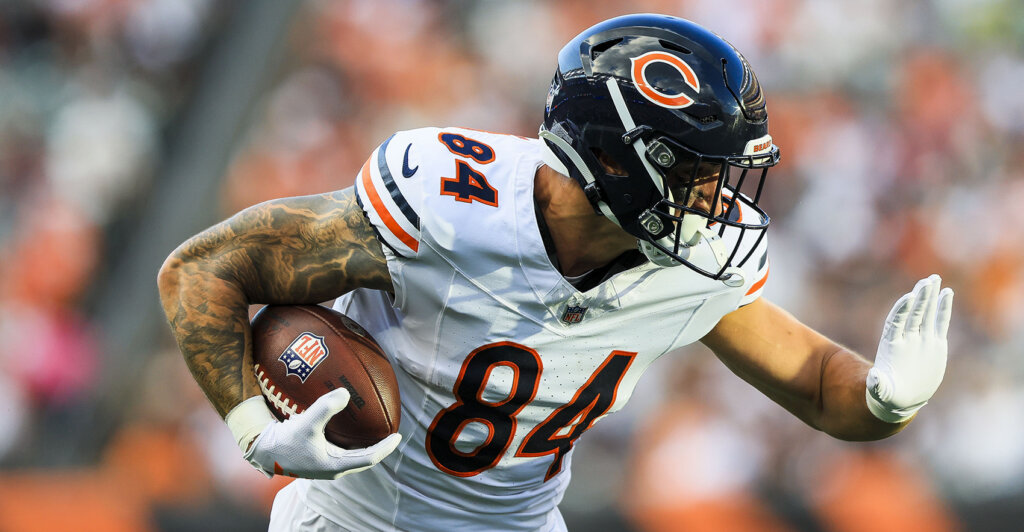
The Chicago Bears completely dismantled the Panthers in Week 1, dropping a historic 59 points and racking up over 550 yards of total offense. It was a certified offensive explosion… and yet, if you started Colston Loveland, you walked away with a soul-crushing goose egg in your fantasy lineup. Understandably, the fantasy community is panicking. How does a team score eight TDs without its star, highly drafted TE catching a single football? Take a deep breath and step back from the ledge. While the box score looks like an absolute disaster, a closer look at the actual snap counts reveals that Loveland is going to be completely fine. Loveland was on the field for 65 offensive snaps – the most of any non-QB, non-offensive lineman on the entire Bears roster. He paced all Chicago pass-catchers with 36 snaps on passing plays and led the entire team with 32 routes run. So what happened? Watching the game back, it was a combination of two things. First, the Panthers seemed to dedicate extra attention to Loveland, frequently bracketing him in the middle of the field to force Caleb Williams to look elsewhere. Second, when the coverage did break down, Williams just barely missed him on a couple of deep, big-play opportunities that would have instantly saved his fantasy day. The underlying usage is pristine. The target volume will follow the field time, and this goose egg is highly unlikely to continue.
Conclusion: Do not panic-sell. Loveland is an elite buy-low candidate right now if his current manager is overreacting to Week 1.
Carolina Panthers
Chuba Hubbard (71% snaps); Jonathon Brooks (19% snaps)
The draft community spent the entire summer trying to bury Chuba Hubbard in favor of shiny new rookie Jonathon Brooks. Well, welcome to Week 1, where reality comes to crash the party. In a historic 59-37 shootout loss to the Bears, Hubbard didn’t just hold onto his starting job – he completely locked down this backfield. Hubbard was out there for 48 of the Panthers’ 68 offensive snaps, dominating with a 71% snap share. Meanwhile, Brooks was relegated to a distant second, getting onto the field for just 13 plays (a meager 19% rate). It was actually AJ Dillon who saw the second-most RB snaps.
Hubbard was highly efficient with his opportunities, averaging 4.9 yards per carry, serving as the primary red zone option, and hitting the paint twice (once on the ground, once through the air).
Looking at his final box score, 10 carries might look a little light for a “workhorse” back. But make no mistake: those low rushing totals are entirely a byproduct of the absolute offensive explosion on the other side of the ball. When the Bears are hanging 59 points on your head, you simply cannot afford to sit back and establish the run. If this game had stayed even remotely competitive or neutral, Hubbard easily would have cleared 15 to 20 carries. Crucially for fantasy managers, Hubbard was also the only RB on the roster to see a single target in the passing game. He isn’t just out there eating up snaps because the coaching staff trusts him as a pass blocker; he is firmly cemented as the team’s preferred pass catcher out of the backfield. That dual-threat utilization gives him a remarkably safe weekly floor in PPR formats.
As for Brooks, it is hard to be overly optimistic right now. While he is certainly worth holding onto in deeper leagues, you shouldn’t let his draft pedigree blind you. If your roster is hurting and one of the shinier, high-upside waiver wire options is sitting out there on the wire this week, do not hesitate to cut bait on the rookie to improve your team today. Right now, this is firmly Chuba’s backfield.
Conclusion: Hubbard is a locked-in RB2 for Week 2. Brooks is a luxury stash – but do not miss out on better, immediate-impact players just to keep him on your bench.
Tampa Bay Buccaneers
Ted Hurst (75% snaps)
When Mike Evans packed his bags, it left a huge void on the outside in Tampa. Many speculated that Ted Hurst could fill it. Hurst did not just get his feet wet in his NFL debut; he was thrown straight into the deep end, securing a surprising 75% snap share. For a rookie wideout playing in his very first professional football game, that level of immediate trust from the coaching staff is an absolute flashing neon sign. At 6’4″ and 206 pounds, Hurst physically profiles as a carbon copy of the man he is replacing. While it is unfair to expect anyone to step in and immediately replicate Evans’ production, the underlying usage suggests the Buccaneers are giving him every opportunity to do exactly that. He ran routes on nearly every passing play and looked every bit the part of the team’s new primary downfield boundary threat. If this kind of playing time is the baseline for Hurst moving forward, we are looking at a draft-day steal who is poised to completely obliterate his current market value.
Conclusion: Hurst is a high-priority waiver wire addition if he is somehow still sitting on your league’s wire. The volume is there right now.
Indianapolis Colts
Alec Pierce (59% snaps)
Alec Pierce entered Week 1 with a clear flashing warning sign: he was on a designated pitch count. Working his way back from an offseason ankle surgery, the Colts capped him at a modest 32 snaps. Nevertheless, Pierce was a focal point of the passing game. He tied veteran Keenan Allen for the team lead with six targets and paced all Indianapolis pass-catchers with 61 yards. What makes this baseline exciting is the efficiency. He didn’t need a heavy field presence to produce; when he was out there, Daniel Jones looked his way. Now that Michael Pittman is gone, there is a vacuum for a true alpha perimeter target.
Conclusion: If Pierce can earn a target share like this while being eased back in, his role should expand as his health and snap counts normalize.
New York Giants
Malik Nabers (52% snaps)
The Giants chose to be cautious with Malik Nabers in his return from last year’s knee injury, limiting him to 36 snaps – about a 52% snap share. Despite the partial workload, his efficiency was notable. Nabers ran a route on 24 of those 36 snaps and quickly commanded nine targets. That amounts to a solid chunk of the team’s total pass attempts, which he turned into six receptions for 69 yards. If this is Nabers at less than 100%, look out. He is just a really good player.
I also liked the growth I saw from Jaxson Dart. I was concerned about the Giants offense due to it being tied to Matt Nagy, but good players are just good players. Dart was 23 for 29 for 230 yards and three TDs. He still runs a lot (11 carries), but the accuracy numbers are very encouraging.
Conclusion: If Nabers can earn this kind of target volume while playing roughly half the game, his weekly outlook should expand significantly.
New Orleans Saints
Devaughn Vele (91% snaps)
If you are looking strictly at the raw box score, Devaughn Vele looks like a tempting waiver wire target. The Saints offense logged 90 total snaps and threw the ball 56 times during a high-scoring overtime game against the Lions, which naturally elevated everyone’s numbers. Vele took advantage, playing 82 snaps and earning nine targets, which he turned into a 7/69/1 line. The team gave him a solid contract, and he should see regular reps on the outside while the depth chart mends. However, there is a good chance this performance is a bit of an outlier. The Saints likely will not maintain this kind of extreme pass volume every single week, and a struggling Lions secondary certainly helped create a friendly environment. Vele’s heavy usage feels mostly driven by a specific, high-paced game script that went deep into extra time. Also, do not forget that Jordyn Tyson should come back at some point this season.
Conclusion: Avoid overspending on him. Vele offers some short-term floor value in deeper PPR leagues, but it might be wise to temper expectations before assuming this is a permanent breakout.
Pittsburgh Steelers
Rico Dowdle (58% snaps); Jaylen Warren (37% snaps)
The backfield split provided a bit of a statistical puzzle in Week 1. Rico Dowdle led the way in terms of field presence, outsnapping Jaylen Warren 39 to 25. Despite the extra playing time, Dowdle struggled significantly with his efficiency, managing just 15 yards on his eight carries. He did salvage some PPR utility by earning five targets in the passing game, but the overall lack of production was notable. Meanwhile, Warren was far more efficient with his limited time on the field, leading the backfield in carries (10 to 8), rushing yards (46 to 15), and total opportunities (16 to 13). However, the broader concern here is the environment. Pittsburgh looks poised to remain a low-scoring offense. This pessimistic outlook limits the weekly ceiling for all Steelers skill players, meaning there simply might not be enough total TDs to excite fantasy managers. Dowdle’s low efficiency is an issue, but the offensive environment makes it even harder to overcome.
Conclusion: This looks like a backfield in flux within a low-upside offense. Dowdle has performed well on bad offenses before, so we can give him one mulligan. Not sure I can start him anywhere, though.
Philadelphia Eagles
Dontayvion Wicks (91% snaps); Makai Lemon (64% snaps)
One of the more intriguing training camp storylines seems to have carried over into the regular season. Dontayvion Wicks dominated the playing time in Week 1, logging a 91% snap share and clearly playing ahead of Makai Lemon. Wicks looked sharp with his reps, validating the positive buzz he generated throughout the summer.
However, the primary question moving forward is sustainability. While Wicks has the upper hand right now, it remains to be seen if he can maintain this significant gap over Lemon for the entirety of the season.
Conclusion: Wicks is a strong waiver wire option, but it is worth monitoring whether this snap distribution shifts in the coming weeks.