
Is Fantasy Football Hard? Settling a Simple Question


(Want to LISTEN to this article? Kyle breaks it all down in the audio clip above!)
How did you react to that simple question?
Was the answer obvious? Perhaps, you might’ve been offended that the question was even asked. Who the hell decided to write an article like this? And what are they getting at?
I must confess… part of me wants to treat this question as a science experiment. I was curious to see the responses after this question was thrown out to a few of my friends one night.
Settle a debate: Is Fantasy Football Hard?
Feel free to comment below 👇
— Kyle Borgognoni (@kyle_borg) August 21, 2026
The results from that simple 1-day poll were way closer than I imagined and opened up the debate even further. Yes, maybe labeling it as “hard” was too simple but it was interesting how contrasting the results were.
If you’ve been playing fantasy football for awhile, can you go on a short journey with me? I’ve never written an article like this but my goal is to present a fun, open-minded discussion before the season starts.
Break It Down Like I’m Five
I heard a ton of responses from my question involving the concept of “luck”. Some gave a percentage (“this is 95% luck!”) or others referenced some sort of combination of things being out of our control.
There have been numerous legitimate academic studies on this topic including this often cited study by a group of researchers from MIT. I’ll give you the TLDR because let’s be honest, few people out there (sadly) enjoy a good PDF download of academic research anymore:
- They quantified R* values of various games and endeavors from coin flipping, the stock market, real sports, and daily fantasy sports (DFS) on a scale of 0 (pure luck) to 1 (pure skill).
- The paper concluded that DFS came in at roughly 55% skill, 45% luck, not far behind some professional sports outcomes.
- It is worth noting the paper was utilized to justify why DFS should not be considered gambling, which had its own political entanglings way back in 2018.
The question I posed online might’ve been a bit vague and veiled but it was to encourage conversation. When I ask someone online or even a friend, they usually think of their season-long leagues. They think of their long-running home league or the office league Dale from accounting joins because they needed a 10th member. There have been articles devoted to luck vs. skill in season-long leagues if you want to go down that route.
I want to Michael Scott this thing and simplify the answer to the question “Is Fantasy Football Hard?”. I decided to break it down into two areas: complexity and solvability.
I must confess therein lies a problem: how many more overlapping categories could we add? This two-dimensional breakdown is laughably simple but it at least opens up the conversation to see how layered fantasy football can be. I can hear the mouth breathers screaming into their Android phones that “this is stupid” or “why are you writing an article on this”.
Welp, let’s see where we end up!
Is Fantasy Football Complex?
What do we mean by complexity? A system is considered “complex” if there are many parts that interact with each other in multiple ways. Often, complexity is a “measure of resources” taking inventory of how much time (# of steps) and space is needed. I can play the game of chess but only at a novice level with friends and family. However, true grandmasters understand the complexity of how the pieces interact with each other from both sides of the board multiple steps ahead.
Consider for a moment the myriad of variables at play within every single play of football. We have 11 members on defense and 11 on offense reacting on every single play based on their assignment, the play call, or downright off-the-wall moments. While boiling down the outcome to a 5-yard loss or a TD is helpful for gathering data and box score hunting, it fails to capture the sheer amount of chaos that ensues every down. We have entire professions, websites, and content creators devoted to exploring the complexity of the game of football trying to quantify through EPA, player grades, and charting. You might have beef with one of those methods but the core of the exploration is the same: what just happened?
“But Kyle, I thought we were talking about fantasy football?”
Correct. Outwitting your buddy Dave from high school who always chases preseason hype might not feel as complex as the actual game of football. Your spouse or significant other might look at your annual habits and be able to summarize playing fantasy football in a couple of simple annual endeavors:
- Preparation & Research– “That podcast you keep listening to with the dumb potty jokes and a cardboard bear“
- Draft Day– “That thing you do in your football jersey with your middle-aged has-been friends“
- Team Management– “When you come out of the bathroom with your legs numb after sitting on the toilet for 45 minutes”
- Waiver Wire Pickups– “That thing you do before bed that looks like you’re cheating but you’re looking at players who suddenly become the most important person in your life”
- Start/Sit Decisions– “When I catch you staring off into the abyss on Sunday morning”
- Trading– “When I think you’re texting a side piece but it’s just Dave again”
- Playoffs– “When you get stressed out of your mind about the possibility of turning $50 into $400 after 5 months of labor”
Ok, that obviously is a bit reductionist and silly but in terms of actions, these are certainly keystone habits we have related to fantasy football.
If a system has low complexity, we do not have much interaction between the variables at play. Instead, we would consider a system “simple” if it follows predictable, linear behaviors.
If a system has high complexity, we begin to grasp the amount of diverse factors that sometimes affect each other, occurring at the same time, and spitting out an infinite and unpredictable number of large-scale outcomes.
I will not bore you with more academic research (Kyle, citing one PDF was enough!) but complex systems theory is well,… complex. I will not try to mask my own ineptitude in trying to explain these topics. You can start going down the rabbit hole of non-linear interactions, autonomy, and large-scale behavior, etc. Instead, I will share what I do know from experience in this profession and giving myself small opportunities to step back and reflect. Listen, I am often a fool but if I had to give myself one area of, I am stubbornly consistent and willing to put in the time.
I’ve written my fair share of articles for the Fantasy Footballers over the years. I’ve written about everything from Five RBs That Could Lose Targets (my first one way back in 2016!), to 55 Fantasy Stats… About the #55, 8,000+ words on NFC Offensive Lines (never again!), FSWA’s Article of the Year in 2020, and stupidly enough, a 65,000 word article highlighting 1,000 stats and facts for my 1,000th article for the site. Apologies, but that list was not given to prop myself up or allure you into a cloud to sniff my farts (Footballers fans will get this reference, please!).
Rather, I want to simply to say, for the past decade, I’ve sat with a lot of data.
Historical data gives us some boundaries to work with… but it is not perfect. Part of my research process often is finding the historical significance of certain positions. This is one of the areas I feel most informed when researching for the Dynasty podcast, DFS & Betting Podcast, and especially for the Fantasy Footballers main podcast. I’m looking something up in my spreadsheets or on certain websites (thanks Stathead!) almost daily to find out how often something occurred in recent history.
You’ll see stats like “x% of QBs have busted over the last decade” and often that data is used to support what will happen in the future just because that player happens to be a QB fitting that same criteria. However, stats like these are orthogonal to someone’s performance in 2026. In other words, it is statistically independent and does not influence their actual performance. There is ZERO correlation between the two points. It is a fun data point and yet it does not carry the weight and significance to a player’s future outcomes like we think it does.
We have “buckets” to group players into because it is helpful for our brains to process. We crave order, meaning, and love connecting the dots, even when it is irresponsible (statistically speaking) to do so. Dear lord, we love playing connect-the-dots as fake football managers for our fake teams. But every player has hundreds of buckets.
Caleb Williams, for example, fits into a number of “identifying buckets” such as No. 1 overall picks, 1st round QBs, Heisman-winning QBs, and Bears QBs, to name just a few. All of these identifiers tell us who Caleb Williams is and who other QBs are that we can group him with. Helpful? Sure. But NONE of those categories bears any weight or effect on Caleb Williams’ actual performance on an NFL field. The fact the Bears had crappy QBs over the years does not influence future performance unless you believe the Bears are absolutely cursed. The ghosts of Rex Grossman, Jay Cutler, Caleb Hanie, and Craig Krenzel (just to name a few) and the coaching of guys like Marc Trestman, Matt Nagy, and Dave Wannstedt should not influence your view of Williams.
Take this tweet I recently shared:
Over the last decade, what did rookie WRs average in the 1st 6 weeks? pic.twitter.com/R6ASKUpjAY
— Kyle Borgognoni (@kyle_borg) August 31, 2026
This data shows us the average for snaps and targets over the last decade but the main responses I received: Is this a Carnell Tate tweet? What are you saying about Cyrus Allen?
If we are trying to find outcomes for players, in this case rookie WRs, we hopefully understand how complex of a web we are trying to entangle. Tate was drafted No. 4 overall to a Titans team with a young QB, a new play-caller, and a pedigree from Ohio State aka WRU. That is not even to mention his college production profile, your review of his game film, his route tree, the offensive play-calls, the defensive coverages, the game situations, and the litany of other variables I will likely never think of when evaluating the player. Whew.
If I could boil this down to one key point, it is this: there is a huge difference between statistics being descriptive (here’s what happened in this situation) and prescriptive (here’s what could happen in 2026). I share that all the time with our podcast listeners and yet, I am just as guilty as anyone trying to say this means that for the future. There is much more at play that using one statistic to make fantasy football decisions.
So… is fantasy football complex? In my opinion, it definitely is and probably more even more complex than we imagine. We are “hopelessly, hilariously outgunned” as Nick Fury explained to the Avengers, and yet when a player “hits”, we chalk it up to our own expertise. However, there are decisions in our fantasy management (trades, start/sits) that are simple to execute. Setting a lineup is simple but the outcome is not.
As I do in most cases, I’ve found that so many answers to questions involve nuance and the uncomfortable “both/and” response. The questions I get on Twitter and Discord are usually “should I pick this player or that one” and my brain often turns into the Math Lady meme cycling through all the various factors at play.
Is Fantasy Football Solvable?
After covering complexity, we have to ask a follow up: can this problem be solved? My boys (10 & 7 years old) will sometimes complain how a math problem is “too tough” or bring me something they think is broken beyond repair.
Solvability, in its simplest form, asks the question: can this problem be solved? Can it be worked out? It is finding out if there is a exact or closed-form solution. When I was working with my older son on his math homework the other day, we sat down with the information the word problem presented and then leapt into how we could solve it. What variables were at play, what inputs, and do we have a process for solving this problem?
For the math heads out there, they are shouting from the rooftops that “math can be your friend!” if you have the right tools, equations, and understanding. Others are begging us not to try to quantify a part of football that does not truly play out that way. This tension of solvability was put on display recently as the ongoing debate regarding whether “sacks are a QB stat or not?”
The question is asked but how can you truly solve this equation?
There has been a lot of discourse in recent years about this subject. Offensive line play is obviously a big part of the equation but sack avoidance is part of creating positive plays for your offense and not turnover or turnover on downs plays. I highly recommend this article from Kevin Cole on sack avoidance with prospects and Eric Eager’s on who controls pressure rates.
I also will add a player’s perspective on the subject where the great Kurt Warner recently went into detail:
I bring up that example to showcase how you can conclude with give you a range of answers based on how the problem is set up. We have algorithms, computer programs, and turing machines that can find a correct answer based on a finite amount of time for any valid input. However, finding out which inputs are most valuable is an exercise in itself. What factors should we weigh in a system (fantasy football) that is ever changing AND deals with opponents who are also autonomous?
If a system has low solvability, we are likely in the dark of the true variables and parts of the process we should be focusing on. If you are willing to go down this road with me, consider the amount of fruitless time you’ve spent over the years researching and pinpointing data for your fantasy drafts only to be duped by injuries or just being plain wrong. Did you focus on that one tweet or chart you saw while scrolling before your draft? Was that how you “solved” your RB2 start for the week: a random account on X sharing a hunch?
In the past, I’ve written about the phenomenon of NFL Draft misinformation and even took a decade’s long look at “top-30” visits for prospects. My goal was to solve some of the predictability of NFL teams and how they might draft with the public information we had before the draft. I likened the problem to a dating game. We are trying to play matchmaker between NFL teams and their prospects and the prospect visit piece of information is simply another way for us to connect the dots and “solve” who could end up on which NFL team.
Going back a decade, if a team makes at least ONE top-30 visit with a top-100 @_mockdrafts
WR, 54% of the time they took a WR in top-3 rounds.If they meet with 3+, that rate skyrockets to 76% 🚀 https://t.co/2QdSdcKR3M
— Kyle Borgognoni (@kyle_borg) April 14, 2026
It was a fun project to undertake but I also was left at the very end with a simple conclusion: I’m not sure this data solves the problem. These are billion dollar organizations that obviously do not (and should not) want to tip their hand ahead of time. What incentive(s) does a high-profile have to leak out their actual plans ahead of the NFL Draft? What is the benefit of sharing info about picks/players that might NOT be available? Instead, we have percentage likelihoods of what has happened in the past but it is not a dogmatic conclusion of what will happen.
If a system has high solvability, we often know the constraints and have developed a step-by-step process for answering a problem. “Honey, what are we having for dinner?” can sometimes be a loaded question to ask your spouse but there (hopefully) is a simple process to moving forward. You know the constraints, the budget, what is in the fridge, and what type of time it takes to prepare a meal.
So… is fantasy football solvable? For fantasy football, creating a starting lineup is not a complicated process. You set your lineup (Thursday night players out of your FLEX!), your team scores points and yada yada yada, you whoop Dave yet again. At the end of the week, you survey the process and you say to yourself: good lord, Dave is weak and I am strong.
We have projections on our site to give us a baseline to work from when giving start/sit decisions. It is part of our weekly process that hopefully makes the solvability part easier for FootClan members. Are they perfect? No. If they were, the solvability would be off the chart.
Putting This Together
Apologies, but I am landing the plane here.
This was how I tried to simplify the original question. Thought matrices might drive some people insane but hey, you remember the Punnett Square from Biology right? I want to help those visual learners (I used to be a high school teacher!) who might need a little more and are tired of reading.
I want to be clear on a couple issues with this chart:
- this is just ONE way to answer the question.
- This is meant to be a map but not a dogmatic
- You can easy vacillate between all 4 quadrants in your approach.
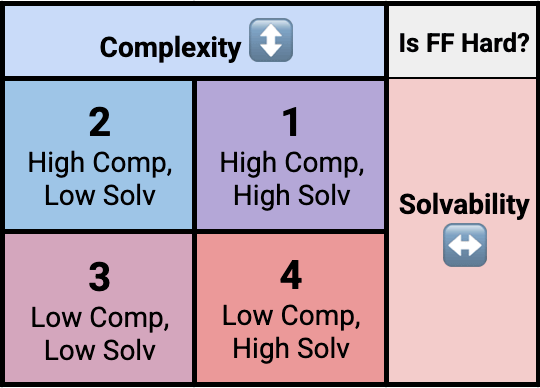
For each one of these quadrants, I have created a “title”, a phrase, and a list of pros and cons based on how you might approach fantasy football.
Quadrant 1: Multi-Step with Clear Action Plan
This is an inter-connected web of variables but perhaps if we have a process, we can come to a conclusion.
“This will take time but there is a route”
- Pros: This makes fantasy football a challenging process at every turn. Some people love the challenge!
- Cons: It might overcomplicate the fun that might be had!
Quadrant 2: “Paradoxical”
Despite this being somewhat easy in the mechanisms at play (start/sits, etc.), maybe fantasy football is more complicated than I realize.
“This is over my head & I don’t have a way. Fantasy football is all luck!”
- Pros: It recognizes how many variables are at play in fantasy. It is honest.
- Cons: It easily pushes off everything as “luck” or chaos. It is likely a bit pessimistic.
Quadrant 3: “Parabolic”
I’m using the term parabolic in the way we think of biblical parables or fables. They often are deeper in meaning and understanding despite their simplicity. Farming metaphors have been used for centuries because of how relatable and simple it might be but the truths that emerge from these stories often confounded even the wisest people.
“This looks easy to digest but I have no clue. Why do I keep falling short in the fantasy playoffs? What am I doing wrong?”
- Pros: There is mystery to fantasy football and a deep well of questions that remain.
- Cons: It is not easy to make or gauge progress.
Quadrant 4: Predictable
“This seems easy to me and it is easy! Are you kidding me? Just pick good players!”
- Pros: Fantasy Football is achievable and not an issue.
- Cons: Fantasy Football is not challenging or you might be overlooking
The Verdict
Maybe it’s the tension of the question that gets me excited. Landing at a specific answer to the question was never my goal. Aha! (Also, props to you if you actually read through this thing. Reading is a lost art these days but perhaps the highest leverage activity you can take because it should cause you to think!)
Honestly, the nuanced discussion does not bother me at this stage of my career. I share routinely with members of my home leagues that this is way more complicated sometimes than it needs to be and yet so simple some days. I often land in between Quadrants 2 and 3 during the season. During the off-season, I end up dipping into Quadrants 1 and 4 thinking I have everything figured out before any actual football was played. Hilarious!
I did want to present some of my favorite responses to the poll.
@_ColtWilliams: “Fantasy football can be hard to understand at first, but the basic concepts can be taught in 20 minutes. while fantasy football can certainly become complex, I wouldn’t say it’s particularly hard to learn or play, especially for the average person in a typical home/work league. You could teach someone the basics right before the draft and they’d already have a leg up on the competition.”
@NicoSaysThings Fantasy football is golf: anyone can play, not everyone can win, and sometimes, it’s just not your day.”
@ProntoJoey: “It’s hard in that it requires some research and strategy but it shouldn’t be so hard that you can’t enjoy it“
Comments
I think the real question remains not only unanswered, but alarmingly unaddressed: How does this affect LeBron’s legacy?
Excellent article Kyle!! Very thought provoking in every sense. It has made me really look at the process and now I can tell my wife that I am not wasting time with my fantasy football / DFS research, since I am trying to solve a complex but solvable (sometimes) question, who do I play this week in the Flex position?