
Midseason Dynasty Rankings & Trade Charts for 2026 (Fantasy Football)


We are at the mid-point of the NFL season and for dynasty managers, you are making decisions about whether you want to go for a title or not. Your league’s trade deadline is approaching and it is crucial to understand how dynasty value works.
On the Fantasy Footballers Dynasty Podcast this week, we decided to work through a number of dynasty tier questions and rankings. The episode comes out on Wednesday AM but this article is meant to give you some framework to work from in your deadline deals.
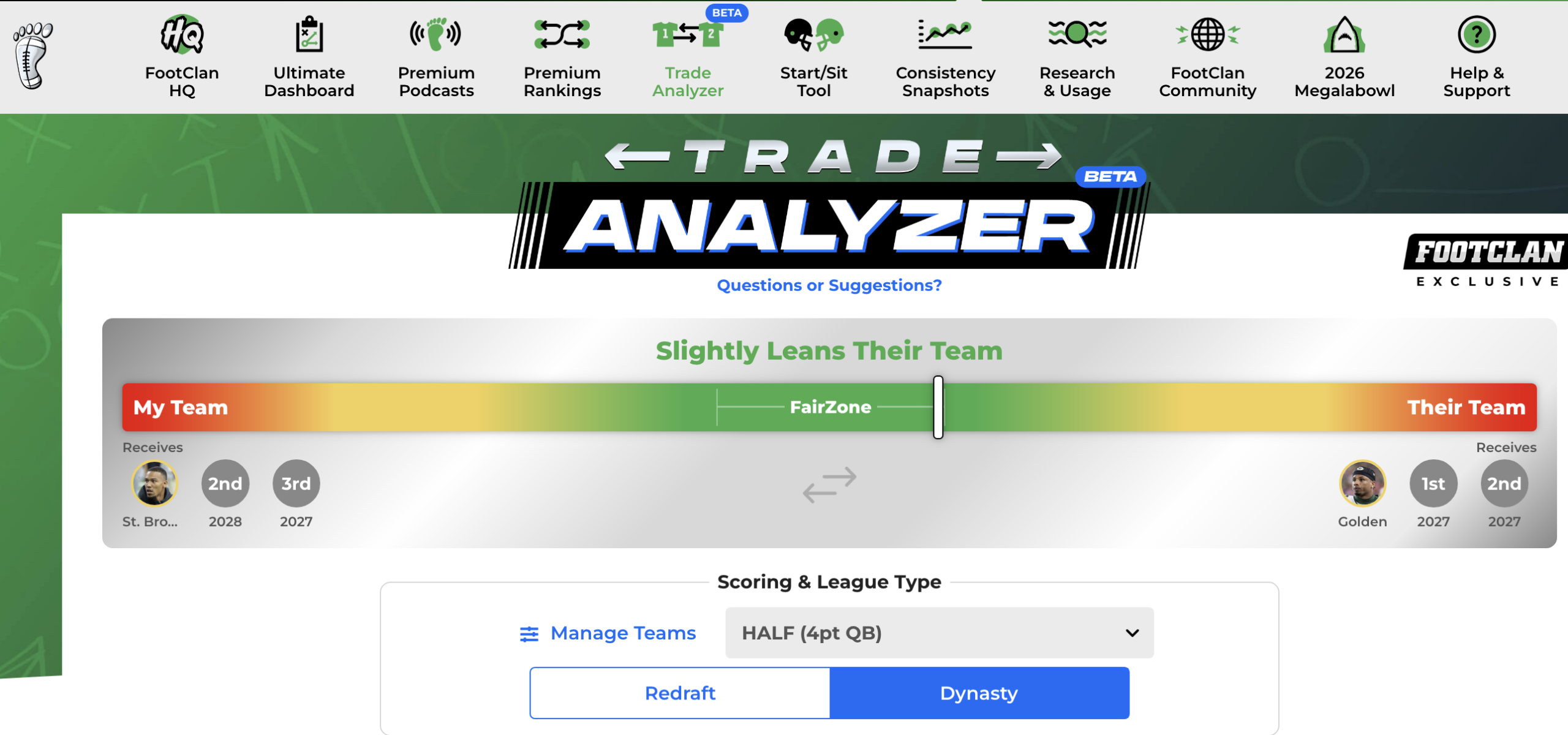
Note: Our Trade Analyzer for FootClan members also allows you the opportunity to plug and play options from your customized leagues and scoring settings.
Dynasty Startup Rankings: 5 Things to Know
Maybe you are just here to look at a chart and move on.
I cannot in good conscience skip forward without sharing five things you need to know and consider before blindly looking at something and taking it as a gospel. We have our dynasty rankings that update weekly and we’ve revamped some of the process.
1. What Season Are You In?
I want to start here because this was the genesis of how we changed our Dynasty Rankings. The old system (and honestly what you find on the majority of sites) fails to give proper context for your teams. We decided to add a slider for our ranks that mixes in some of our rest of season rankings available to the FootClan with our dynasty rankings.

For example, if you went into our app and sorted by WR dynasty rankings with “long-term” selected on the slider, you might end up in a tier of players like this:
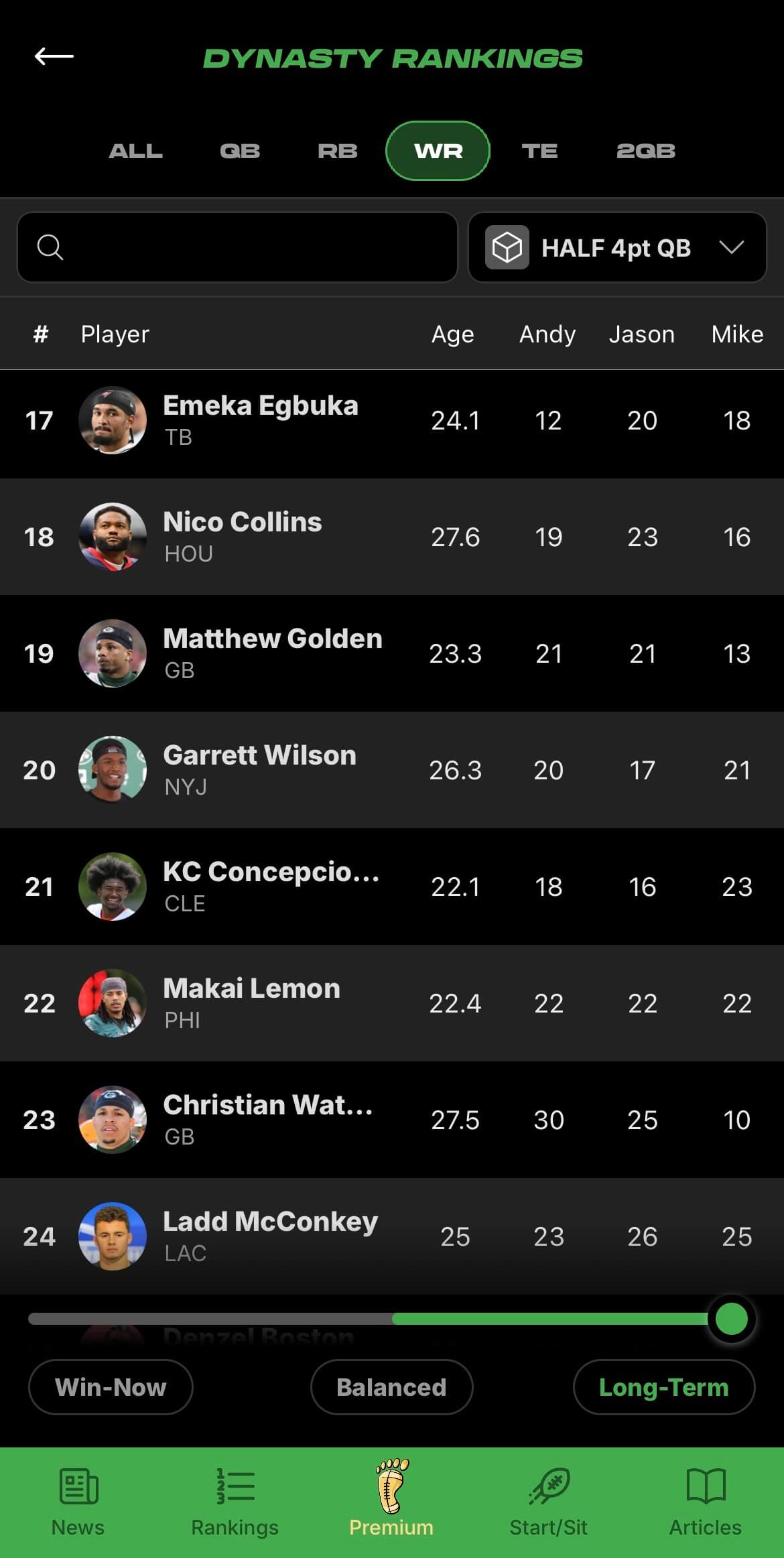
Using the slider can also give you a range of outcomes and rankings for a player, which is really how trade negotiations work anyway. When you begin a conversation do not lock in on one value, consider the pros and cons of different combinations knowing you will be on the wrong side sometimes. We have a great article (The Psychology Behind Trading in Dynasty) if you want a deeper dive on the subject.
2. Startup Ranks Can Be an Illusion
Most people (I know some of you are degens) do not participate in startup drafts in the middle of the season. Thus, when I see startup rankings referenced from various sites, it gives a heavy emphasis on when you are in a dynasty draft. 99% of you are not considering this context because you are building the boat as you are going. Yes, you might’ve had a plan at your draft when it took place a few years ago but since then it’s been a hodge-podge of “I think I’m a contender” to “I should probably sell this guy”.
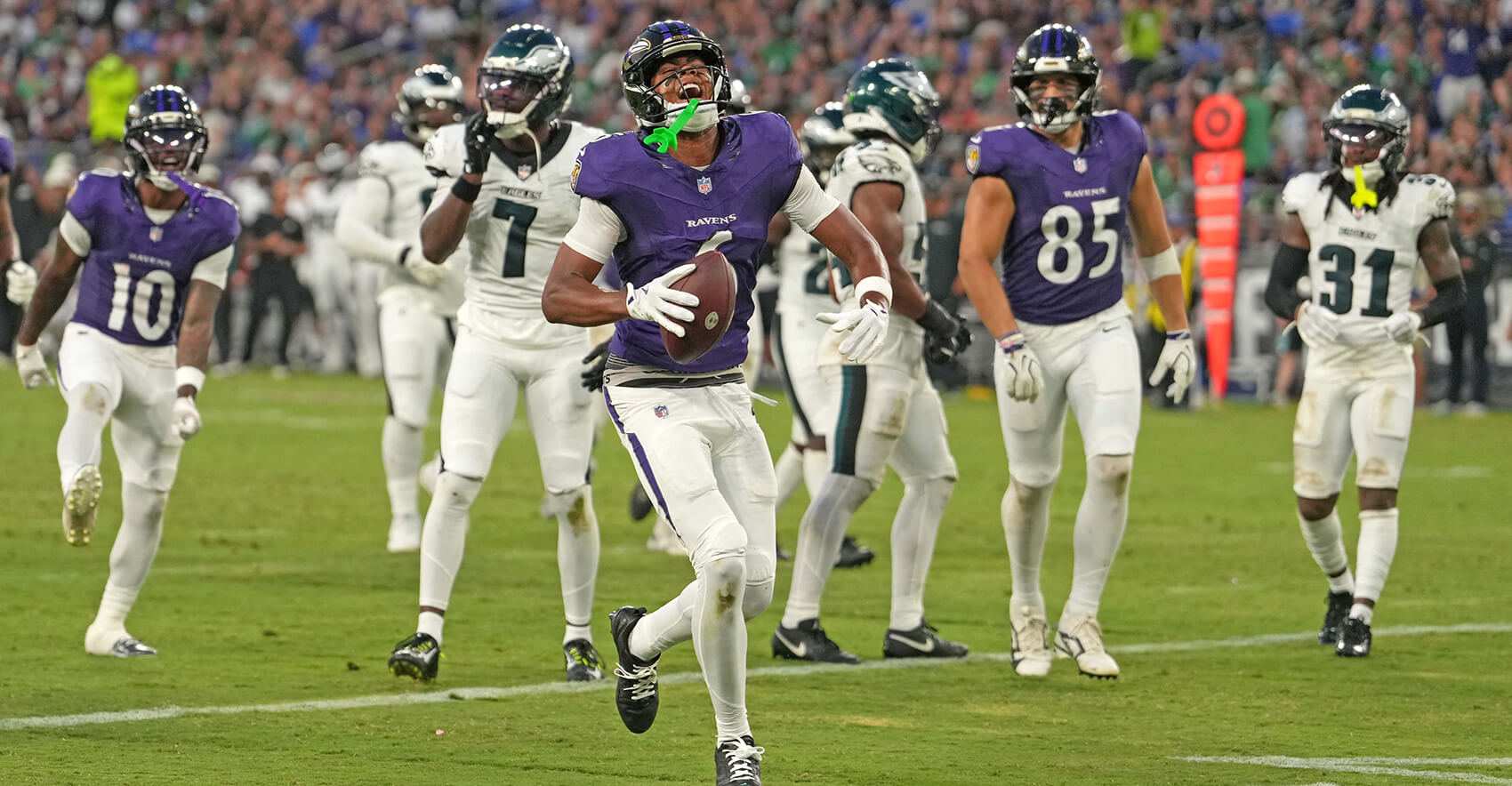
None of us follow a carefully constructed plan because we are playing a strategy-based game that is a chaotic mess week-to-week, and even moreso year-over-year. Startup rankings are helpful but do not always give you direct context to where you or an NFL player is at right now. Ja’Kobi Lane might look fun in a startup draft list but his appeal for the rest of 2026 feels rough without Lamar Jackson.
IMAGN IMAGES via Reuters Connect
3. Dynasty Values Are Not Final
Certain sites like KeepTradeCut (KTC) use crowd-sourced decisions to try and calculate perceived “value” of each players. We reference this site sometimes on the Fantasy Footballers Dynasty podcast and certainly find it as a valuable part of the dynasty discussion especially considering we’ve been doing a KeepTradeCut segment on the podcast since 2016.
However, I do need to bring up the pros and cons of “dynasty value” sites. The values and figures (based on people voting on the site) eventually condense into one number. This value might feel like a true number and it is true to the site. However, it is an arbitrary value better used as a 3rd or 4th tie-breaker in evaluating trades rather than a set figure: “this is how much this player is worth!“. Consider the “value” of players like Michael Thomas or Juju Smith-Schuster, who were once seen as the 1.01 in startups.
You can value a player a certain way, trade for/away for a certain value, and receive certain value based on their actual fantasy production. Those are three different ways to see one player and we’re not even discussing future production or future value or their age curve, etc. The point isn’t to dive too deep into player takes but rather hold loosely the defining structure of dynasty tiers. I wrote an article a couple years ago entitled “Dynasty Tiers: 5 Tips for Assessing Value” where I shared tips I wish someone would’ve told me years ago about dynasty tiers.
These are my issues with rankings in general:
- Is there that big of a difference between certain players?
- Do we draft or trade based on linear rankings lists alone?
- Are any of these values stable year over year?
- Are we overcomplicating things?
- Do we take the time to zoom out and realize how wildly off we were projecting certain careers 3-5 years out?
The NFL changes so much more than we realize and yet dynasty rankings feel true to us in the moment as a “this is where this player should go”. Often, I find this is a mirroring mechanism for all of us (myself included) who have looked at rankings and tiers so long that it’s easy to get #TakeLock. I wrote a Dynasty Tiers article back in July looking at the top-60 WRs. At the time, the rankings felt real and true but things change.
4. Rookie Picks are Fun & Fickle
We love what is right in front of us while often assuming things will turn out better in the future. The cheapest rookie picks to acquire are further in the future.
Rookie picks are a double-edged sword knowing how valuable AND fragile they can be. The cheapest first-round pick you can get would be a year or two in advance. For instance, midway through the 2026 season, the next rookie draft will be your 2027 picks. While making trades, 2028 and 2029 rookie picks will be considerably cheaper than 2027 picks. (This works both ways in deals so make sure you understand what year you are actually trading for.)
In a dynasty league, investing in these assets (in exchange for expiring veterans) at their price is good for rebuilding because they are guaranteed to gain value as time passes. However, the future classes might be seen differently based on different positional strengths. The 2024 RB class was very different than 2025s; this should cause you to pause and consider if you are trading away that type of class.

Ryan Kang/Getty Images
But ask yourself the question: Am I acquiring picks just to go through the process? Is the player I am trading away still worth holding even in a rebuild? This feels like what the Jets are going through with Garrett Wilson. The team has three 1st round picks for 2027 currently and acquiring another feels like overkill. What is the best case scenario: you hope that 1st round pick turns into a WR… like Garrett Wilson?!
5. Are you considering your league’s context?
The issue with rankings for dynasty leagues is that every league is its own multiverse. Jonathan Taylor might be on the contending team in your league but sitting at the bottom of another making it hard to give across-the-board advice that is tailor-made for every single league.
You might need a RB and the chart identifies what it takes to start a trade conversation. Unfortunately, the context of your league and the managers in it do NOT want to trade with you because they know you are one RB away from being a real threat. You also might have a team that is RB-heavy hoarding from the rest of your league. You might say to yourself that upgrading at RB is your top priority. Look around, every one is short on RBs too making it tough to find the right trade partner.
Quick Reference Dynasty Trade Chart
I decided to gather all of the trade compensation “starters” in one spot. Print it out so you can put it on your fridge in your mother’s basement next to that award you got for “most improved” on your 3rd grade basketball team. The draft picks listed are related to SuperFlex Dynasty Leagues.
Check out the full list of players and where we have them ranked in our Dynasty Rankings.
| Position | Tier 1 | Tier 2 | Tier 3 | Tier 4 | Tier 5 | Tier 6 | Tier 7 |
| Josh Allen | Drake Maye to Joe Burrow | Trevor Lawrence to Brock Purdy | Tyler Shough to Jaxson Dart | Jared Goff to C.J. Stroud | Matthew Stafford on | QB35 or later | |
| 2 1sts + Tier 3 WR | 2 1sts + young piece | 2 1sts | Future 1st + tier 5 RB/WR or tier 3 TE | Future 1st + young piece | Two 2nds or a 2nd + another piece | Future 2nd | |
| Gibbs & Bijan | Kenneth Walker | Ashton Jeanty to James Cook | Breece Hall to Bhayshul Tuten | Saquon Barkley to Jadarian Price | Kyle Monangai on | RB36 or later | |
| 2 1sts + a RB/WR in tier 3 | 2 1sts + a RB/WR in tier 5 or better | 2 1sts or 1st + 2nd + young piece | Future 1st + 2nd | Future 1st or two 2nds | Future 2nd + young piece | Future 2nd | |
| JSN to Amon-Ra | Nabers to Olave | McMillan to Golden | McConkey to Boston | Stribling to Omar Cooper | Davante Adams on | WR55 or later | |
| 3 1sts + more or 2 1sts + a RB/WR in tier 3 or better | 2 1sts + a RB/WR in tier 4 or better | 2 1sts + a RB/WR in tier 5 or better | 1st + young piece | Future 1st | Two 2nds | Future 2nd | |
| Brock Bowers | Trey McBride & Colston Loveland | Tyler Warren to Harold Fannin Jr. | Dalton Kincaid to Terrance Ferguson | TE15-20 | TE21 on | Ben Sinnott | |
| 3 1sts or 2 1sts + tier 3 TE | 2 future 1sts | Future 1st + young piece | Two 2nds or 2nd + tier 6 RB/WR | Future 2nd | Future 3rd | A Bag of Magic Beans |
This list is NOT gospel. It represents a range, not an end point.
You’re not going to like hearing this: tiers are made up. Yup, imagine that. In a game predicated on being fantasy, dynasty tiers are made based on personal choice. This isn’t meant to belittle your decisions or somehow poo poo on the process of creating dynasty tiers. It is more holding with an open hand how exact and precise this endeavor is supposed to be.
In this format, you are projecting over multiple years starting a dance between talent, age, pedigree, production, team situation, and contract status. You might value one or two of those traits above the others but they all should be factored in.