
Will Justin Jefferson Bounce Back in 2026? (Fantasy Football)


From WR2 in 2024 to WR21 in 2025, Justin Jefferson took quite the fall in production. It is ludicrous to say that Jefferson “lost a step” or suddenly became deficient in route-running prowess. The plain and simple truth is that no WR is QB-proof; they can be open all day, as Jefferson often is (fourth in average separation, min. 100 targets), but ultimately a somewhat accurate pass is critical to their production.
Going into 2026, we wonder if Jefferson’s elite capability can be used effectively. Can Jefferson return to elite WR1 status? The answer to this is completely dependent on his surrounding infrastructure. There is no question about his attributes (the Adversary vertex), nor is there any real analysis necessary about opponents in the schedule (the Victim vertex). A study of Jefferson’s 2026 bounce-back potential makes a case for the Infrastructure vertex to be equally as important as the Capability vertex when using Diamond model analysis for any player.
What Went Wrong
Root Cause Exercise
The root cause analysis for Jefferson’s disappointment looks something like this:
- Why did Jefferson have a down year in 2026? Depressed stat line.
- Why was his stat line depressed? A 7% reduction in catch rate, almost 2.5 yards less per catch, and eight fewer TDs.
- Why did these core metrics fall? Neither Vikings QB was an efficient passer in 2025.
You may be familiar with this root cause analysis technique as the “5 Whys,” but sometimes it doesn’t take five iterations to find the core issue.
QB Play
Evaluating Minnesota’s 2025 passing metrics sets the baseline for incoming QB Kyler Murray’s upside. The Vikings generated just one 300+ passing yard game and four 250+ yard games all season (scoring 22 points or less in three of those four).
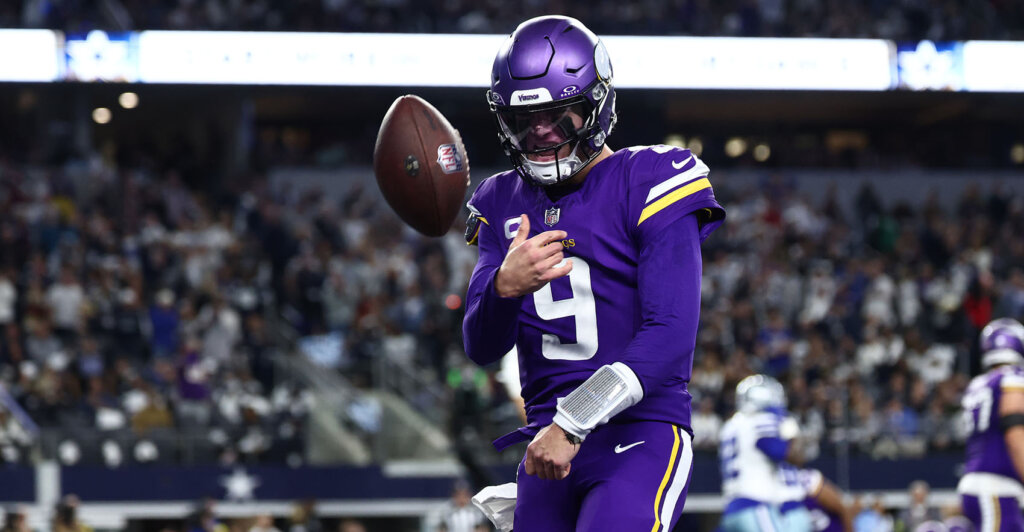
Kevin Jairaj-Imagn Images
McCarthy often operated on a rushed clock, logging a sub-2.5-second time-to-throw on 32.3% of dropbacks. Under 2.5 seconds, he posted a 56.9 PFF grade (bottom-19 of 78 passers), a 65.5% completion rate, and a 3.1% turnover-worthy play rate. Per PlayerProfiler, his 1.96-second average time to throw led to 18 Danger Plays, 18 Interceptable Passes, and a 79.3 True Passer Rating.
Though ranking top-10 in deep attempt rate (13.6% on 20+ yard throws), McCarthy ranked 29th in deep completion rate, 34th in passer rating, and third in turnover-worthy plays. His untamed aggressiveness put the ball in constant jeopardy.
As an Eagles fan, I was hoping to see a mature passer on a march to recapture his 2017 upside. However, when Wentz replaced an injured McCarthy, he displayed similar volatility under pressure (6.1% turnover-worthy play rate). However, Wentz was more efficient overall with 7.2 YPA (T-14th) and a 65.1% completion rate (16th).
Jefferson’s splits illustrate the contrast between the two passers:
| Wentz (Wks 3-8) | G | Tgt | Rec | Yds | Y/R | RecTD | Ctch% | Y/Tgt |
| Total | 5 | 50 | 34 | 477 | 14 | 0 | 68 | 9.5 |
| Per Game Avg. | 1 | 10 | 6.8 | 95.4 | 14 | 0 | 68 | 9.5 |
| 17-Game Pace | 17 | 170 | 115.6 | 1621.8 | 14 | 0 | 68 | 9.5 |
| McCarthy (Wks 9-17) | G | Tgt | Rec | Yds | Y/R | RecTD | Ctch% | Y/Tgt |
| Total | 10 | 78 | 43 | 446 | 10.4 | 1 | 55.1 | 5.7 |
| Per Game Avg. | 1 | 7.8 | 4.3 | 44.6 | 10.4 | 0.1 | 55.1 | 5.7 |
| 17-Game Pace | 17 | 132.6 | 73.1 | 758.2 | 10.4 | 1.7 | 55.1 | 5.7 |
Justin Jefferson could have had a stellar season with Carson Wentz if he had stayed healthy. A 38-target, 42-reception, and ~850-receiving-yard difference in 17-game pace confirms “Nine” was the problem. It could result in his departure depending on how camp goes.
Road to Redemption
The stats confirmed what we saw with our eyes: QB play stood in the way of Jefferson’s success. Additionally, his performance with Wentz on the field corroborated that Jefferson’s capability had not diminished. Now, the question is, “Can Kevin O’Connell get at least 2025 Wentz-level production out of Kyler Murray?”
Kevin O’Connell
Before we get into Kyler Murray‘s potential to lead this offense, we should evaluate the scheme and coaching he is walking into. KOC has multiple consecutive successes in getting the most out of veteran QBs.
- Exhibit 1: Kirk Cousins – Threw for more TDs, fewer INTs, and a higher completion percentage at a higher air yards per attempt with KOC than the average of his 16-game seasons w/ Washington.
- Exhibit 2: Daniel Jones – Despite not playing a single game for Minnesota, it cannot be a coincidence that he played at a Pro Bowl caliber for the Colts after his sideline stint with the Vikings.
- Exhibit 3: Sam Darnold – He had the best statistical year of his career with KOC, then went on to win the Super Bowl with the Seahawks the very next season.
- Exhibit 4: Carson Wentz – KOC got more yards per game, a higher completion percentage, and a better winning percentage out of Wentz than his last season, where he played at least five games.
It is tough to look at this track record and doubt the label of “QB whisperer” bestowed upon KOC. Whisperer he may be, but is Kyler listening? We will have to evaluate that through training camp and the start of the season.
Kyler Murray and the Scheme
KOC comes from the McVay-Shanahan tree so that we can expect a lot of motion, play-action, and bootlegs. The intent is to create space in the intermediate middle of the field for layered middle-field reads of deep crossers and seam shots for explosive plays. It is easy to see why Jefferson works in such a scheme given the health of his route tree.
The challenge in seeing the upside in 2026 comes down to Kyler Murray. His physical profile is vastly different than any of the QBs mentioned above. Every single QB KOC has coached, going as far back as his Rams days, is at least 6’3″. Kyler is 5’10” in cleats! The under-center frequency of this offense could expose Kyler’s vertical challenges. Murray has, perhaps by necessity, operated under-center a minimal amount. In fact, it is only five percent of his career snaps in Arizona. The preference is reportedly a compensatory mechanism for vision impaired by the height disadvantage, but better QB rushing opportunities.
The “crutch” of shotgun and pistol formations seems incompatible with the scheme. One would assume the shotgun preference comes with a downgraded performance while under-center. On the contrary, Murray has registered an eighth-ranked 8.9 yards per attempt when under-center in the last three years. This bootleg dime by Murray shows there is a potential compatibility between passer and scheme.
One more from the 2024 vault shows Kyler's upside as a rusher out of an under-center play-action execution. This one results in a 26-yd rush. pic.twitter.com/jgTg7Kkmpp
— Vernon Meighan (@FFB_Vern) July 18, 2026
Under-center production wasn’t limited to bombs through the air; it highlighted the impact Kyler can have as a rusher as well. While both McCarthy and Wentz have mobility, Kyler’s looks and feels different. His rushing is more a combination of high-end quickness and long speed. Wentz has good initial explosiveness in the first step, but a slower build-up speed, while McCarthy has quickness without a lot of top-end speed. Kyler’s legs are a clear upgrade.
Another 16-yd strike on a traditional play-action. The movement clears Murray's vision and throwing lane to find a MOF target. pic.twitter.com/L7VHmX6DKL
— Vernon Meighan (@FFB_Vern) July 18, 2026
As we look at the additional plays from 2025, we can see even more potential in scheme compatibility. I was pleased to see that it wasn’t limited to play-action bootlegs. Because Kyler can step up in the pocket for a middle-of-the-field pass or a rushing opportunity, KOC has a lot he can work with so long as the Outside Zone rushing game is humming.
Murray’s Top Target Production
Jefferson is guaranteed to be Murray’s top target should he win the job. Murray has been able to support a WR with at least 100 targets for most of his career.
| Season | Player | Position | Targets | Receptions | Yards | TDs |
| 2019 | Larry Fitzgerald | WR | 109 | 75 | 804 | 4 |
| 2020 | DeAndre Hopkins | WR | 160 | 115 | 1,407 | 6 |
| 2021 | Christian Kirk | WR | 103 | 77 | 982 | 5 |
| *2022 | Marquise Brown | WR | 107 | 67 | 709 | 3 |
| *2023 | Trey McBride | TE | 106 | 81 | 825 | 3 |
| Marquise Brown | WR | 101 | 51 | 574 | 4 | |
| 2024 | Trey McBride | TE | 147 | 111 | 1,146 | 2 |
| Marvin Harrison Jr. | WR | 116 | 64 | 924 | 8 | |
| *2025 | Trey McBride | TE | 169 | 126 | 1,239 | 11 |
| Michael Wilson | WR | 126 | 84 | 1,041 | 6 |
Evaluating pure WR1 seasons (2020 DeAndre Hopkins, 2024 Marvin Harrison Jr.) shows Murray’s ability to unlock dominant fantasy outcomes. Without a Trey McBride-level TE siphoning target share in Minnesota, Jefferson offers a baseline of 1,400+ receiving yards and 7+ TDs.
The Critical Concerns
No matter what kind of upside we believe in, it would be irresponsible to ignore the potential pitfalls.
Risk 1: J.J. McCarthy Wins the Starting Role
Kyler Murray enters camp as the favorite, but Kevin O’Connell’s offensive system is notoriously complex in verbiage and operational details. If Murray struggles to master the playbook, McCarthy’s familiarity gives him an edge. However, Kyler will be graded on a curve, essentially an assessment of his growth in grasping said schematic complexities. A McCarthy victory under center reinstates the production bottlenecks from 2025, severely lowering Jefferson’s fantasy floor. Here’s to hoping Kyler wins the job.
Risk 2: Split Camp Reps and Volatility
Dividing first-team reps through training camp inherently limits chemistry between Jefferson and his QB, placing a hard cap on his fantasy ceiling. If both passers struggle in camp, a slow start could force organizational volatility. Instability of that scale risks demotivating a franchise cornerstone, leading to self-preservation and business decisions that directly harm fantasy output.
Conclusion

Jeffrey Becker-Imagn Images
Redraft: I’m extremely surprised that Justin Jefferson is hanging onto the edge of the first round in redraft ADP. His talent is undeniable and clearly insulating his value against the volatility risk posed by the QB situation. When we look at the WRs following him, we see several options, each with their own questions at QB, like Drake London and Nico Collins. Given those names, I prefer the upside of Jefferson around that 1.12 value.
Dynasty: The uncertainty is creating quite a range of trade market value. One trade I saw included Jefferson and a ’27 first for Terry McLaurin, Josh Jacobs, and Jake Ferguson! This is insane to me and a gross and fearful overreaction to the infrastructure risks. The ’27 first should be on the other side of that equation.
Now, a more reasonable trade I saw was Jefferson for a ’26 first, ’27 first, and Wan’Dale Robinson. A good trade for each side, assuming the seller is a true rebuilding team and the buyer is a competitor. At the end of the day, I like acquiring Jefferson at a slightly lower price than that last trade. If things go horribly wrong this season, I believe Jefferson lands in a good situation sooner rather than later, whether through a big Vikings move at QB or a Jefferson trade request.
At the end of the day, I will bet on talent in either case, and I think you should too.
Comments
No one is questioning jjs talent. The “Bet on talent” statement should be regarding the qb’s here and they have both shown to be bottom half caliber passers. I would tread lightly here.